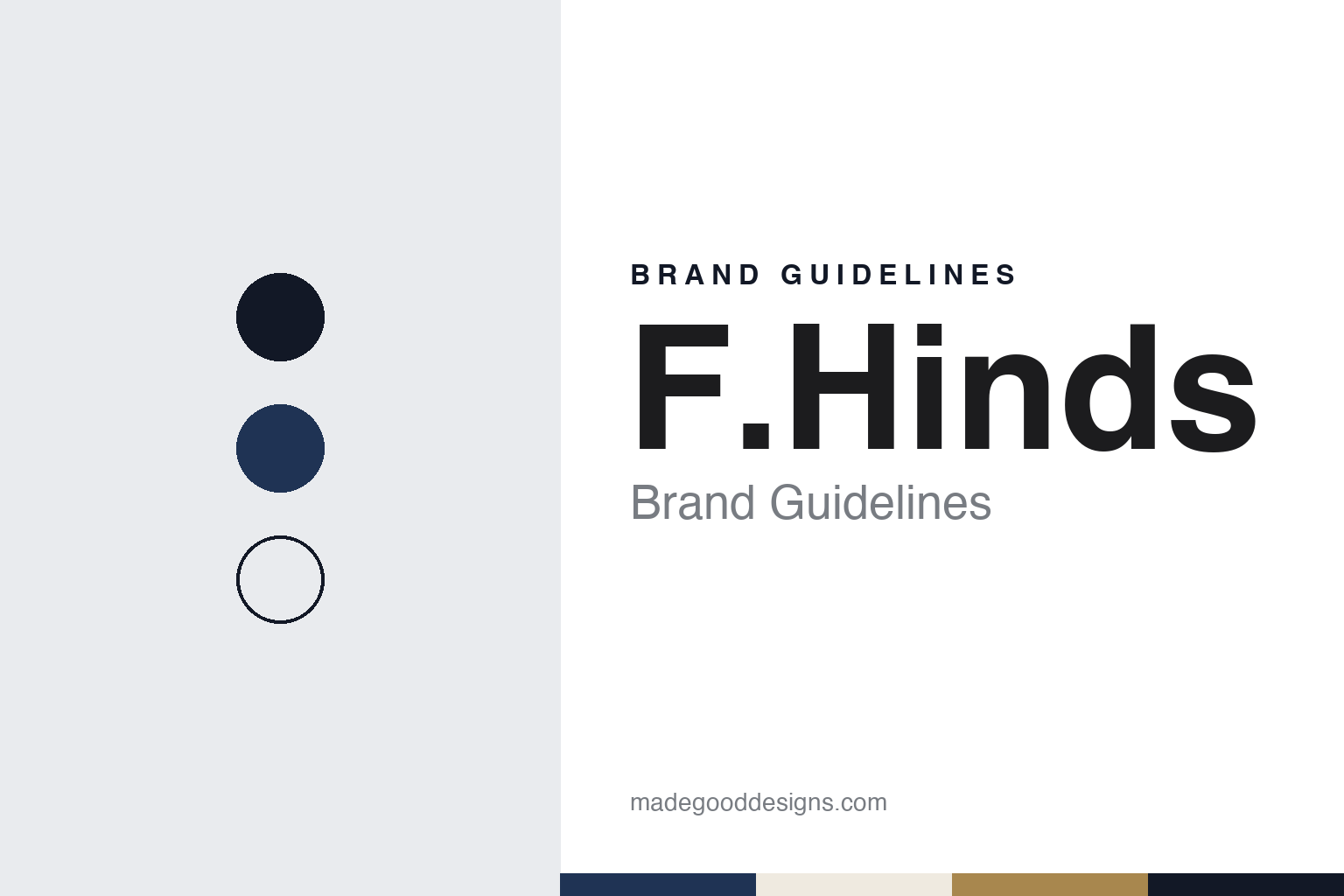
F.Hinds Brand Guidelines
The family jewellers founded in Paddington in 1856.
Aa
Two constants: a navy, ivory and antique gold palette and a classic serif register. Abstract homage — not an F.Hinds product or mark; no logo, sign or piece of jewellery is reproduced.
Harrow Road, 1856
A clockmaker’s son opens a shop in London.
F.Hinds dates its business to 1856, when George Henry Hinds took on a shop on Harrow Road in Paddington, in west London. The company’s own history says it was the first Hinds shop and sold jewellery, clocks and watches, with repairs, and that the family’s link with the trade goes back further, to Joseph Hinds, George’s father, who worked as a clockmaker in Stamford, Lincolnshire, in the early 1800s. Retail Gazette, interviewing the chairman in June 2026, gave the same founder, street and year.
The company’s timeline traces steady growth across London. It says George moved the business to larger premises on Edgware Road in 1876, that other family members opened shops across the capital, and that his son William took over in 1883 and opened a second shop on King Street in Hammersmith. By 1900, the company says, Hinds had become a limited company, with its office in Clapham, and expanded rapidly in the years that followed. William’s sons became directors between 1908 and 1912.
The business then divided. The company says the remaining brothers split Hinds Limited by agreement after a difference of opinion, placing the split in the 1920s; English Wikipedia puts it shortly after the First World War. Frank’s part became F.Hinds and William’s became W.Hinds. English Wikipedia adds that William Hinds later ran some 25 jewellers’ shops, took up theatre under the stage name Will Hammer and was one of the founders of Hammer Film Productions.
Frank’s sons Eric and Roy joined in 1943 and 1950, and by the 1950s, the company says, F.Hinds had grown to 18 branches. They took over in 1963 and, in 1966, moved the head office to Uxbridge, where it remains.
Colour
From workshop to high street.
For much of its history F.Hinds made a good share of what it sold. Chairman Andrew Hinds told Retail Gazette in 2026 that the company had manufactured many of its pieces until the 1960s, when his father decided the business needed to specialise and stop trying to handle the whole process. He said that when he started in the trade in the late 1980s the supply chain was largely British, with some European sourcing, and that it has since become global, though local production still suits categories such as wedding rings.
The company says its shop estate grew alongside Britain’s new towns and shopping centres. It brought in its first computer in 1974 and electronic tills in 1979, and ended the 1970s with 66 branches across England and Wales. Members of the next generation joined in the 1980s. In 1990, the company and English Wikipedia both say, F.Hinds bought the last shop owned by the other side of the family, in Worthing, so that the two halves of the business came back together after more than six decades apart.
F.Hinds was early to sell online. Retail Gazette reported that it launched its first website in 1997, and the company describes itself as one of the first UK jewellers to have an e-commerce site. It says its branches passed 100 in 2000.
The range mixes own collections with outside brands. English Wikipedia names house lines including My Diamonds, the Aureus gold-on-silver collection and a Kilimanjaro tanzanite collection. The chairman told Retail Gazette that the company has increasingly promoted platinum alongside white gold, and that titanium and mixed-metal collections have become more important. In 2026 the company listed its services as repairs to jewellery and watches, a made-to-measure design service, valuations, engraving and watch battery replacement.
Typography
Jewellery and accessories chains.
Jewellery and accessories chains sell through the shop itself as much as through any advertising, so the sign over the door, the colour of the shopfront and the way a window is arranged carry most of the identity. Histoire d’Or, the French chain, is one example: its parent company, THOM, says its stores use an open front, a single identity colour, red, and a layout meant to help customers choose a gift.
The formats in this guide run from watch and fine-jewellery boutiques to mall shops and fashion-accessories stores. Bucherer, in Lucerne, sells many watch and jewellery brands alongside its own fine jewellery, which Luxury London reported in December 2025 is designed and made in an atelier at its headquarters. At the other end of the range are chains selling fashion jewellery and accessories from small units and department-store corners, a format that France’s competition authority described in June 2021 when it reviewed the takeover of the Agatha brand’s 32 boutiques and 40 corners.
Ownership varies as widely as format. Some of the chains covered here in Switzerland, France, the Netherlands, England, Spain, Poland, Germany, Australia and the United States are family businesses, some are listed on a stock exchange, and some belong to private-equity funds or to larger groups. Bucherer was family-owned from 1888 until Rolex bought it in a deal announced in August 2023, while Histoire d’Or has passed between investment funds since the merger that created THOM.
Each guide sets out what can be checked: who founded the chain and when, who owns it now, which own-label collections and services the company names, and how it presents its founders and owners on its corporate pages. Where a fact rests only on the company’s own word, the guide says so.
Aa
A classic serif for a Victorian family name. (Specimen set in Cormorant Garamond, a serif STAND-IN; NOT the F.Hinds logo.)
F.Hinds
Six generations and an outlet chain.
F.Hinds remains in family hands. Retail Gazette called it in June 2026 “one of Britain’s last large independent family-owned jewellers”, still controlled by the founding family and trading from 132 F.Hinds and Chapelle stores across the UK; a company statement the same year gave 133 stores across England, Scotland and Wales. The company describes itself as family-run since 1856, across six generations. Andrew Hinds is chairman; the company says Paul Hinds, of the next generation, is managing director.
The second name on the shop list arrived in 2019. English Wikipedia says F.Hinds bought Chapelle, a jeweller specialising in outlet centres, after Chapelle had gone into administration, and kept 12 of its shops; the company says Chapelle joined with 12 stores and its own website, and that it still trades under the Chapelle name. In March 2022 the first new Chapelle shop under F.Hinds ownership opened at the Designer Outlet West Midlands in Cannock, according to Staffordshire Live, as cited by English Wikipedia.
The family has also been active in the trade. English Wikipedia says F.Hinds joined the Responsible Jewellery Council in 2008 and in August 2011 was among the first members to be certified after an independent audit, and that Andrew Hinds was elected chairman of the National Association of Goldsmiths in 2014. The company says it is a certified member of the Responsible Jewellery Council, describes itself as the longest-standing retail member of the National Association of Jewellers, and says it was named Retailer of the Year at the UK Jewellery Awards in 2023.
For its 170th year the company launched a campaign called “Giving Confidence”, carried across shop windows, point of sale and digital channels with the line “170 years of giving confidence”. Retail Gazette named the Bradford Broadway store as one of its flagships.
For a design guide, F.Hinds shows how a family name, a founding year and a single street in Paddington can carry a high-street jeweller’s identity for 170 years. Compare Beaverbrooks and Goldsmiths, two more British jewellery chains. For this guide we use a deep navy, an ivory and an antique gold with a serif, an unofficial interpretation; no product or logo is reproduced.
Explore & save
Keep F.Hinds’s identity on hand — save it to a board in the Made Good inspiration library.
F.Hinds identity set
Pin the F.Hinds navy, ivory and antique gold palette and the classic serif register to your own board.
Source & notes
Frequently Asked Questions
What font can I use to match the F.Hinds look?
This guide describes F.Hinds’ type as “A classic serif for a Victorian family name”. Its type specimen is set in Cormorant Garamond from Google Fonts as a stand-in; Cormorant Garamond is not F.Hinds’ own lettering.
What colours are in the F.Hinds palette?
This guide’s F.Hinds palette is Deep navy #1F3354, Ink #121826, Ivory #EFEAE0, Antique gold #A8874E and Paper #FAF8F3. The tones are the guide’s own unofficial interpretation, not official F.Hinds hex codes.
When was F.Hinds founded?
F.Hinds was founded in 1856, in Harrow Road, Paddington, London.
Who founded F.Hinds?
F.Hinds was founded by George Henry Hinds in 1856. F.Hinds is known for High-street jewellery, watches, repairs, Chapelle outlets.
Who owns F.Hinds?
F.Hinds today: F.Hinds, Uxbridge (family-owned). F.Hinds is known for High-street jewellery, watches, repairs, Chapelle outlets.