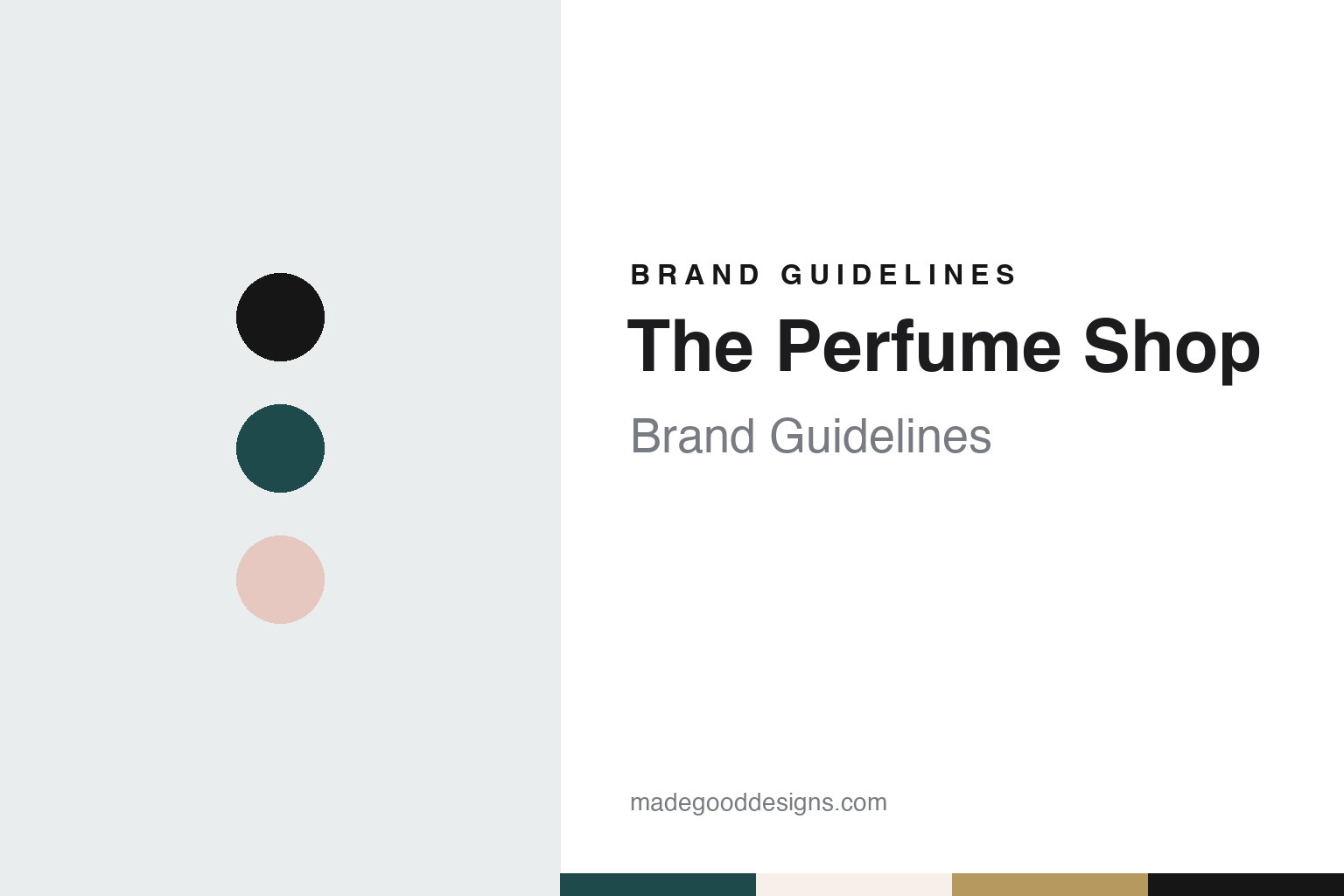
The Perfume Shop Brand Guidelines
The British fragrance specialist founded in 1992.
Aa
Two constants: a The Perfume Shop ink, teal and rose palette and a clean geometric sans register. Abstract homage — not a The Perfume Shop product or mark; no shop sign, logo or packaging is reproduced.
Fragrance and little else
A British chain built on one product family.
The Perfume Shop is a British chain of shops built around fragrance. The trade magazine Cosmetics Business, profiling it in August 2010, described it as trading in the UK since 1992, and reported that its managing director at the time had joined in that founding year as manager of the chain’s shop in Birmingham and rose through the ranks. The same article placed its head office in High Wycombe, Buckinghamshire, where English Wikipedia also puts it, alongside a distribution centre in Dunstable.
From the start the format was specialist. When it launched, Cosmetics Business reported, the chain set out to offer customers “aspiration, access and accessibility”; by 2010 its managing director summed up the offer as “price, service and range.” The magazine described the shops’ open frontage, with products on clear display and little fuss, as part of the appeal, especially for shoppers wary of department-store perfume counters. In that interview the managing director said the chain was entirely dedicated to selling fragrance, and described it as the country’s second-largest fragrance retailer after Boots — a ranking given as the company’s own.
English Wikipedia adds that the chain typically traded from smaller shops than many other retailers, averaging about 400 square feet, and that half of its sales came in the six weeks before Christmas; it describes a classic bricks-and-mortar business with high-street shops and a website.
Colour
Merchant Retail Group, then A.S. Watson.
By the mid-2000s The Perfume Shop belonged to Merchant Retail Group, a company listed on the London Stock Exchange whose other main business was the De Gruchy department store in St Helier, Jersey. In July 2005 A.S. Watson, the Hong Kong health-and-beauty retailer, bought Merchant Retail Group, and with it The Perfume Shop, which then had 114 branches in shopping centres and malls across the UK and Ireland. A press release from A.S. Watson’s parent, then Hutchison Whampoa and today CK Hutchison Holdings, dated 13 August 2005, confirmed that the deal was complete and that Merchant Retail Group’s shares had left the London market; it said The Perfume Shop would run as a stand-alone business under its existing management, and quoted the group’s managing director as seeing room for another 100 stores within three to five years. Cosmetics Business later confirmed the 2005 purchase from Merchant Retail Group.
The purchase put The Perfume Shop into a group that already owned the Superdrug and Savers chains in the UK and had bought the French perfumery chain Marionnaud earlier in 2005, the release said. A.S. Watson placed The Perfume Shop in its luxury division, a group spokesperson told Cosmetics Business in 2010, and said its stores sold designer houses such as Chanel and Christian Dior alongside exclusives. The chain had grown to 179 stores across the UK by 2010, its managing director told the magazine, with five new high-street openings in 2009 and about 1,500 staff across the business, the magazine reported.
Ownership sits today with A.S. Watson (Health & Beauty UK), part of the A.S. Watson Group, according to English Wikipedia, citing Companies House. English Wikipedia also records a shop-in-shop concept inside Superdrug stores from 2010, first trialled in 11 stores including Aylesbury, Milton Keynes, Glasgow and Westfield London.
Typography
How perfumery chains present themselves.
Perfumery and beauty-store chains sell other companies’ brands, so their own identity has to live in the shop itself: the sign over the door, the logo on the bag, the colours of the shop floor and the way the counters are laid out. The chains in this group come from Belgium and the Netherlands, the United Kingdom, the Czech Republic, Spain, the United States, France, the Gulf, Portugal and Italy, and each guide describes its signs, logos and colour schemes only as the company itself publishes them.
Store formats vary widely. Some chains grew from a single high-street perfumery; others trade mainly from shopping-centre and mall units, from shop-in-shop counters inside a sister chain, or largely online with a few physical stores. The Perfume Shop, for one, opened boutique stores for niche perfume houses in 2025. Each guide gives store and country counts only as a dated source reports them, and says when that count was made.
Ownership is part of the story. Some chains belong to large retail groups: ICI Paris XL and The Perfume Shop, for example, both sit within A.S. Watson, the Hong Kong health-and-beauty retailer. Others remain family-owned, or have passed between investors, supermarket groups and specialist retailers over the decades. Where a chain was sold, restructured or closed, the guide says what happened and when, and it never implies that a closed chain still trades.
Loyalty cards and own-label ranges are named here only as the companies name them, and corporate pages on founders and owners are treated as the company’s own account. Where an independent, dated source — a newspaper, a trade title or an official register — tells the story differently, both versions are given, and the guide makes clear which rests only on the company’s word.
Aa
A clean geometric sans — for a chain that keeps to one product family. (Specimen set in Jost, a sans STAND-IN; NOT The Perfume Shop logo.)
The Perfume Shop
A club, boutiques and a new positioning.
Loyalty has become a large part of the business. English Wikipedia dates the launch of its Rewards Club card scheme to September 2011. In July 2026 Retail Gazette reported that the 14-year-old scheme had been renamed The Perfume Club, with six million members, member-only prices, points that can be redeemed against future fragrance purchases and weekly rotating perks such as brand offers and competitions. Members also get early access to launches, promotions and in-store events, and the company said it expected the scheme to give it more insight into how members shop.
The store estate has also changed shape. In May 2025 Retail Gazette reported that the chain would open two boutique stores that summer, at Brent Cross Shopping Centre in London and Lakeside Shopping Centre in Thurrock, giving room to niche perfume houses — the paper named Contes de Parfums, Hugh Parsons and Laboratorio Olfattivo — and quoted managing director Gill Smith calling the concept “a bold step forward.” The same report said the chain was extending a delivery partnership with Deliveroo during 2025.
In August 2026 Cosmetics Business reported a new brand positioning, “The Power of Perfume,” launched with a campaign across film, social media and stores. The company described the campaign’s black-and-white visual style as focused on “authentic human moments,” and its customer director called the change “an evolution rather than a reinvention.”
For a design guide, The Perfume Shop shows how a single-category retailer can build an identity on focus: open shopfronts, one product family and a members’ club. Compare Superdrug, its sister chain under A.S. Watson in the UK, and ICI Paris XL, the group’s Benelux perfumery chain. For this guide we use ink black, a deep teal and a rose with a sans, an unofficial interpretation; no product or logo is reproduced.
Explore & save
Keep The Perfume Shop’s identity on hand — save it to a board in the Made Good inspiration library.
The Perfume Shop identity set
Pin The Perfume Shop ink, teal & rose palette and the clean geometric sans register to your own board.
Source & notes
Frequently Asked Questions
What font can I use to match the The Perfume Shop look?
This guide describes The Perfume Shop’s type as “A clean geometric sans — for a chain that keeps to one product family”. Its type specimen is set in Jost from Google Fonts as a stand-in; Jost is not The Perfume Shop’s own lettering.
What colours are in the The Perfume Shop palette?
This guide’s The Perfume Shop palette is Ink black #161616, Deep teal #1F4A4C, Rose quartz #E6C8C1, Soft gold #B5995F and Paper #F8F6F2. The tones are the guide’s own unofficial interpretation, not official The Perfume Shop hex codes.
When was The Perfume Shop founded?
The Perfume Shop was founded in 1992, in United Kingdom.
Who owns The Perfume Shop?
The Perfume Shop is owned by Merchant Retail Group; A.S. Watson since 2005.