ICI Paris XL Brand Guidelines
The Ixelles perfumery that became a Benelux chain.
Aa
Two constants: an ICI Paris XL plum, ink and champagne palette and a Parisian serif register. Abstract homage — not an ICI Paris XL product or mark; no shop sign, logo or packaging is reproduced.
Ici Paris à Ixelles
A Belgian couple, a shop in Ixelles and perfume from Paris.
ICI Paris XL began as a single perfumery in Ixelles, the Brussels municipality whose name, spoken in French, sounds like the letters “XL.” The Brussels daily La Dernière Heure, in a history of the chain published for its fortieth anniversary in September 2008, reported that the first shop opened in May 1968 and was founded by a couple, Arthur and Gusta Brenig — the paper spells the name Breinig — who called it “Ici Paris à Ixelles,” roughly “Paris is here, in Ixelles.” The name stayed with the business, shortened to ICI Paris XL; the company writes it in capitals, as ICI PARIS XL, and French Wikipedia notes the same styling.
The founder was not new to the trade. La Dernière Heure reported that in 1946 Arthur Brenig had opened a perfumery in Antwerp with his brother-in-law, and that he travelled to Paris by train to buy the perfumes he sold there. The Ixelles shop carried that idea to Brussels: a little of the French capital in Brussels, as the paper put it. English Wikipedia also traces the name to the founders’ train journeys to Paris to buy perfume, and Dutch Wikipedia adds that such luxury goods were then imported directly from the French capital, and that the couple wanted to make them available to a wider public.
Growth came first through acquisition at home. Twenty years after the first opening, in 1988, the Brenigs took over the 19 perfumeries of the Santal group, a chain that Arthur Brenig’s brother-in-law had built up in the meantime, according to La Dernière Heure; French Wikipedia gives the same account.
Colour
From a family chain to Kruidvat, then A.S. Watson.
The family did not keep the chain. La Dernière Heure reported in 2008 that in 1996 the Dutch supermarket group Groenwoudt bought the ICI Paris XL perfumeries, and that three years later they passed into the Kruidvat group, the Dutch health-and-beauty retailer; French Wikipedia follows that account. English and Dutch Wikipedia instead date the purchase by Kruidvat Holding to 1996. Dutch Wikipedia dates the chain’s first shop in the Netherlands to 1997.
In 2002 Kruidvat itself changed hands. On 27 September 2002 the European Commission cleared the acquisition of the Dutch companies Kruidvat Holding and Kruidvat Superdrug by A.S. Watson, the Hong Kong health-and-beauty retailer that then belonged to Hutchison Whampoa. The Commission’s press release listed the trade names Kruidvat operated: Kruidvat and Trekpleister in the Netherlands, Superdrug in the United Kingdom, Rossmann in Poland, Hungary and the Czech Republic, and “Ici Paris XL” in the Netherlands and Belgium. The deal had been notified to the Commission at the end of August 2002, and the review found that the two groups overlapped only in the United Kingdom.
Under the new owner the chain kept growing. La Dernière Heure counted 224 shops in the Benelux in 2008, 107 of them in Belgium, with 1,267 staff in Belgium and a distribution warehouse of 20,000 square metres on a former Renault site in Vilvoorde, north of Brussels. English Wikipedia, citing a Luxembourg shopping centre in 2018, gives about 230 outlets across Belgium, the Netherlands and Luxembourg; French Wikipedia, citing the company, gives 291 perfumeries in 2015: 119 in Belgium, 169 in the Netherlands and four in Luxembourg. English Wikipedia says the chain grew quickly after the A.S. Watson takeover, through new stores and the enlargement, refurbishment and relocation of existing ones. Dutch Wikipedia describes a range of cosmetics, perfumes and skincare products, and places its offices in Renswoude, in the Netherlands, home of A.S. Watson’s Benelux head office, and in Vilvoorde in Belgium.
Typography
How perfumery chains present themselves.
Perfumery and beauty-store chains sell other companies’ brands, so their own identity has to live in the shop itself: the sign over the door, the logo on the bag, the colours of the shop floor and the way the counters are laid out. The chains in this group come from Belgium and the Netherlands, the United Kingdom, the Czech Republic, Spain, the United States, France, the Gulf, Portugal and Italy, and each guide describes its signs, logos and colour schemes only as the company itself publishes them.
Store formats vary widely. Some chains grew from a single high-street perfumery; others trade mainly from shopping-centre and mall units, from shop-in-shop counters inside a sister chain, or largely online with a few physical stores. The Perfume Shop, for one, opened boutique stores for niche perfume houses in 2025. Each guide gives store and country counts only as a dated source reports them, and says when that count was made.
Ownership is part of the story. Some chains belong to large retail groups: ICI Paris XL and The Perfume Shop, for example, both sit within A.S. Watson, the Hong Kong health-and-beauty retailer. Others remain family-owned, or have passed between investors, supermarket groups and specialist retailers over the decades. Where a chain was sold, restructured or closed, the guide says what happened and when, and it never implies that a closed chain still trades.
Loyalty cards and own-label ranges are named here only as the companies name them, and corporate pages on founders and owners are treated as the company’s own account. Where an independent, dated source — a newspaper, a trade title or an official register — tells the story differently, both versions are given, and the guide makes clear which rests only on the company’s word.
Aa
A Parisian serif — for a chain named after Paris and Ixelles. (Specimen set in Playfair Display, a serif STAND-IN; NOT the ICI Paris XL logo.)
ICI Paris XL
A perfumery named after a place.
The chain marked its fortieth year in 2008 with a Beauty Bus: a coach converted into a make-up studio that, La Dernière Heure reported, would tour Belgium for four months, stopping at large workplaces, at places used by commuters and, at weekends, at shopping centres, alongside a three-day beauty fair in November.
Its ownership has stayed with A.S. Watson since 2002. In 2010 the trade title Cosmetics Business named Belgium’s ICI Paris XL among the group’s European chains, alongside France’s Marionnaud and Britain’s The Perfume Shop, and in July 2026 the news site Shopappy described it as A.S. Watson’s Benelux-centred luxury fragrance chain, and listed Kruidvat, Trekpleister and Superdrug among the group’s other banners. A.S. Watson is part of CK Hutchison Holdings, the Hong Kong group that succeeded Hutchison Whampoa, and English Wikipedia lists Brussels as the chain’s home city.
The most fully documented part of the identity is the name itself. La Dernière Heure explained it as a little of the French capital brought to Brussels, and English Wikipedia notes that the “XL” records the location of the first shop in Ixelles. A phrase in French and a pun on a Brussels address have carried the chain across three countries for close to six decades.
For a design guide, ICI Paris XL shows how a place name and a pun can become a retail brand. Compare Marionnaud, the French perfumery chain A.S. Watson bought in 2005, and The Perfume Shop, its British sister chain. For this guide we use a deep plum, ink and champagne with a serif, an unofficial interpretation; no product or logo is reproduced.
Explore & save
Keep ICI Paris XL’s identity on hand — save it to a board in the Made Good inspiration library.
ICI Paris XL identity set
Pin the ICI Paris XL plum, ink & champagne palette and the Parisian serif register to your own board.
Source & notes
Frequently Asked Questions
What font can I use to match the ICI Paris XL look?
This guide describes ICI Paris XL’s type as “A Parisian serif — for a chain named after Paris and Ixelles”. Its type specimen is set in Playfair Display from Google Fonts as a stand-in; Playfair Display is not ICI Paris XL’s own lettering.
What colours are in the ICI Paris XL palette?
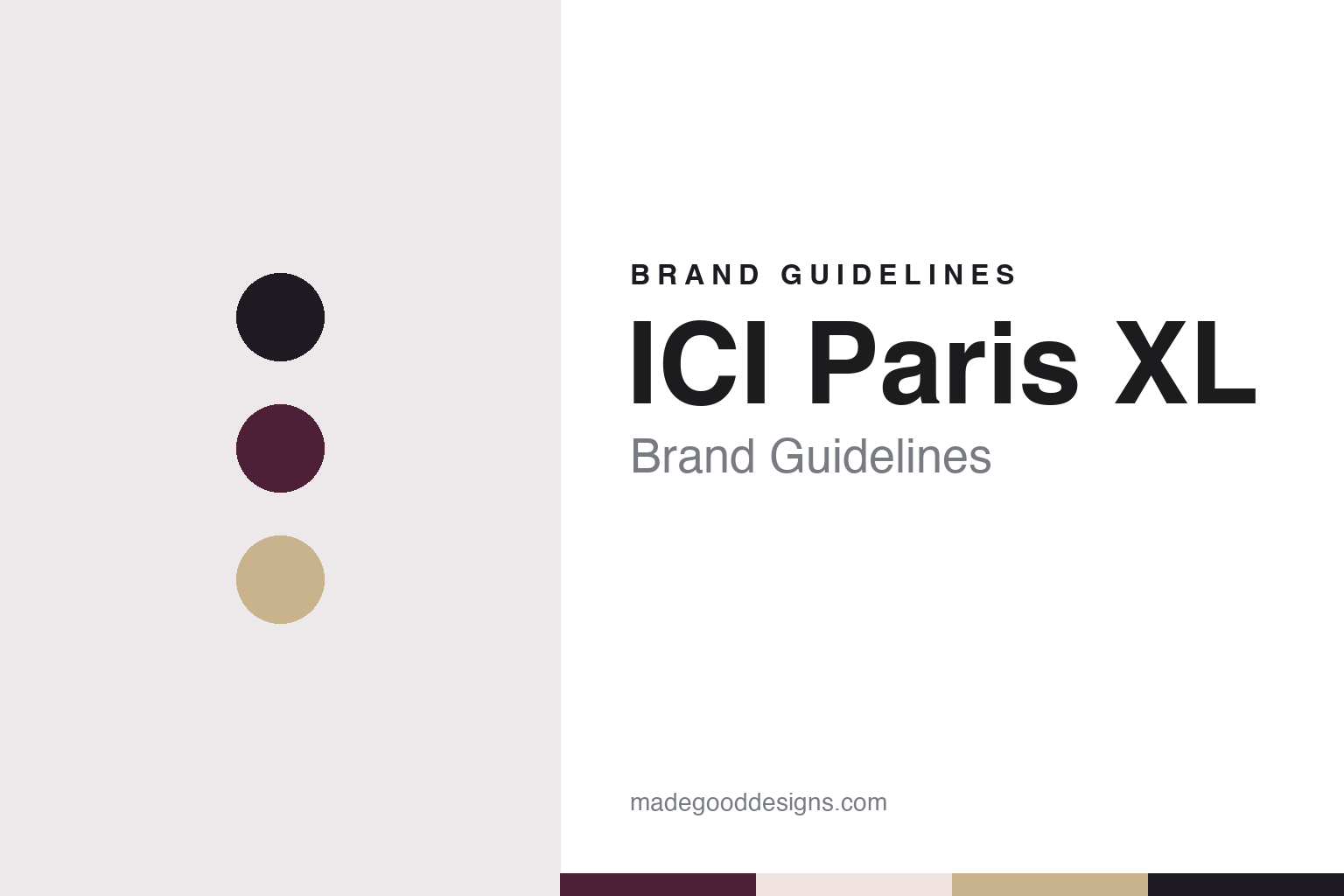
This guide’s ICI Paris XL palette is Deep plum #4E2038, Night ink #1D1A22, Champagne #C9B38C, Powder blush #F1E3E0 and Paper #FAF7F3. The tones are the guide’s own unofficial interpretation, not official ICI Paris XL hex codes.
When was ICI Paris XL founded?
ICI Paris XL was founded in May 1968, in Ixelles, Brussels, Belgium.
Who founded ICI Paris XL?
ICI Paris XL was founded by Arthur and Gusta Brenig in May 1968.
Who owns ICI Paris XL?
ICI Paris XL is part of A.S. Watson (CK Hutchison).