Hong Kong Book Fair Brand Guidelines
The trade council’s July book fair on the Wan Chai waterfront.
Aa
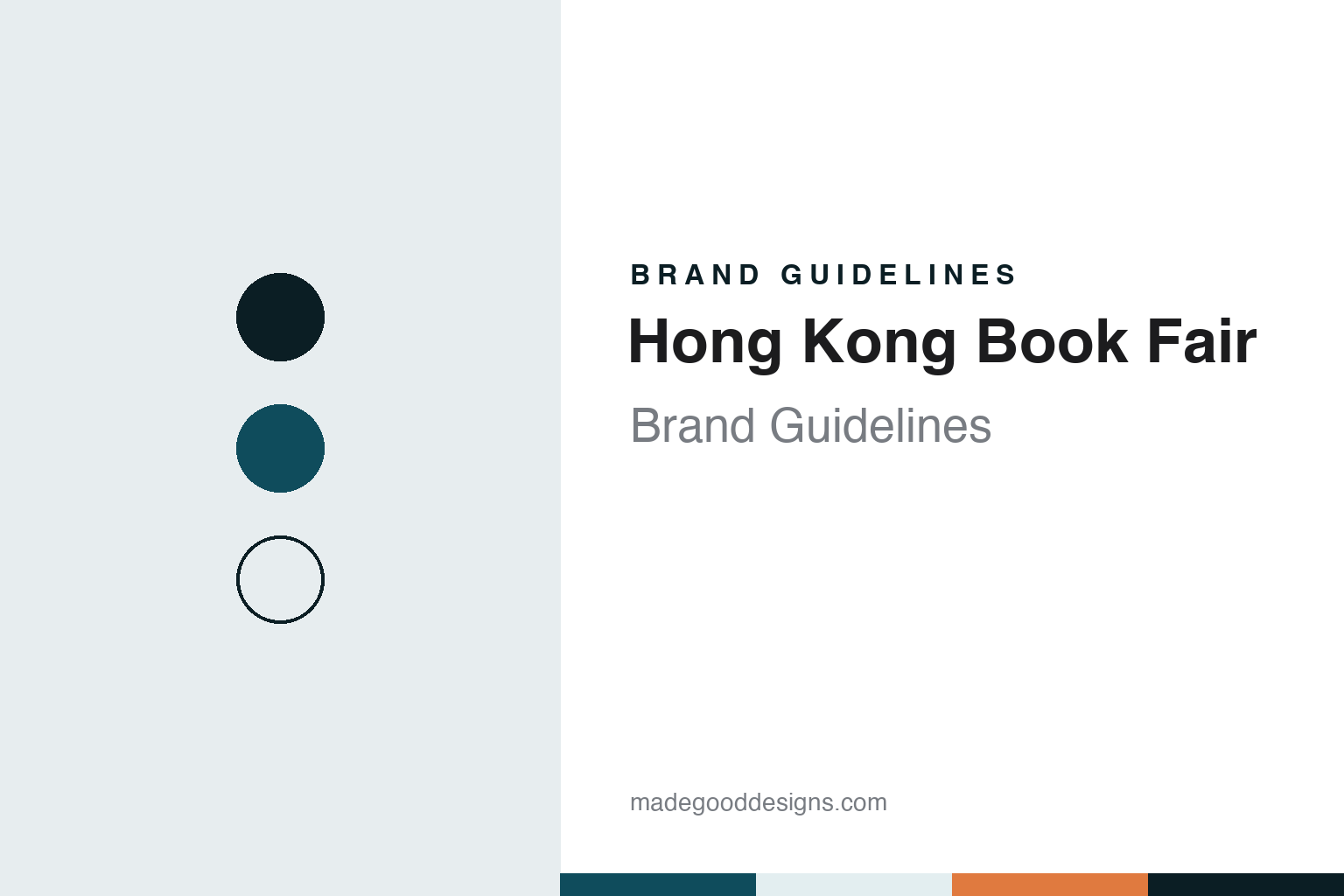
Two constants: a harbour teal and summer orange palette and an Open sans register. Abstract homage — not a Hong Kong Book Fair mark; no logo, poster or key visual is reproduced.
A trade council’s book fair
Publishers asked for a bigger platform, and the HKTDC answered in 1990.
The Hong Kong Book Fair is organised by the Hong Kong Trade Development Council (HKTDC) and held each year, usually in the middle of July, at the Hong Kong Convention and Exhibition Centre in Wan Chai, according to English Wikipedia. Books and printed matter sit alongside stationery, multimedia publishing and, in recent years, craft and creative products.
Its roots are older than the fair itself. English Wikipedia describes an exhibition held by the Hong Kong Publishing Federation at City Hall as its predecessor, and says that once the convention centre was completed in 1989, publishers felt the need for a larger and more professional platform and asked the trade council to help. The first fair was held in 1990. Chinese Wikipedia gives the details: the 1990 show opened on 22 June on the second floor of the convention centre, ran for four days with free entry, and brought together 149 exhibitors and about 200,000 visits.
The fair grew with the building. Chinese Wikipedia says that in 1997 it became the first public exhibition held in the convention centre’s new wing, and that the same edition opened a dedicated children’s hall and added an international copyright fair and an Asian publishing seminar for the rights trade. In 1999 it began late-night opening on Fridays and Saturdays and added a section for university presses; in 2001 the Hong Kong Arts Development Council joined as a co-organiser of its cultural and reading programme.
Themes became a fixture in the 2000s. Chinese Wikipedia dates the first theme chosen with outside advisers to 2007, “Reading Hong Kong,” the year the fair was extended to seven days. In 2009 the organiser added an English-language zone and a literary gallery showing writers’ manuscripts and collections. English Wikipedia lists later themes: “Reading the World, Reading as Self-discovery” for the 22nd fair in 2011, Chinese martial arts literature in 2016, romance literature in 2018 and “Sci-Fi and Mystery” in 2019, and notes about 670 exhibitors from 37 countries and regions in 2017. The 2020 edition did not take place.
Colour
Theme of the year, writers’ series and a copyright corner.
The fair’s public face is its theme of the year. For 2026 the 36th fair ran from 15 to 21 July under the theme “Reading the World: Cultural Legacy | Joyful Journeys,” RTHK reported on 23 June 2026, with the organiser expecting more than 770 exhibitors and over 600 events. Jenny Koo, deputy executive director of the HKTDC, told RTHK the aim was to invite readers to explore traditional culture “through reading.”
The same report named the new elements of 2026: a first ASEAN Literary Festival, co-organised by the HKTDC and the Hong Kong ASEAN Foundation, and a larger “Cultural and Creative Space,” introduced in 2025, with Yunnan as its featured province and pavilions for Fujian and Hangzhou showing crafts and creative products. On opening eve, RTHK reported on 14 July 2026 that stalls ranged from English-language books and manga to stationery, handmade goods and intangible cultural heritage crafts.
The fair’s own pages set out the regular structure: a theme-of-the-year programme, a “Renowned Writers” seminar series, an “English and International Reading” series, a World of Art & Culture gallery, a Copyright Corner for the rights trade and listings of new book releases. The organiser’s figures for 2026 give 770+ exhibitors and 990,000 visits. For comparison, English Wikipedia records more than 1.01 million visitors in 2014, for the 25th fair.
The book fair also shares the convention centre with other July shows. The organiser’s site links it with the Hong Kong Sports and Leisure Expo and World of Snacks, and groups the three under a wider “Cultural July” banner.
Typography
How international book fairs present themselves.
International book fairs usually take their names from two things: the host city and the words book fair. Many are known by a form in the local language, and some by a short acronym or nickname that readers and the trade use more often than the full title, so that a single name can appear in several versions on posters, badges and press releases.
Most of these fairs serve two audiences. Trade days are set aside for publishers, rights agents, booksellers, distributors, librarians and translators, who come to meet, buy and sell translation rights and attend professional programmes. Public days follow or run alongside, when readers come to browse the stands, buy books and attend author talks, readings and signings, often with separate programmes for children and young readers.
Behind each fair sits an organiser. Some are run by universities, some by foundations set up by writers’ and publishers’ associations, some by state book bodies and some by exhibition companies that run fairs in their own halls. Inside the venue, halls are usually arranged by country and by publisher, with a rights centre for the trade and, at many fairs, a pavilion for a guest of honour: a country, region or city that brings its own writers, publishers and programme for one edition.
Visually, these fairs tend to keep a name and a wordmark from one year to the next while the edition poster, the annual theme or the guest pavilion changes. This guide describes those identities plainly, as dated sources describe them; the colours and type shown here are our own interpretation, and no logo, poster or pavilion is reproduced.
Aa
An open sans for a theme-led reading fair. (Specimen set in Archivo, a sans STAND-IN; NOT the Hong Kong Book Fair logo.)
Hong Kong Book Fair
One venue, one month, a new theme each year.
For a designer, the Hong Kong Book Fair is a brand built on repetition and renewal. The name stays plain: the city, the words “book fair,” and the organiser’s initials in front, as in “HKTDC Hong Kong Book Fair,” the form the council uses on its own pages and the form English Wikipedia uses for the 22nd and 25th editions. The Chinese name, 香港書展, simply means “Hong Kong book exhibition.” What changes each year is the theme line, which Chinese Wikipedia says the organiser sets each year with publishers and professional bodies, and which is then carried through seminar series, gallery displays and signage.
That gives the identity a clear hierarchy. The fixed layer is the name, the venue on the Wan Chai waterfront and the July dates recorded for most editions. The changing layer is the theme of the year, a phrase such as “Reading the World” that has been reused and extended across editions, paired with a second line for the season. A third layer belongs to the programme: the writers’ series, the English-language reading strand, the children’s hall and the craft pavilions, each of which needs its own wayfinding inside a large exhibition building.
The audience is broad. Chinese Wikipedia describes the fair as a summer event for families as well as readers, with publishers timing new titles and signing sessions to the fair, while the copyright fair added in 1997 and today’s Copyright Corner speak to the trade. A design system for such an event has to work on a ticket, a hall banner, a seminar slide and a phone screen in the same week.
For a design guide, the Hong Kong Book Fair shows how a trade council can run a reader-facing event with a steady name and a yearly theme. Compare Taipei International Book Exhibition, another Chinese-language fair with a guest-of-honour pavilion, and Frankfurter Buchmesse, a trade fair built around rights. For this guide we use a harbour teal and a summer orange with a sans, an unofficial interpretation; no product or logo is reproduced.
Explore & save
Keep Hong Kong Book Fair’s identity on hand — save it to a board in the Made Good inspiration library.
Hong Kong Book Fair identity set
Pin the harbour teal and summer orange palette and the Open sans register to your own board.
Source & notes
Frequently Asked Questions
What font can I use to match the Hong Kong Book Fair look?
This guide describes Hong Kong Book Fair’s type as “An open sans for a theme-led reading fair”. Its type specimen is set in Archivo from Google Fonts as a stand-in; Archivo is not Hong Kong Book Fair’s own lettering.
What colours are in the Hong Kong Book Fair palette?
This guide’s Hong Kong Book Fair palette is Harbour teal #0F4C5C, Ink #0B1E24, Mist #E3EEF0, Summer orange #E07A3F and Paper #F7F9F9. The tones are the guide’s own unofficial interpretation, not official Hong Kong Book Fair hex codes.