International Kolkata Book Fair Brand Guidelines
The Boi Mela of the Publishers & Booksellers Guild, held since 1976.
Aa
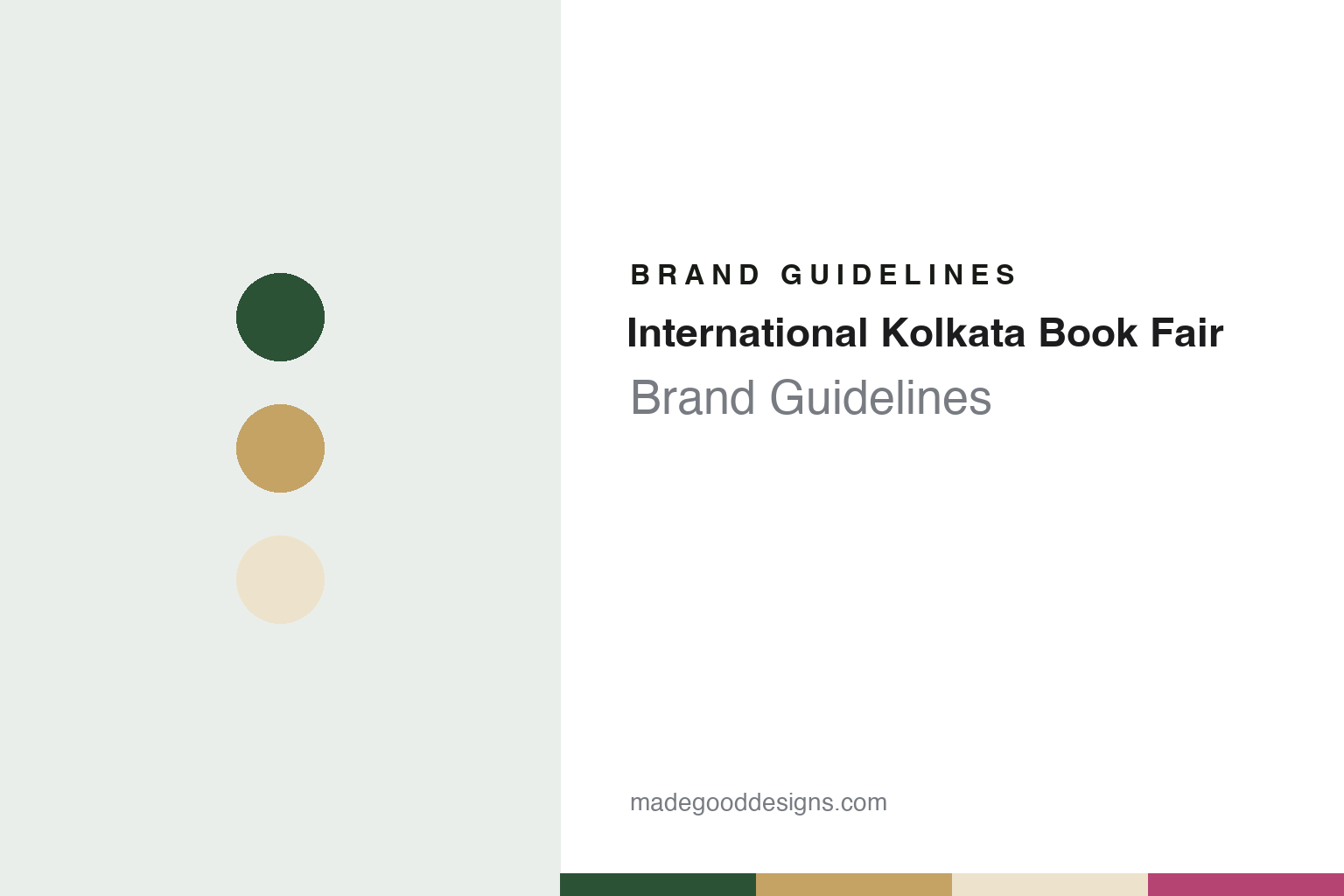
Two constants: a green, bamboo and jute palette with a pink accent and a Bengali-style serif register. Abstract homage — not an International Kolkata Book Fair asset; no logo, poster or mascot is reproduced.
The Boi Mela
A guild of publishers and booksellers and a fair for readers.
The International Kolkata Book Fair, known in Bengali as the Boi Mela — literally “book fair” — and formerly as the Calcutta Book Fair, is organised by the Publishers & Booksellers Guild. The Guild says it was founded in 1975 to promote reading and to support publishers and booksellers in their trade, and that the fair was established in 1976. That date is borne out in the press: in late 2025 the Millennium Post reported that the Guild had invited photographers who covered the fair between 1976 and 1996 to submit their work, and a 2023 essay in the National Herald spoke of a bookseller who had attended 25 of the fair’s 46 years.
The fair is open to the public rather than run as a trade fair. A February 2023 essay in the National Herald quoted a Kolkata bookseller who contrasted it with trade fairs such as Frankfurt: it “isn’t a trade fair,” she said, and is “entirely open to the public.” English Wikipedia describes it in the same terms, as a fair for the general public rather than for wholesale distributors. The Guild says the fair appears in the International Publishers Association’s calendar of book fairs.
English Wikipedia also records that during the 1980s and early 1990s Kolkata had a second annual book fair, the state government’s Grontho Mela, held from late December to early January as a showcase for government publishing houses, and that the two fairs were merged in 1992.
Colour
From the Maidan to Salt Lake.
The fair has moved several times. For most of its history it was held on the Maidan, the large park in the centre of the city; English Wikipedia says it moved to the Park Street end of the Maidan in 1991. The National Herald essay traces the later moves: from the Maidan to a site near Science City on the Eastern Metropolitan Bypass — the Milan Mela ground, which English Wikipedia says hosted the fair from 2007 to 2017 — and then to Salt Lake, where the 2023 fair was held at the Central Park Mela Ground. English Wikipedia says the Salt Lake ground was renamed Boimela Prangan in 2022; the Guild’s website now gives the venue as Boi Mela Prangan, beside the Karunamoyee bus stand.
The fair runs in January and February, from noon to 8 pm, the Guild says. Traditionally it opened on or just after Saraswati Puja, the festival of the goddess of arts and learning, the National Herald essay notes, and a bookseller quoted there said a direct metro line now serves the Salt Lake grounds. The edition of 2021 did not take place, English Wikipedia records; the 45th edition was held from 28 February to 13 March 2022 with Bangladesh as theme country, and the 48th from 28 January to 9 February 2025 with Germany as theme.
Each year a country is invited as the focal theme to present its literature and culture, the Guild says. English Wikipedia’s year-by-year list includes Italy in 2012, Peru in 2014, Costa Rica in 2017 and France in 2018. For the 49th edition, held from 22 January to 3 February 2026 at Boimela Prangan, the focal theme country was Argentina, which had not filled that role before, t2 reported in November and December 2025; 25 January 2026 was marked as Theme Country Argentina Day, and the edition was fully digitised, with programmes open to virtual audiences, t2 reported.
The organisers reported about 2.7 million visitors for 2025, according to t2; the National Herald put the 2023 estimate at about 2.6 million, with close to a thousand stalls.
Typography
Book fairs and their visitors.
International book fairs usually take their names from two things: the host city and the words book fair. Many are known by a form in the local language, and some by a short acronym or nickname that readers and the trade use more often than the full title, so that a single name can appear in several versions on posters, badges and press releases.
Most of these fairs serve two audiences. Trade days are set aside for publishers, rights agents, booksellers, distributors, librarians and translators, who come to meet, buy and sell translation rights and attend professional programmes. Public days follow or run alongside, when readers come to browse the stands, buy books and attend author talks, readings and signings, often with separate programmes for children and young readers.
Behind each fair sits an organiser. Some are run by universities, some by foundations set up by writers’ and publishers’ associations, some by state book bodies and some by exhibition companies that run fairs in their own halls. Inside the venue, halls are usually arranged by country and by publisher, with a rights centre for the trade and, at many fairs, a pavilion for a guest of honour: a country, region or city that brings its own writers, publishers and programme for one edition.
Visually, these fairs tend to keep a name and a wordmark from one year to the next while the edition poster, the annual theme or the guest pavilion changes. This guide describes those identities plainly, as dated sources describe them; the colours and type shown here are our own interpretation, and no logo, poster or pavilion is reproduced.
Aa
A Bengali-style serif for a city fair. (Specimen set in Tiro Bangla, a serif STAND-IN; NOT the International Kolkata Book Fair logo or wordmark.)
International Kolkata Book Fair
A fairground of books, with a theme country at the gate.
The fair is laid out as a fairground of lanes and pavilions rather than trade halls. For 2026, t2 reported a Little Magazine Pavilion and a Children’s Pavilion among the regular sections, and the Millennium Post described a children’s pavilion and an international complex at Boimela Prangan. Publishers from across India take part alongside international houses: t2 named Penguin Random House and Oxford University Press among those with dedicated pavilions in 2026.
The fair also hosts the Kolkata Literature Festival, which t2 described as an integral part of the fair; its 12th edition ran on 24 and 25 January 2026 in the fairground auditorium. The Guild’s website carries the line “Books Unite Cultures,” and its executive committee is led by president Sudhangshu Sekhar Dey, with Tridib Kumar Chatterjee as honorary general secretary. Beyond the main fair, the Guild says it organises smaller events, including a book festival for the Bengali New Year, an autumn fair before Durga Puja, and fairs in housing complexes and rural schools.
The National Herald essay describes the fair’s feel in its own terms: nine gates at the Salt Lake ground, crowds that slow the traffic, a hot pink banner over the entrance, and older memories of stalls on the Maidan with bamboo, earth and jute carpets underfoot.
For a design guide, the International Kolkata Book Fair shows how a public fair can be named by its city and its everyday word — Boi Mela — while each edition is dressed by its focal theme country. Compare the New Delhi World Book Fair, India’s other long-running winter book fair, and the Buenos Aires International Book Fair, held in the country that was focal theme in Kolkata in 2026. For this guide we use a deep green, a bamboo tan and a jute cream with a pink accent and a serif, an unofficial interpretation; no product or logo is reproduced.
Explore & save
Keep International Kolkata Book Fair’s identity on hand — save it to a board in the Made Good inspiration library.
International Kolkata Book Fair identity set
Pin the International Kolkata Book Fair green, bamboo and jute palette and the Bengali-style serif register to your own board.
Source & notes
Frequently Asked Questions
What font can I use to match the International Kolkata Book Fair look?
This guide describes International Kolkata Book Fair’s type as “A Bengali-style serif for a city fair”. Its type specimen is set in Tiro Bangla from Google Fonts as a stand-in; Tiro Bangla is not International Kolkata Book Fair’s own lettering.
What colours are in the International Kolkata Book Fair palette?
This guide’s International Kolkata Book Fair palette is Maidan green #2C5236, Lamp black #171A15, Bamboo #C4A365, Jute #EDE3CC and Banner pink #B54473. The tones are the guide’s own unofficial interpretation, not official International Kolkata Book Fair hex codes.