New Delhi World Book Fair Brand Guidelines
The National Book Trust fair at Pragati Maidan, held since 1972.
Aa
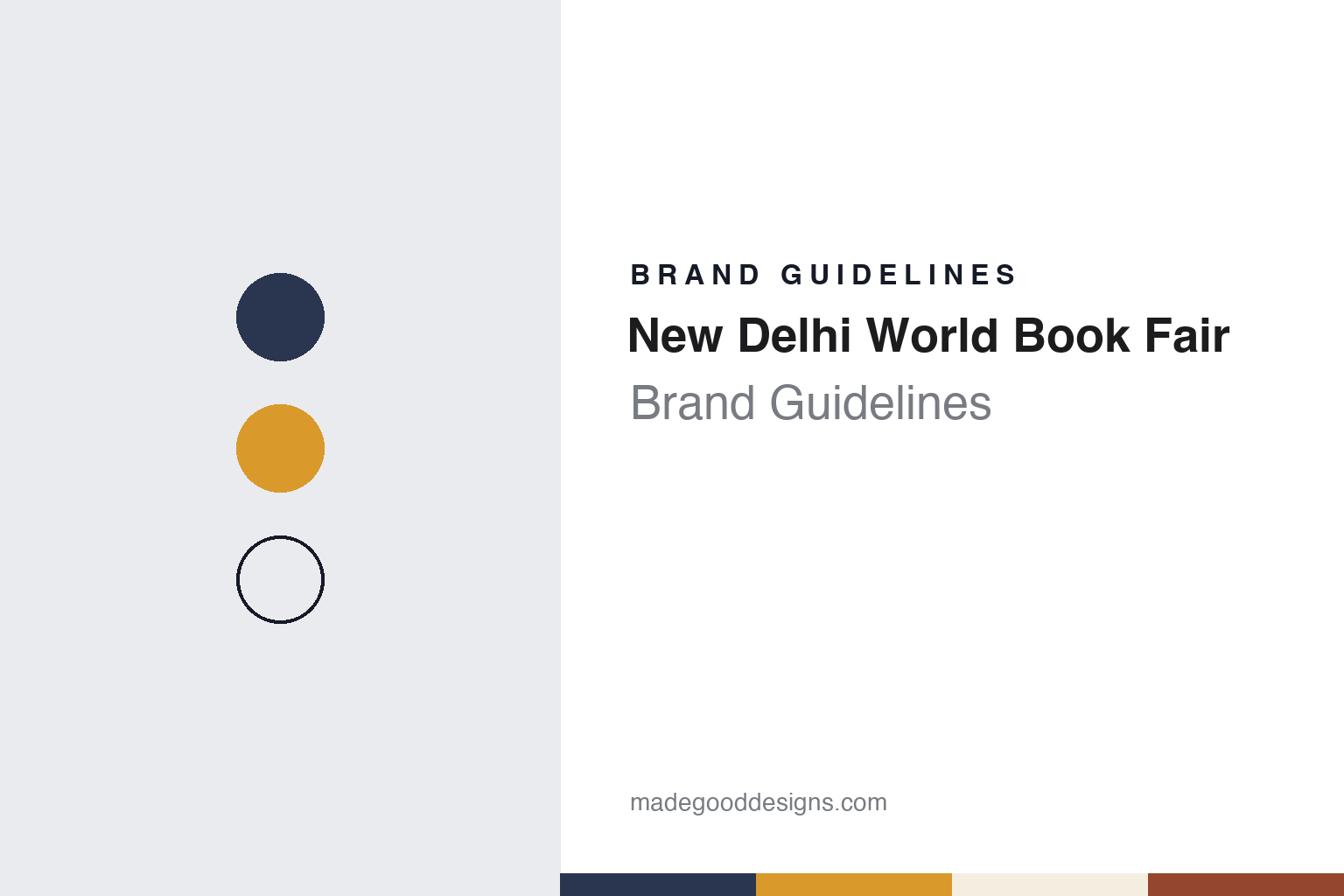
Two constants: a slate, marigold and cream palette and a humanist sans register. Abstract homage — not a New Delhi World Book Fair asset; no logo, poster or wordmark is reproduced.
A Fair at Pragati Maidan
A national book body and an exhibition ground.
The New Delhi World Book Fair, often shortened to NDWBF, is organised by the National Book Trust, India (NBT), a national book body that, English Wikipedia notes, publishes books and promotes reading. Its own fair calendar for 2026 lists events in Pune, Mumbai, Gorakhpur and Bikaner as well as Delhi, but the New Delhi fair is the one that gathers international publishers.
The fair began in 1972. English Wikipedia gives the dates of that opening edition as 18 March to 4 April 1972, at Pragati Maidan, with about 200 participants; in February 2025, NBT chairman Milind Sudhakar Marathe told the Press Trust of India, in a report carried by The Tribune, that “the NDWBF started in 1972.” Pragati Maidan, the exhibition grounds in central New Delhi, was itself opened that year, according to English Wikipedia.
For four decades the fair was held every two years. When the 20th edition opened on 25 February 2012, IANS described it in a report carried by the Deccan Herald as “the biennial fair”, noted that the previous edition had taken place in 2010, and reported that the NBT had spent several years seeking to make it an annual event. English Wikipedia says that from 2013 the fair has been held every year, organised by the NBT together with the India Trade Promotion Organisation (ITPO), which manages Pragati Maidan, under a memorandum of understanding. The 21st edition ran from 4 to 10 February 2013, with France as guest country and the theme “Indigenous Voices: Mapping India’s Folk & Tribal Literature”.
The calendar has shifted with the change. Editions in the 2010s were held in February and then, from 2016, in early January, English Wikipedia’s year-by-year list shows; the 2020 fair was held online, on 30 and 31 October 2020. The 2024 and 2025 editions returned to February, and the 2026 edition ran in January.
Colour
Halls, pavilions and a guest country.
The 2012 fair gives a clear picture of the format. IANS reported that it filled ten of the twelve halls at Pragati Maidan, about 45,000 square metres, with 1,300 exhibitors in some 2,500 stalls, and that its theme was the link between literature and cinema, marking a hundred years of Indian film. A follow-up report on 5 March 2012 described three pavilions — a rights pavilion, a theme pavilion and a children’s pavilion — and a forum on the exchange of rights in the context of digitisation. For rights buyers, the NBT released a catalogue of about 300 titles on Indian cinema with contact details for rights enquiries. The organisers reported more than 700,000 visitors.
Each edition now carries a theme and a guest country. English Wikipedia lists Poland as the guest of honour in 2014, Singapore in 2015, with Korea as focus country, the European Union in 2018 and Sharjah in 2019. In February 2024 the 52nd edition opened at Bharat Mandapam, the convention centre inside the Pragati Maidan complex that was unveiled in 2023, with the theme “Multilingual India: A Living Tradition”, The Tribune reported on 11 February 2024.
The 2025 fair ran at Bharat Mandapam from 1 to 9 February under the theme “Republic@75”, with more than 2,000 publishers and exhibitors, and the organisers reported more than two million visitors, the Press Trust of India reported on 11 February 2025.
The 53rd edition ran from 10 to 18 January 2026 at Bharat Mandapam. Speaking to Akashvani News on 8 January 2026, NBT director Yuvraj Malik said that more than a thousand publishers from over 35 countries were taking part, that entry was free that year, which he described as new, and that Qatar was guest of honour country and Spain the focus country. The Tribune reported on 18 January 2026 that the children’s pavilion that year was called Kidz Express.
Typography
Book fairs and their visitors.
International book fairs usually take their names from two things: the host city and the words book fair. Many are known by a form in the local language, and some by a short acronym or nickname that readers and the trade use more often than the full title, so that a single name can appear in several versions on posters, badges and press releases.
Most of these fairs serve two audiences. Trade days are set aside for publishers, rights agents, booksellers, distributors, librarians and translators, who come to meet, buy and sell translation rights and attend professional programmes. Public days follow or run alongside, when readers come to browse the stands, buy books and attend author talks, readings and signings, often with separate programmes for children and young readers.
Behind each fair sits an organiser. Some are run by universities, some by foundations set up by writers’ and publishers’ associations, some by state book bodies and some by exhibition companies that run fairs in their own halls. Inside the venue, halls are usually arranged by country and by publisher, with a rights centre for the trade and, at many fairs, a pavilion for a guest of honour: a country, region or city that brings its own writers, publishers and programme for one edition.
Visually, these fairs tend to keep a name and a wordmark from one year to the next while the edition poster, the annual theme or the guest pavilion changes. This guide describes those identities plainly, as dated sources describe them; the colours and type shown here are our own interpretation, and no logo, poster or pavilion is reproduced.
Aa
A humanist sans for an annual book fair. (Specimen set in Mukta, a sans STAND-IN; NOT the New Delhi World Book Fair logo or wordmark.)
New Delhi World Book Fair
A national organiser, a trade promoter and a guest country.
The fair’s identity rests on a few constants. The name has stayed the same, with the short form NDWBF used in coverage and by the organiser. The organiser has stayed the same: the National Book Trust, with ITPO as partner and host since 2013. And the site has stayed the same: Pragati Maidan, first in its halls and open-air theatre — the 2012 edition was opened at the Hamsadhwani open-air theatre, IANS reported — and in 2024, 2025 and 2026 in Bharat Mandapam.
Around those constants, each edition changes its look through the theme and the guest country. A theme pavilion presents the year’s subject, a guest of honour pavilion presents the visiting country’s books, and the children’s pavilion runs its own programme. Coverage of recent editions also describes a mix of trade and public visitors: the 2025 fair drew Hindi and English publishers such as Penguin Random House and Vani Prakashan, The Tribune reported, alongside large numbers of readers.
The edition numbers reflect the fair’s history as a biennial event: the fair that began in 1972 reached its 20th edition in 2012 and its 53rd in 2026, after the switch to an annual calendar in 2013.
For a design guide, the New Delhi World Book Fair shows how a public-body fair can keep one name and one site while each edition takes its colour from a theme and a guest country. Compare the International Kolkata Book Fair, India’s other long-running winter book fair, and the Sharjah International Book Fair; Sharjah was guest of honour in New Delhi in 2019. For this guide we use a slate blue, a marigold and a cream with a sans, an unofficial interpretation; no product or logo is reproduced.
Explore & save
Keep New Delhi World Book Fair’s identity on hand — save it to a board in the Made Good inspiration library.
New Delhi World Book Fair identity set
Pin the New Delhi World Book Fair slate, marigold and cream palette and the humanist sans register to your own board.
Source & notes
Frequently Asked Questions
What font can I use to match the New Delhi World Book Fair look?
This guide describes New Delhi World Book Fair’s type as “A humanist sans for an annual book fair”. Its type specimen is set in Mukta from Google Fonts as a stand-in; Mukta is not New Delhi World Book Fair’s own lettering.
What colours are in the New Delhi World Book Fair palette?
This guide’s New Delhi World Book Fair palette is Hall slate #2A3550, Night ink #151A26, Marigold #D99A2B, Brick #94472E and Page cream #F4EEE1. The tones are the guide’s own unofficial interpretation, not official New Delhi World Book Fair hex codes.