Sharjah International Book Fair Brand Guidelines
The November book fair at Expo Centre Sharjah.
Aa
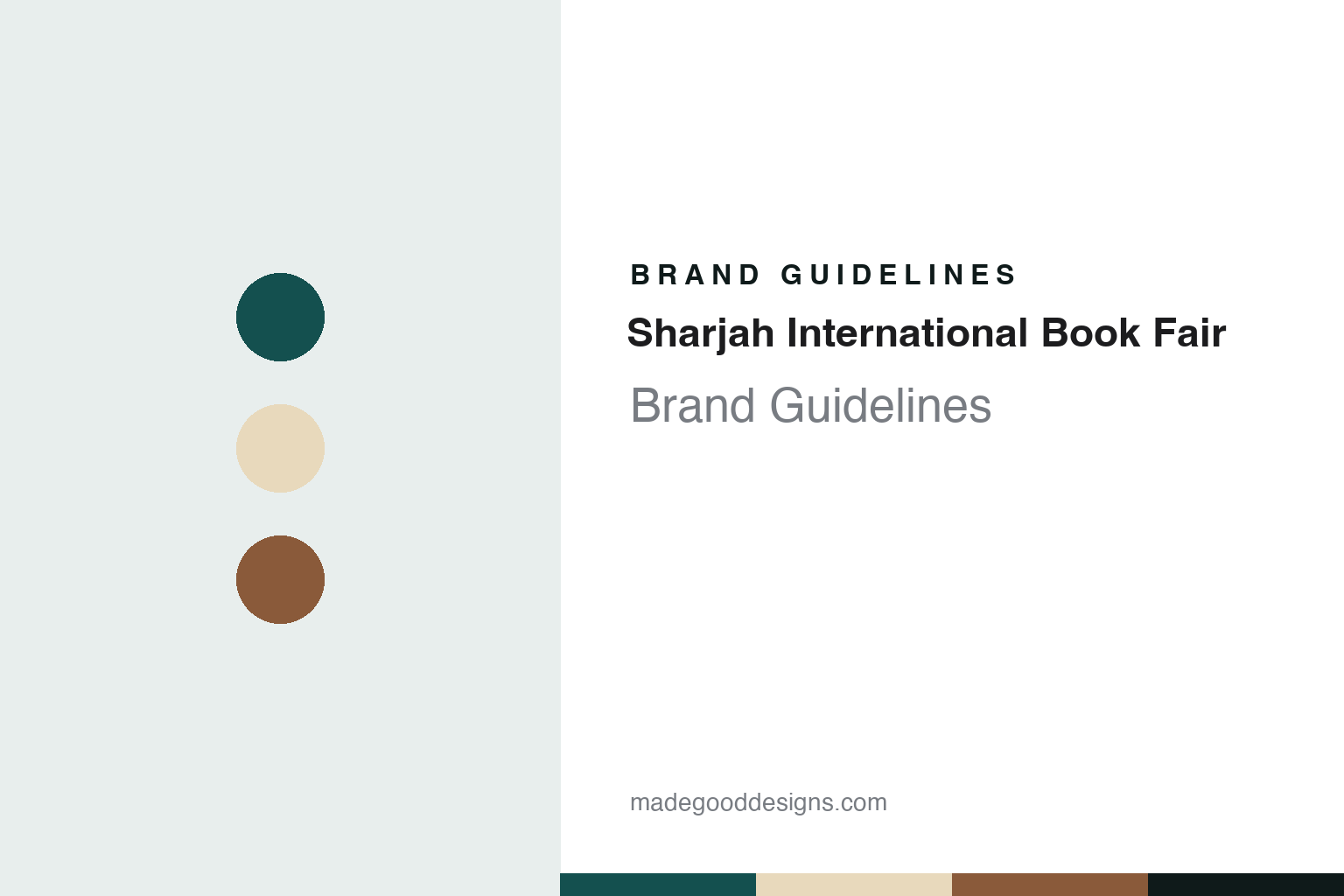
Two constants: a deep teal and warm sand palette and a Humanist sans register. Abstract homage — not a Sharjah International Book Fair product or mark; no logo, key visual or stand is reproduced.
A fair that began with six publishers
Opened in January 1982 with a handful of stands.
The Sharjah International Book Fair, known by its initials SIBF, is a book fair held each year in Sharjah, one of the seven emirates of the United Arab Emirates. Its first edition opened on 18 January 1982, Gulf News reported in October 2016, with a limited number of publishers; The National, looking back in November 2023, put the number of publishers at that first fair at six. The fair was opened by Sheikh Dr Sultan bin Muhammad Al Qasimi, the Ruler of Sharjah, under whose patronage it has run since, according to both newspapers and English Wikipedia. English Wikipedia adds that the books on show at the first fair were bought by him.
The early years were modest. The National wrote in 2023 that attendance at the first fair was low. The fair did not take place in 1990; it returned in 1991 with more than 476 publishing houses from 30 Arab and other countries, the paper said. The first fair was held in January; recent editions have been held in November, with the 2023 fair running until 12 November and the 2026 fair until 15 November, according to The National and Gulf News.
The fair is now organised by the Sharjah Book Authority (SBA), a government body established by an Emiri decree in 2014, according to English Wikipedia. The authority’s remit covers publishing, printing, translation, book festivals and children’s literature: it also runs the Sharjah Children’s Reading Festival, launched in 2010, the Publishers Conference held before the fair and the Sharjah Publishing City free zone, and it takes stands at book fairs abroad, including the Frankfurter Buchmesse and the London Book Fair, the same article says, citing The National (2017) and Gulf News (2019). In November 2026 Gulf News named Sheikha Bodour Al Qasimi as the authority’s chair.
Colour
Expo Centre Sharjah, every November.
The fair is held at Expo Centre Sharjah, the emirate’s exhibition centre, as The National reported for the 2023 edition and Gulf News for the 2026 edition. It is primarily a public fair: in a 2021 interview with Publishers Weekly, the Sharjah Book Authority described it as a consumer show and said every event at the fair is free to attend. Visitors range from families and school groups to collectors looking for old manuscripts, maps and books, the authority said in the same interview.
Each edition carries a theme and a guest of honour. In 2021, the fair’s 40th edition, the guest of honour was Spain, the authority told Publishers Weekly, and it said that 1,576 publishers from 83 countries would take part. In 2023 the guest of honour was South Korea, under the theme “We Speak Books,” The National reported. The 45th edition opened on Wednesday 4 November 2026 with Oman as guest of honour and the theme “Made of Stories,” according to Gulf News.
The numbers the fair publishes are the organiser’s own. For 2026, Gulf News reported, it listed 2,673 publishers and exhibitors from 124 countries and some 1,500 events over 12 days. For 2023 The National gave more than 2,000 publishers and exhibitors from 108 countries, with 2.17 million visitors recorded the year before. English Wikipedia counts more than 1,700 cultural, artistic and scientific events in 2023, from workshops for children and illustrator-led sessions on comics and manga to theatre performances, panel discussions and book signings.
The trade side comes first in the calendar. A three-day Publishers Conference precedes the public days, with matchmaking sessions for the buying and selling of publishing and translation rights, roundtables and workshops; English Wikipedia, citing the organiser, says nearly 1,150 publishers and literary agents from 108 countries attended the 2024 conference, held from 3 to 5 November. A translation grant for publishers taking part in the conference has run since 2011, the same article says. In 2020 the fair was held in a hybrid format, with discussions streamed online, the authority told Publishers Weekly the following year.
Typography
How book fairs present themselves.
International book fairs usually take their names from two things: the host city and the words book fair. Many are known by a form in the local language, and some by a short acronym or nickname that readers and the trade use more often than the full title, so that a single name can appear in several versions on posters, badges and press releases.
Most of these fairs serve two audiences. Trade days are set aside for publishers, rights agents, booksellers, distributors, librarians and translators, who come to meet, buy and sell translation rights and attend professional programmes. Public days follow or run alongside, when readers come to browse the stands, buy books and attend author talks, readings and signings, often with separate programmes for children and young readers.
Behind each fair sits an organiser. Some are run by universities, some by foundations set up by writers’ and publishers’ associations, some by state book bodies and some by exhibition companies that run fairs in their own halls. Inside the venue, halls are usually arranged by country and by publisher, with a rights centre for the trade and, at many fairs, a pavilion for a guest of honour: a country, region or city that brings its own writers, publishers and programme for one edition.
Visually, these fairs tend to keep a name and a wordmark from one year to the next while the edition poster, the annual theme or the guest pavilion changes. This guide describes those identities plainly, as dated sources describe them; the colours and type shown here are our own interpretation, and no logo, poster or pavilion is reproduced.
Aa
A humanist sans for a bilingual fair. (Specimen set in IBM Plex Sans, a sans STAND-IN; NOT the Sharjah International Book Fair logo.)
SIBF
One name, one hall, a new theme each year.
The fair’s identity rests on its full English name and its four-letter short form. Gulf News, The National and Publishers Weekly all use SIBF alongside the full name Sharjah International Book Fair. Each edition then adds its own layer: a theme line, such as “We Speak Books” in 2023 or “Made of Stories” in 2026, and a guest-of-honour country, Spain in 2021, South Korea in 2023 and Oman in 2026. The name and the venue stay the same while the theme and the guest country change from year to year.
The fair also sits inside a wider calendar run by the same authority. The Publishers Conference opens each edition for the trade, the Sharjah Children’s Reading Festival is a separate event for younger readers, and the authority carries the Sharjah name to fairs abroad, English Wikipedia says. In November 2026 Gulf News reported that the authority had been guest of honour at the Warsaw International Book Fair that spring.
For design work, that suggests a two-tier system: a permanent wordmark and short form that work in Arabic and in English, and a yearly layer for the theme, the guest country and the programme. A public fair of this kind, with children’s areas, theatre stages, signing tables and publishers’ stands in one exhibition centre, also needs wayfinding that reads quickly for families as well as for the trade visitors of the conference days.
For a design guide, the Sharjah International Book Fair shows how a public book fair can keep one name and one venue while each edition brings a new theme and guest country. Compare the Frankfurter Buchmesse and the London Book Fair, two fairs where the Sharjah Book Authority has taken stands. For this guide we use a deep teal and a warm sand with a sans, an unofficial interpretation; no product or logo is reproduced.
Explore & save
Keep Sharjah International Book Fair’s identity on hand — save it to a board in the Made Good inspiration library.
Sharjah International Book Fair identity set
Pin the deep teal and warm sand palette and the Humanist sans register to your own board.
Source & notes
Frequently Asked Questions
What font can I use to match the Sharjah International Book Fair look?
This guide describes Sharjah International Book Fair’s type as “A humanist sans for a bilingual fair”. Its type specimen is set in IBM Plex Sans from Google Fonts as a stand-in; IBM Plex Sans is not Sharjah International Book Fair’s own lettering.
What colours are in the Sharjah International Book Fair palette?
This guide’s Sharjah International Book Fair palette is Deep teal #14504F, Ink #0F1A1A, Warm sand #E8D9BC, Date brown #8A5A3A and Paper #FAF7F1. The tones are the guide’s own unofficial interpretation, not official Sharjah International Book Fair hex codes.
When was Sharjah International Book Fair founded?
Sharjah International Book Fair was founded in 1982 (first edition, January), in Sharjah, United Arab Emirates.