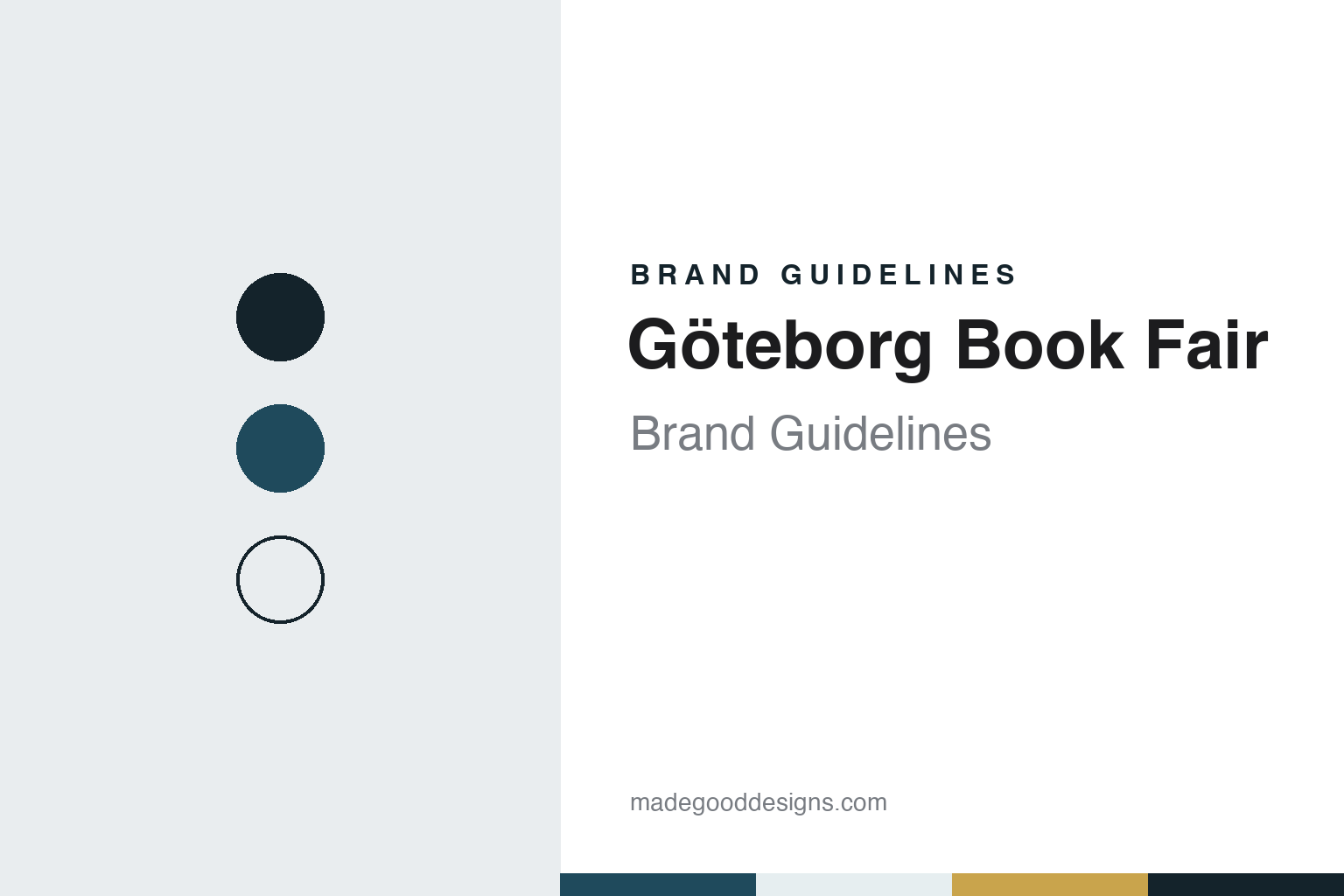
Göteborg Book Fair Brand Guidelines
A librarians’ seminar in Gothenburg that grew into a four-day book fair.
Aa
Two constants: a harbour blue and old gold palette and a Bookish serif register. Abstract homage — not a Göteborg Book Fair asset; no logo, mermaid or poster is reproduced.
Bibliotek 85
A seminar for librarians.
The Göteborg Book Fair — in Swedish Bokmässan, and for many years marketed as Bok & Bibliotek — started as a training idea. The fair’s own history page says that in the autumn of 1984 two friends, Bertil Falck and Conny Jacobsson, agreed to put on seminars as further education for librarians, under the working name Bibliotek 2000. Falck was administrative head of the Gothenburg city library; Jacobsson had been head of the library in Hagfors, in Värmland, and had started a library-services company there.
They chose Svenska Mässan, the exhibition centre in Gothenburg, where seminar rooms could be hired in August 1985, and once they had a hall it made sense to invite exhibitors too. The first fair, called Bibliotek 85, opened on 23 August 1985, Swedish Wikipedia says. It was a pure trade fair, ran for three days and recorded 5,000 visits, according to the organiser.
The second year changed its character. For 1986 the founders invited publishers and the wider education and culture sector, extended the fair to four days and opened two of them to the general public; the organiser counts 26,000 visits that year. The fair took the name Bok & Bibliotek — “Book & Library” — and Falck and Jacobsson set up a company, Bok & Bibliotek i Norden AB, to run it.
The organiser’s English website uses two spellings of the city, Göteborg and Gothenburg, for the same event. Its Swedish name today is simply Bokmässan, “the book fair”.
Colour
Halls, themes and a guest of honour.
The fair still takes place at Svenska Mässan, and it is now owned by the same body as the hall. Swedish Wikipedia records that Bok & Bibliotek i Norden AB merged on 23 November 2017 into Svenska Mässan Gothia Towers AB, the company behind the exhibition centre and the Gothia Towers hotel in the same building, whose ultimate owner is the private foundation Svenska Mässan Stiftelse. The organiser’s English site gives the venue as The Swedish Exhibition & Congress Centre.
The dates have settled in late September. Swedish Wikipedia’s year-by-year table shows the fair moving between August, September and October in its first decade and a half, and running on the last weekend of September or close to it in recent years, from a Thursday to a Sunday. The 2026 fair ran from 24 to 27 September.
Each edition carries one or more themes, and usually a guest of honour. According to Swedish Wikipedia’s table, South Korea was the guest in 2019, South Africa in 2022, with “Voices from Ukraine” added that year, and Sápmi in 2024, with space as a second theme. For 2026 the organiser named Québec as guest of honour, with popular education and games as themes.
The floor follows a familiar plan. Swedish Wikipedia describes halls lettered A to H: children’s books and comics in the A hall, the large publishers in the central B hall, organisations, regions and foreign exhibitors in C, and libraries and institutions in D and E, with seminar rooms upstairs. Comics have had their own seminar strand since 1986, and a fixed comics stage since 2010. An International Rights Centre, with around eighty tables, is where publishers and agents meet, the same article says.
Visitor numbers are counted as visits, not people. Boktugg, the Swedish book-trade site, reported on 30 September 2024 that the fair recorded 93,661 visits over four days, explaining that exhibitors and journalists are scanned each time they pass the entrance; it said 2020 was held only online and 2021 was a reduced edition of mostly seminars with 6,700 visits. SVT Nyheter reported 95,706 visitors on 29 September 2025. For 2026 the organiser reported 106,578 visits, 811 exhibitors and 300 seminars.
Typography
Design and documentation.
International book fairs usually take their names from two things: the host city and the words book fair. Many are known by a form in the local language, and some by a short acronym or nickname that readers and the trade use more often than the full title, so that a single name can appear in several versions on posters, badges and press releases.
Most of these fairs serve two audiences. Trade days are set aside for publishers, rights agents, booksellers, distributors, librarians and translators, who come to meet, buy and sell translation rights and attend professional programmes. Public days follow or run alongside, when readers come to browse the stands, buy books and attend author talks, readings and signings, often with separate programmes for children and young readers.
Behind each fair sits an organiser. Some are run by universities, some by foundations set up by writers’ and publishers’ associations, some by state book bodies and some by exhibition companies that run fairs in their own halls. Inside the venue, halls are usually arranged by country and by publisher, with a rights centre for the trade and, at many fairs, a pavilion for a guest of honour: a country, region or city that brings its own writers, publishers and programme for one edition.
Visually, these fairs tend to keep a name and a wordmark from one year to the next while the edition poster, the annual theme or the guest pavilion changes. This guide describes those identities plainly, as dated sources describe them; the colours and type shown here are our own interpretation, and no logo, poster or pavilion is reproduced.
Aa
A bookish serif — for a fair whose symbol is a mermaid from a 1483 book. (Specimen set in Fraunces, a serif STAND-IN; NOT the Göteborg Book Fair logo.)
The mermaid
A symbol taken from a fifteenth-century book.
The fair’s symbol is older than the fair. Its history page explains that the mermaid comes from an illustration in Skapelsens sedelärande samtal, printed in 1483, which the organiser describes as the first printed book in Swedish. The same image had served as the emblem when Sweden marked 500 years of the Swedish book in 1983.
The way it was adopted was improvised. According to the organiser, Falck and Jacobsson found one of the 1983 jubilee’s plastic carrier bags printed with the mermaid, smoothed it out as well as they could and placed it on a photocopier — which is why the tail fin looks slightly bumpy on the fair’s early posters. A few years later the image was redrawn by the designer Bo Berndal, who had made the logo for the 1983 jubilee: the mermaid’s upper body was turned to the right and her tail was given a new spring.
That drawing remains the fair’s mark. The organiser’s press page offers the logotype in black and in a negative version, in RGB files for screens and CMYK files for print, and asks that it be used only where the fair itself is referred to. The page does not publish colour values or a typeface, so the palette in this guide is our own.
Around that fixed emblem the rest of the identity changes each year. The plain Swedish name, Bokmässan, stays the same, while the themes and the guest of honour are new for every edition; the organiser’s English site opens with the year’s dates, the venue and the guest of honour. Swedish Wikipedia notes that publishers’ stands tend to return to the same places from year to year, with the aisles laid out like streets in a city.
For a design guide, the Göteborg Book Fair shows how an event can borrow a mark from the history of the printed book and keep it for decades. Compare Frankfurter Buchmesse, the German trade fair against which Swedish Wikipedia sets Bokmässan’s mix of trade and public days, and Festival du Livre de Paris, which also had Québec as a guest of honour, in 2024. For this guide we use a harbour blue and an old gold with a serif, an unofficial interpretation; no product or logo is reproduced.
Explore & save
Keep Göteborg Book Fair’s identity on hand — save it to a board in the Made Good inspiration library.
Göteborg Book Fair identity set
Pin the Göteborg Book Fair harbour blue and old gold palette and the Bookish serif register to your own board.
Source & notes
Frequently Asked Questions
What font can I use to match the Göteborg Book Fair look?
This guide describes Göteborg Book Fair’s type as “A bookish serif — for a fair whose symbol is a mermaid from a 1483 book”. Its type specimen is set in Fraunces from Google Fonts as a stand-in; Fraunces is not Göteborg Book Fair’s own lettering.
What colours are in the Göteborg Book Fair palette?
This guide’s Göteborg Book Fair palette is Harbour blue #1F4A5C, Ink #14232B, Sea mist #E6EEF0, Old gold #C9A44C and Paper #F8F6F1. The tones are the guide’s own unofficial interpretation, not official Göteborg Book Fair hex codes.
When was Göteborg Book Fair founded?
Göteborg Book Fair was founded in 1985 (as Bibliotek 85), in Gothenburg, Sweden.
Who founded Göteborg Book Fair?
Göteborg Book Fair was founded by Bertil Falck and Conny Jacobsson in 1985 (as Bibliotek 85).