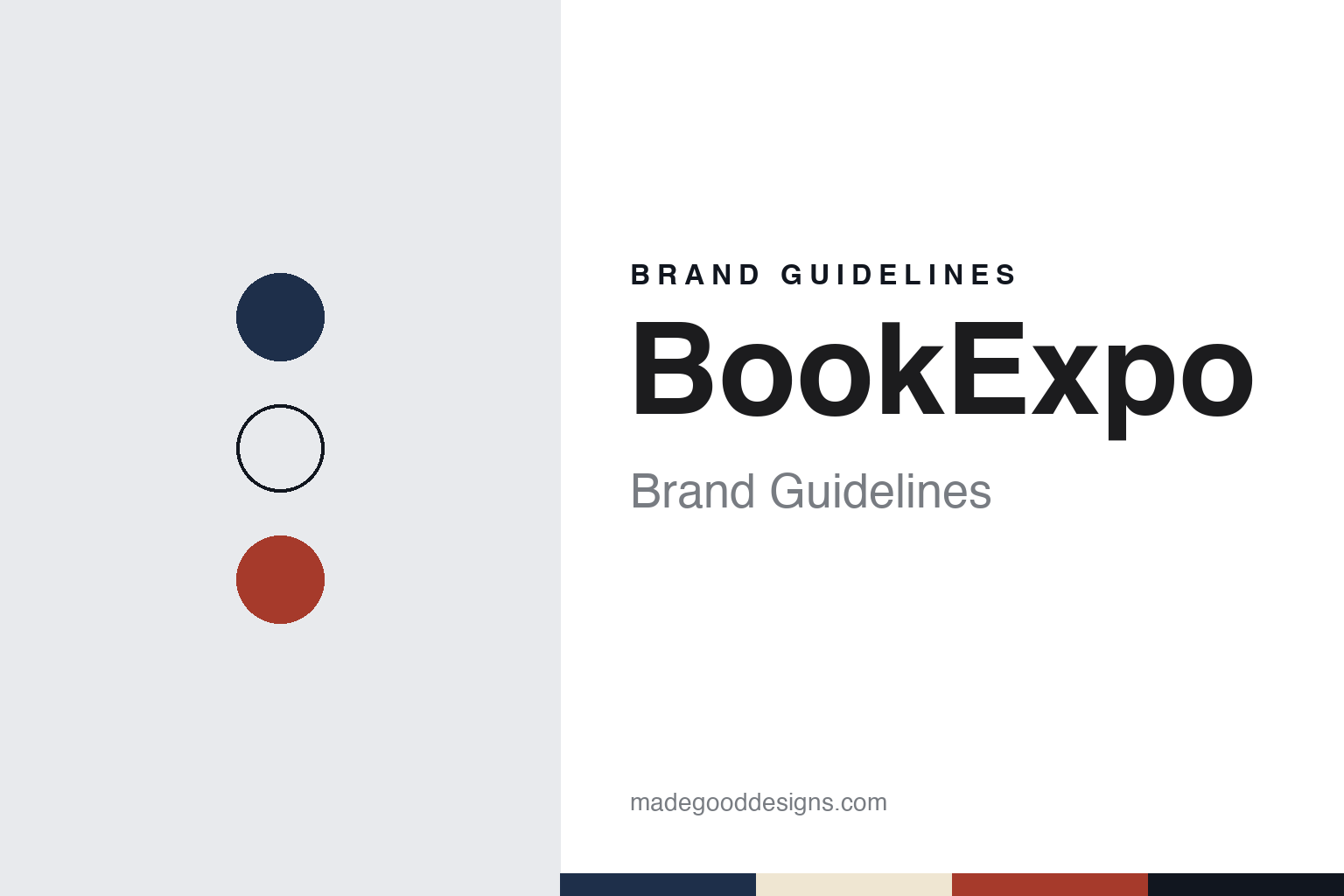
BookExpo Brand Guidelines
The US book trade show that began as the ABA convention.
Aa
Two constants: a navy, cream and brick red palette and a Bookish serif register. Abstract homage — not a BookExpo product or mark; no logo, key visual or stand is reproduced.
From “ABA” to BookExpo America
A booksellers’ convention that became a trade show.
BookExpo was the annual trade show of the American book business, held over several days in late May or early June. It began as the convention and trade show of the American Booksellers Association (ABA), the trade association of the country’s bookshops. English Wikipedia, citing the Chicago Tribune, dates the first convention to 1947; Publishing Perspectives, citing the Associated Press, wrote in December 2020 that the show developed in the 1940s under the association’s aegis. In the trade the convention was known simply as “ABA,” Shelf Awareness recalled in October 2016.
Until 1970 the convention was held in Washington, D.C.; from 1971 it moved between cities, with Boston, Washington, Los Angeles and New York among the hosts of the early 1970s, English Wikipedia says. In the 1990s and early 2000s it was often held in Chicago.
The association then sold the show. According to English Wikipedia, Reed Exhibitions bought a 49 percent share in 1994 and took full control in 1995, when the event was renamed BookExpo America, shortened in the trade to BEA. From then on it was produced by an exhibition company rather than by the book trade itself, Publishing Perspectives noted, though the ABA, the Association of American Publishers and the Association of Authors’ Representatives remained sponsors of the show, Shelf Awareness reported in 2016. Publishers Weekly described its later organiser, ReedPop, as the pop-culture events division of Reed Exhibitions, a business owned by the information group RELX.
Colour
The Javits years and BookCon.
After Washington in 2006, New York in 2007 and Los Angeles in 2008, BookExpo America settled at the Jacob K. Javits Convention Center in Manhattan from 2009, English Wikipedia says. It spent one year, 2016, at McCormick Place in Chicago, Publishing Perspectives wrote, and then returned to the Javits Center, where the 2017, 2018 and 2019 shows were held.
The show was built for the trade. Publishers took stands to present forthcoming titles, sell current books and trade subsidiary and international rights, and authors, librarians and buyers for bookshops attended, English Wikipedia says. Publishing Perspectives described pre-show conference days, an agents’ and rights centre in an upper-level pavilion overlooking the Hudson River, and “Market Focus” programmes, the name Reed also used for guest-country programming at the London Book Fair.
In 2014 Reed added BookCon, a consumer event for readers held on the weekend after the trade days. Publishing Perspectives credited it to Lance Fensterman, an organiser from the fan-convention world, and said it soon drew more visitors than the professional show. In October 2016 Publishers Weekly reported that BookCon in New York had drawn 18,000 consumer visitors over two days in 2015, by the organiser’s count.
Reed changed the format in 2016. That October, Shelf Awareness and Publishers Weekly reported that BookExpo America would drop “America” and become BookExpo. The event director, Brien McDonald, told Publishers Weekly that the brand needed “a name and logo to take us into the future,” that having America in the name had regionalised the show, and that the new name and logo created more symmetry with BookCon. For 2017 the trade floor was open for two days instead of two and a half, with a conference day before it, and the professional trade audience was capped at 6,000, the magazine said.
Smaller changes followed. In 2018 the agents’ centre moved for one year to the Metropolitan Pavilion, shared with the New York Rights Fair, a joint venture of BolognaFiere and Publishers Weekly; in 2019 the show added Unbound, a show of non-book merchandise, on part of the exhibition floor, Publishing Perspectives wrote.
Typography
How book fairs present themselves.
International book fairs usually take their names from two things: the host city and the words book fair. Many are known by a form in the local language, and some by a short acronym or nickname that readers and the trade use more often than the full title, so that a single name can appear in several versions on posters, badges and press releases.
Most of these fairs serve two audiences. Trade days are set aside for publishers, rights agents, booksellers, distributors, librarians and translators, who come to meet, buy and sell translation rights and attend professional programmes. Public days follow or run alongside, when readers come to browse the stands, buy books and attend author talks, readings and signings, often with separate programmes for children and young readers.
Behind each fair sits an organiser. Some are run by universities, some by foundations set up by writers’ and publishers’ associations, some by state book bodies and some by exhibition companies that run fairs in their own halls. Inside the venue, halls are usually arranged by country and by publisher, with a rights centre for the trade and, at many fairs, a pavilion for a guest of honour: a country, region or city that brings its own writers, publishers and programme for one edition.
Visually, these fairs tend to keep a name and a wordmark from one year to the next while the edition poster, the annual theme or the guest pavilion changes. This guide describes those identities plainly, as dated sources describe them; the colours and type shown here are our own interpretation, and no logo, poster or pavilion is reproduced.
Aa
A bookish serif for a trade show of publishers. (Specimen set in Libre Baskerville, a serif STAND-IN; NOT the BookExpo logo.)
Retired in 2020
ReedPop ended BookExpo and BookCon in December 2020.
BookExpo no longer runs. The 2020 show was due at the Javits Center in late May, was moved to late July and then did not take place in person; ReedPop instead ran six days of free online programming from 26 to 31 May 2020, Publishers Weekly reported. On 1 December 2020 ReedPop announced that BookExpo, BookCon and Unbound were being retired and would not be held in 2021. The event director, Jenny Martin, said in a statement that the company had decided to “retire the events in their current formats” while it worked out how to rebuild them, Publishing Perspectives and Publishers Weekly reported. The 2019 show at the Javits Center was the last BookExpo to be held.
Its name history is a plain record of who ran it. As “ABA” it was the booksellers’ own convention; as BookExpo America, from 1995, it was an exhibition company’s trade show; as BookExpo, from 2016, it was one half of a pair with BookCon. The 2016 change was a branding decision in so many words: a shorter name and a new logo, chosen, its director said, so that the trade show and the reader event would sit together as one family.
For design work that is a useful case. A trade show that adds a public event has to decide whether the two share one name, one wordmark and one colour system, or keep separate identities. BookExpo and BookCon took the first route, with matching names built on the same word, while the ABA’s Celebration of Bookselling moved to the first day of the 2017 show, Shelf Awareness reported, keeping the booksellers’ own event inside the trade programme.
For a design guide, BookExpo shows how a trade show’s name can follow its owners, from an association convention to an exhibition company’s brand. Compare the London Book Fair, also run by Reed Exhibitions, and the Frankfurter Buchmesse, another trade fair for publishers. For this guide we use a navy, a cream and a brick red with a serif, an unofficial interpretation; no product or logo is reproduced.
Explore & save
Keep BookExpo’s identity on hand — save it to a board in the Made Good inspiration library.
BookExpo identity set
Pin the navy, cream and brick red palette and the Bookish serif register to your own board.
Source & notes
Frequently Asked Questions
What font can I use to match the BookExpo look?
This guide describes BookExpo’s type as “A bookish serif for a trade show of publishers”. Its type specimen is set in Libre Baskerville from Google Fonts as a stand-in; Libre Baskerville is not BookExpo’s own lettering.
What colours are in the BookExpo palette?
This guide’s BookExpo palette is Hudson navy #1E2F4A, Ink #11161F, Galley cream #EFE6D2, Brick red #A63A2B and Paper #FBF8F2. The tones are the guide’s own unofficial interpretation, not official BookExpo hex codes.
When was BookExpo founded?
BookExpo was founded in 1947 (as the ABA convention), in United States.