ORGATEC Brand Guidelines
Koelnmesse’s biennial office and contract fair, traced to 1953.
Aa
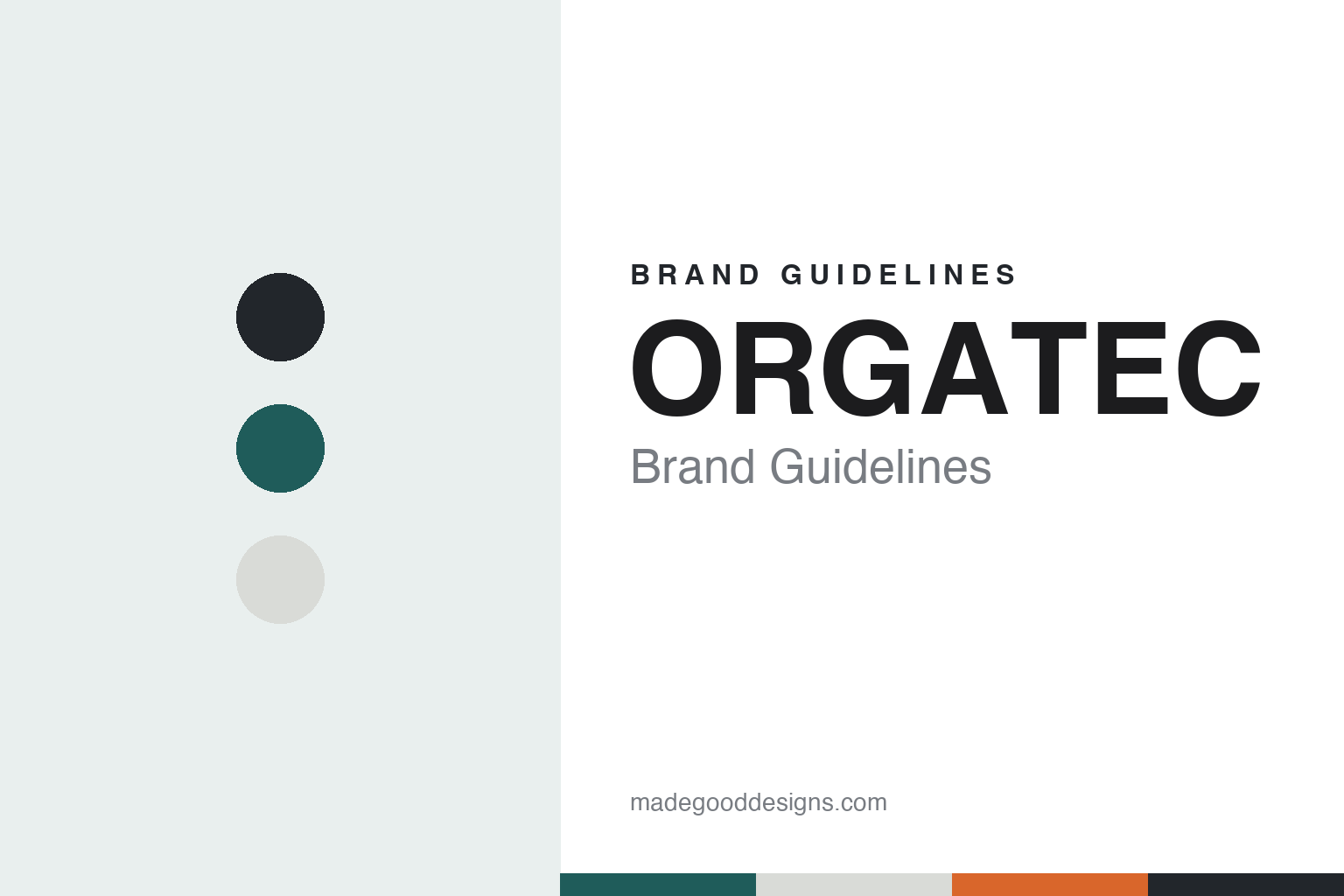
Two constants: a graphite, teal and orange palette and an Office grotesque register. Abstract homage — not an ORGATEC asset; no logo, key visual or exhibit is reproduced.
From Büromöbelmesse to ORGATEC
A West German office-furniture fair of 1953.
ORGATEC is the trade fair for office and contract interiors held by Koelnmesse on the Cologne exhibition grounds in Deutz, on the right bank of the Rhine. German Wikipedia traces it to the Westdeutsche Büromöbelmesse, a West German office-furniture fair first held in 1953, which it says opened with 42 exhibitors and 12,000 visitors. Koelnmesse’s own account of its history lists a specialised office show for Western Germany, “the predecessor of ORGATEC,” among the specialised fairs it built up in the years of reconstruction up to 1953, alongside fairs such as photokina and Anuga and the Cologne furniture fair.
The name changed several times. According to German Wikipedia, the fair kept its first name until 1967. From 1969 to 1975 it ran as ORGATECHNIK, an exhibition for organisation and technology in the office and in business. In 1976 it moved to even-numbered years and became ORGATECHNIK – Internationale Büromesse Köln, an international office fair. Since 1990 it has carried the shorter ORGATEC name, which keeps the first syllables of the older title and the capital letters of its predecessor.
The rhythm is biennial. In October 2012 the Canadian design magazine Azure described ORGATEC as a show that “takes place every two years in Cologne” and gave that year’s dates as 23 to 27 October. Koelnmesse’s facts page for the fair, read in November 2026, lists it as biennial, names the Interior Business Association (IBA), the German industry association for office and workspace furnishing, as its conceptual sponsor, and places it in Halls 5, 6, 7, 8 and 10. Access is for trade visitors only, according to both the organiser and German Wikipedia.
Colour
Furniture, then everything around it.
What ORGATEC shows has widened over the decades. German Wikipedia says the fair began with classic office furniture and gradually added everything a working administration needs, and lists lighting, floor coverings, acoustics, media technology, planning and fit-out, facility services, filing and presentation systems, accessories and software. Koelnmesse’s product segments for the 2026 edition run along similar lines: furniture for offices, institutions and commercially used buildings; acoustic elements, floor and wall coverings and lighting; media and conference technology and hybrid working; and IT, consulting and services.
The audience is defined as planners and buyers. Koelnmesse names architects, interior designers, workplace planners, office and furniture retailers, facility managers, real-estate investors and human-resources managers among its target visitors. German Wikipedia describes the planners of offices and working environments — architects, interior architects and designers — as the traditional core of the trade audience, together with the office-furniture trade and facility management. In English the fair now calls itself a trade fair for workspace and contract solutions; its German title long read “Office und Objekt,” Objekt being the German trade word for the furnishing of public and commercial buildings.
The 2026 edition ran from 27 to 30 October 2026. In November 2025 Workplace Insight reported that ORGATEC had announced a central theme for that edition, “From rooms to relationships: designing spaces in an ever-changing world,” which the report described as the fair’s first central theme, and quoted the fair’s director, Maik Fischer, on spaces becoming places where people meet and where design, technology and human experience come together. Koelnmesse’s closing report says some 550 exhibiting companies from 39 countries took part and that more than 40,000 trade visitors came from 121 countries.
The same report describes the programme around the stands: the second edition of the Wherever Whenever – Work Culture Festival, a series of talks, panels and workshops staged with the IBA that began in 2024; guided tours through the halls; and a planner called Your Perfect Day @ ORGATEC that suggested themed routes. Koelnmesse adds that idd cologne, a set of interior design days in the city, ran in parallel, with Design Post Köln open to ORGATEC visitors.
Typography
Home, interiors and building fairs.
Home, interiors and building trade fairs tend to go by short names. Some are a single word, some an acronym or a coined compound, and many are written entirely in lower case or entirely in capitals; a city name is often added, sometimes in its English form, sometimes in the local one. Behind each name stands an organiser: an exhibition company owned by a city or a region, a trade association that sponsors the event, or, in the case of some American furniture markets, a market authority.
Most of these fairs are held for the trade. Their visitors are retailers and buyers, architects, interior designers, installers, contract and hospitality buyers, and the purchasing groups that supply large chains. A few keep public days at the end of the run or are built for the public from the start, with show homes and room sets for people planning their own homes. Many follow a fixed calendar, annual or every two years, tied to the ordering seasons of their trade.
Inside the halls, the fairs are arranged by product group. One may cover tableware, kitchenware, gifts and home accessories; another furniture and lighting; others floor coverings, ceramic tiles, kitchens, bathrooms or heating and building systems. Most add trend areas, special shows and talk programmes, and several now group suppliers from abroad into sourcing sections or country pavilions.
The identity of such a fair usually rests on a wordmark that is kept from edition to edition, while a key visual, colour or theme changes each year. The guides in this collection describe those names, organisers, dates and formats as dated sources give them, and treat the colours and type shown here as our own interpretation rather than any fair’s official material.
Aa
An office grotesque — ORGATEC in capitals. (Specimen set in Archivo, a sans STAND-IN; NOT the ORGATEC logo.)
ORGATEC
A name in capitals, a theme for each edition.
ORGATEC also has relatives abroad. Koelnmesse’s portfolio page, read in November 2026, lists ORGATEC Tokyo in Japan, for which it gives 151 exhibitors from 16 countries and 33,470 trade visitors, and ORGATEC India in Mumbai, held from 19 to 21 November 2026, which it describes as a platform for office furniture, building automation and workplace services. Those editions carry the Cologne name with the host city or country added.
The identity itself is mostly typographic. Koelnmesse writes the name in capitals, ORGATEC, as German Wikipedia does, and on its 2026 pages pairs it with the city and the dates in a single compact line, in the form “Cologne: 27.–30.10.2026 #ORGATEC.” The 2026 central theme gave that edition a sentence of its own, and the fair’s subtitle has moved from office and organisation towards workspace and contract solutions. The older ORGATECHNIK, with its emphasis on technology and organisation, is still visible in the shortened name.
For visitors, the practical shape of ORGATEC is a walk through five halls of furniture, acoustics, lighting, flooring and media technology, with talks and tours in between, every second October in Cologne. For designers working with the fair’s material, the constants are the capitalised name, the city and the date line; everything else changes from edition to edition with the theme.
For a design guide, ORGATEC shows how a trade fair can keep one short, capitalised name for more than three decades while its subject widens from office furniture to the whole working environment. Compare Koelnmesse, its organiser, and imm cologne, Koelnmesse’s furniture fair in the same city. For this guide we use graphite, a deep teal and a signal orange with a sans, an unofficial interpretation; no product or logo is reproduced.
Explore & save
Keep ORGATEC’s identity on hand — save it to a board in the Made Good inspiration library.
ORGATEC identity set
Pin the ORGATEC graphite, teal and orange palette and the Office grotesque register to your own board.
Source & notes
Frequently Asked Questions
What font can I use to match the ORGATEC look?
This guide describes ORGATEC’s type as “An office grotesque — ORGATEC in capitals”. Its type specimen is set in Archivo from Google Fonts as a stand-in; Archivo is not ORGATEC’s own lettering.
What colours are in the ORGATEC palette?
This guide’s ORGATEC palette is Graphite #22262B, Meeting-room teal #1F5C5A, Felt grey #D9DBD7, Signal orange #D9662B and Paper #F6F6F3. The tones are the guide’s own unofficial interpretation, not official ORGATEC hex codes.