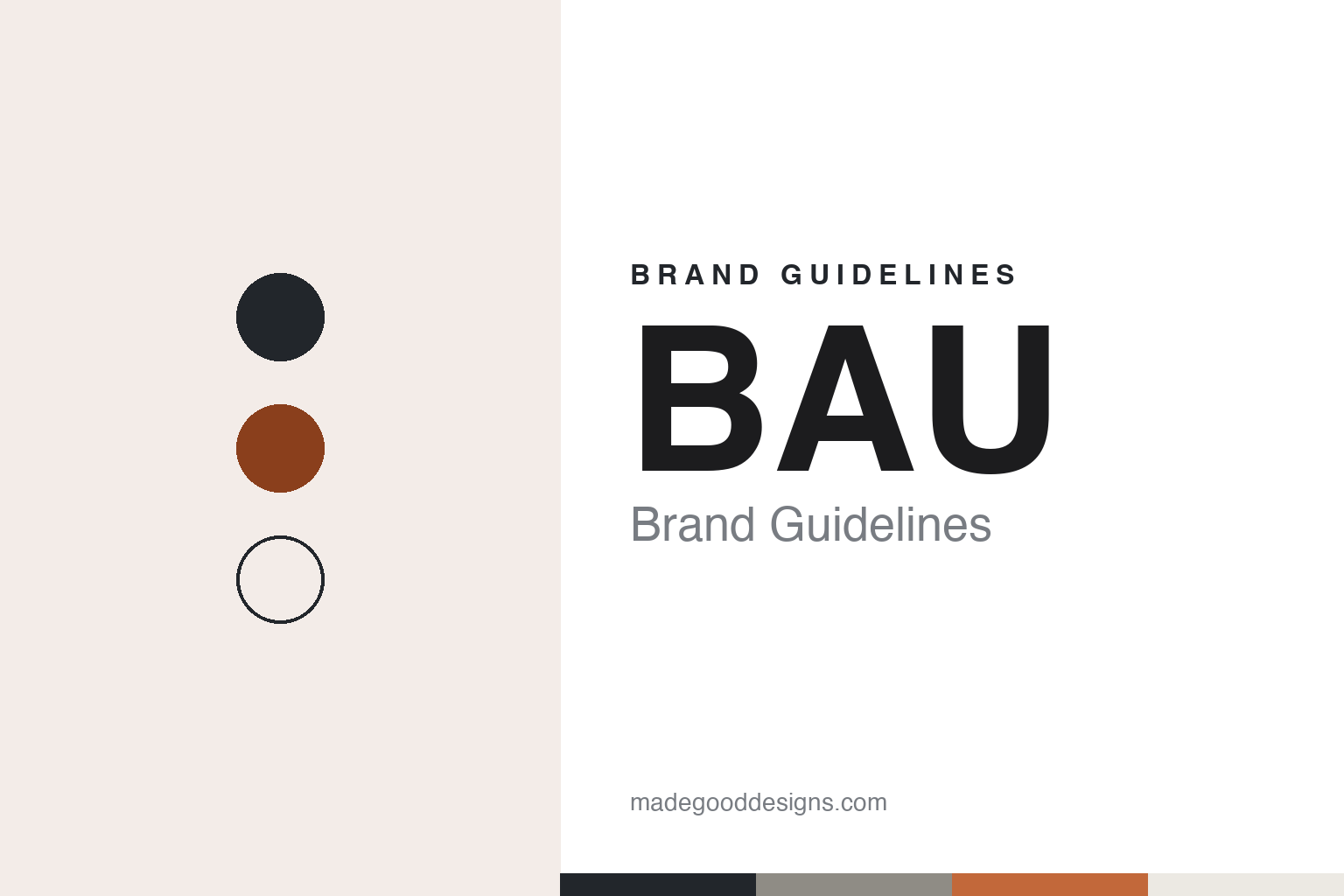
BAU Brand Guidelines
Munich’s biennial fair for architecture, materials and systems.
Aa
Two constants: a concrete, clay and plaster palette and a constructed sans register. Abstract homage — not a BAU or Messe München mark; no logo, key visual or stand is reproduced.
A building fair in Munich
Biennial, in January, since 1964.
BAU is a trade fair for architecture, materials and systems, held every two years in Munich. German Wikipedia dates the first edition to 1964 and names Messe München, the city’s exhibition company, as its organiser. The fair usually runs in January of odd-numbered years. Its name is the German word for building, written in capitals, and in English it is also called BAU Munich.
Messe München says that on 12 February 1998, after 34 years on the Theresienhöhe site near the city centre, it moved to new exhibition grounds on the site of the former Riem airport in the east of the city, opening with 13 halls; it says the grounds were completed in 2018 with two further halls and a conference centre. German Wikipedia places BAU at this Neue Messe München, and the organiser says the 2025 edition filled 18 halls. Messe München’s history pages name its shareholders as the City of Munich, the Free State of Bavaria, the Munich and Upper Bavaria chamber of industry and commerce and the chamber of skilled crafts.
German Wikipedia describes how the fair is arranged: by building materials, products and themes, covering industrial and commercial building as well as housing and interior finishing. Its audience, the article says, is planners, architects and project developers working internationally, alongside building tradespeople, contractors, building-materials dealers and people from the property business. The organiser’s own website names the same groups, from architects, planners and investors to the industrial and commercial sectors and the building trades, and says the fair covers commercial and residential construction and interior work, for new buildings as well as renovation and modernisation. Its current list of exhibition areas runs from aluminium, glass, wood and steel to doors and windows, roofs, floor coverings, tiles and natural stone, building automation, and modular and prefabricated construction.
Colour
Editions, figures and a moved date.
German Wikipedia records the fair’s size edition by edition, using the organiser’s figures. In January 2009 BAU covered 180,000 square metres, with 1,776 exhibitors from 43 countries and 212,035 visitors, more than 37,000 of them from abroad. The 2011 edition used an open-air area for the first time, and the 21st BAU ran from 19 to 24 January 2015, with exhibitors from 42 countries and more than 251,000 visitors. In between, the 2013 fair had 2,028 exhibitors from 41 countries on 183,000 square metres of gross exhibition space, and the 2017 fair 2,120 exhibitors from 45 countries and about 250,000 visitors, some 80,000 of them from abroad. The 2019 fair, from 14 to 19 January, had 2,250 exhibitors from 45 countries, the article says.
The 2011 edition also brought a programme beyond the halls. German Wikipedia says that during BAU 2011 Munich held its first Lange Nacht der Architektur, a long night of architecture, when buildings including BMW Welt, the Allianz Arena and the Highlight Towers opened to the public, some with tours by their architects; BAU 2015 again closed with such a night, opening the Architekturgalerie München, the Museum Brandhorst and the Maximilianeum.
In 2023 the date moved. Stylepark reported on 10 March 2022 that Messe München had moved the next BAU from January to 17–22 April 2023, keeping its hall structure and its key themes: “The Challenge of Climate Change”, “Affordable Housing”, “Resources and Recycling” and “Digital Transformation”, with modular building added. German Wikipedia says the April 2023 fair, held four years after the previous one, had 2,260 exhibitors from 49 countries and about 190,000 visitors.
The fair returned to January in 2025, running from 13 to 17 January. German Wikipedia lists its themes as resilient and climate-appropriate building, change in cities, neighbourhoods and the countryside, and modular and serial building. The organiser says the 2025 edition had about 2,200 exhibitors from 58 countries, 58 per cent of them from abroad, and well over 180,000 visitors, 44 per cent of them from outside Germany.
Typography
How these fairs present themselves.
Home, interiors and building trade fairs tend to go by short names. Some are a single word, some an acronym or a coined compound, and many are written entirely in lower case or entirely in capitals; a city name is often added, sometimes in its English form, sometimes in the local one. Behind each name stands an organiser: an exhibition company owned by a city or a region, a trade association that sponsors the event, or, in the case of some American furniture markets, a market authority.
Most of these fairs are held for the trade. Their visitors are retailers and buyers, architects, interior designers, installers, contract and hospitality buyers, and the purchasing groups that supply large chains. A few keep public days at the end of the run or are built for the public from the start, with show homes and room sets for people planning their own homes. Many follow a fixed calendar, annual or every two years, tied to the ordering seasons of their trade.
Inside the halls, the fairs are arranged by product group. One may cover tableware, kitchenware, gifts and home accessories; another furniture and lighting; others floor coverings, ceramic tiles, kitchens, bathrooms or heating and building systems. Most add trend areas, special shows and talk programmes, and several now group suppliers from abroad into sourcing sections or country pavilions.
The identity of such a fair usually rests on a wordmark that is kept from edition to edition, while a key visual, colour or theme changes each year. The guides in this collection describe those names, organisers, dates and formats as dated sources give them, and treat the colours and type shown here as our own interpretation rather than any fair’s official material.
Aa
A constructed sans for a fair named for building. (Specimen set in Archivo, a sans STAND-IN; NOT the BAU logo or any Messe München typeface.)
BAU
A capitalised word and a changing creature.
The name stays the same from edition to edition, while the campaign image changes. German Wikipedia says that for several editions the fair has had its own specially developed motifs: futuristic animal or plant images meant to stand for the future of building. The organiser’s website pairs the capitalised name with the descriptor “Architecture, Materials, Systems”, and it currently lists four key themes: changing living space, climate-friendly construction, digitalisation and productivity, and resource-saving construction.
BAU has also become the anchor of a small family of events. The organiser’s website groups them as the BAU Network, naming BAU China, Glasstech Asia and Fenestration Asia, and digitalBAU in Cologne. Messe München reported on 4 November 2026 that BAU China 2026 had run from 28 to 30 October 2026 at the China International Exhibition Center in Beijing, together with Fenestration BAU China, the China Architectural Design Expo and a roofing and waterproofing expo, with more than 820 exhibitors and about 52,000 trade visitors by its count.
The halls themselves are part of the setting. Messe München says its Riem grounds were planned by the architecture firm Prof. Kaup, Dr. Scholz und Partner with the engineering firm Obermeyer Planen und Beraten, and it calls them a “trade fair of short distances”; it says 71,000 square metres of the hall roofs are planted with greenery.
For a design guide, BAU shows how a fair can keep a one-word name in capitals for six decades while its campaign imagery changes with each edition. Compare Messe München, the exhibition company that runs it, and ISH, Messe Frankfurt’s biennial fair for building services. For this guide we use concrete grey, a fired-clay orange and lime plaster with a sans, an unofficial interpretation; no product or logo is reproduced.
Explore & save
Keep BAU’s identity on hand — save it to a board in the Made Good inspiration library.
BAU identity set
Pin the BAU concrete, clay and plaster palette and the constructed sans register to your own board.
Source & notes
Frequently Asked Questions
What font can I use to match the BAU look?
This guide describes BAU’s type as “A constructed sans for a fair named for building”. Its type specimen is set in Archivo from Google Fonts as a stand-in; Archivo is not BAU’s own lettering.
What colours are in the BAU palette?
This guide’s BAU palette is Site ink #22262B, Poured concrete #8F8C85, Fired clay #C2683A, Lime plaster #ECE9E3 and Drawing paper #F8F7F3. The tones are the guide’s own unofficial interpretation, not official BAU hex codes.