Hong Kong International Jewellery Show Brand Guidelines
The March jewellery fair on the Wan Chai waterfront since 1984.
Aa
Two constants: a jade, harbour blue and pearl palette and a display serif register. Abstract homage — not an HKTDC asset; no logo, badge or jewel is reproduced.
A council’s fair
Two jewellery lineages in one city.
The Hong Kong International Jewellery Show is organised by the Hong Kong Trade Development Council, the HKTDC, which Tatler Asia notes was established in 1966. In a September 2026 feature by Amrita Katara on Hong Kong’s jewellery fairs, the magazine dates the council’s own jewellery fair to 1984.
That date separates it from another early Hong Kong fair. Tatler Asia describes Hong Kong as having two jewellery-fair organisers with separate histories. The HKTDC runs the March fair. A September fair has a different lineage: in 1991 four trade associations invited the HKTDC to launch a joint September show, whose opening edition ran at the Kowloon Shangri-La Hotel in September 1992; three years later it merged with a rival September show run by Miller Freeman, the trade-show company that through later acquisitions became Informa Markets, today’s organiser of that September event. The March show described here is the HKTDC’s.
The fair settled on the Wan Chai waterfront. Tatler Asia notes that the Hong Kong Convention and Exhibition Centre, where the finished-jewellery show is held, opened in 1988, and that AsiaWorld-Expo, where raw materials are shown, opened in 2005. The same feature gives two points on the fair’s growth: by its 34th edition, in 2017, it drew 2,580 exhibitors, and the 2026 edition, its 42nd, drew roughly 4,000 across its two venues.
Colour
Two shows, two venues.
Each March now has two parts, a format the council calls “Two Shows, Two Venues”. The Hong Kong International Jewellery Show, at the convention centre in Wan Chai, is devoted to finished jewellery. The Hong Kong International Diamond, Gem & Pearl Show, at AsiaWorld-Expo, covers loose stones, pearls and other raw materials. The two run in the same week, with their dates overlapping.
The recent editions follow the same March rhythm. In 2024 the HKTDC held the 40th Jewellery Show at the convention centre and the 10th Diamond, Gem & Pearl Show at AsiaWorld-Expo; the council reported more than 4,000 exhibitors from 44 countries and regions and some 81,000 buyers, and described that year as the return of the two-venue format. In 2025 the 41st Jewellery Show ran from 4 to 8 March and the 11th Diamond, Gem & Pearl Show from 2 to 6 March. Before it opened, the HKTDC said nearly 70 per cent of exhibitors came from outside Hong Kong; the edition added a Gold Jewellery zone and a Young Jewellery Designer Arena for emerging designers, and the council later reported more than 82,000 buyers across the two venues.
In 2026 the HKTDC held the 12th Diamond, Gem & Pearl Show from 2 to 6 March and the 42nd Jewellery Show from 4 to 8 March, five days at each venue. The council said the two shows brought together some 4,000 exhibitors from more than 40 countries and regions. When they closed on 8 March it reported some 80,000 buyers from 150 countries and regions across both events: more than 51,000 from 140 countries and regions at the Jewellery Show and more than 28,000 from 125 at the Diamond, Gem & Pearl Show. On the show’s own statistics page the 2026 Jewellery Show is listed with 2,353 exhibitors from 34 countries and regions.
The 2026 edition also added two group pavilions, according to the HKTDC’s opening-day release: a Hard Pure Gold Pavilion presented by the World Gold Council, with 11 exhibitors showing hard pure gold work, and a pavilion of the Hong Kong Watch Manufacturers Association showing timepieces made with jewellery-setting techniques. The council said its Hall of Fame, the zone for branded collections, had grown by more than 40 per cent on the year before.
Typography
How trade fairs present themselves.
Jewellery, watch, beauty and textile trade fairs usually take their names from one of three places: the trade itself, the city that hosts them, or a coined word. Some names spell out the goods on show, some lead with a city such as Basel, Geneva, Munich, Vicenza, Bologna, Frankfurt or Paris, and some combine the two, so that the name tells a visitor both what is shown and where.
Most of these fairs are built first for the trade. Their halls are planned for retailers, buyers, designers, manufacturers and the press, who come to see new collections, materials and ingredients and to place orders. Some fairs set aside trade days and then open their doors to the public for a day or more, and some add a programme of talks, tours and events in the host city around the halls.
Behind each fair sits an organiser: a foundation set up by the exhibitors, a trade association, or an exhibition company that runs many shows in its own halls and abroad. The organiser often shapes the layout, grouping exhibitors by product, from brand booths and private appointment rooms to shared areas for suppliers, trend presentations and materials forums, and some run sister editions in other cities under a related name.
Visually, these fairs tend to keep a name and a wordmark from one edition to the next while the key visual, season theme or hall design changes each year. This guide describes those identities plainly, as dated sources describe them; the colours and type shown here are our own interpretation, and no logo, key visual or stand is reproduced.
Aa
A high-contrast display serif for hall names and catalogue covers. (Specimen set in Cormorant Garamond, a serif STAND-IN; NOT the HKTDC logo.)
Hong Kong International Jewellery Show
A floor plan of named halls.
The show presents itself through named halls more than through a single image. The HKTDC’s fair overview lists the zones on the floor: World of Glamour, for Hong Kong’s fine-jewellery makers; the Hall of Extraordinary, which the council reserves for exceptional high-value pieces; the Hall of Fame, for branded collections; and the Designer Galleria, for designer pieces aimed at younger buyers. Further zones cover fine jewellery, silver, titanium and stainless-steel jewellery, an Antique & Vintage Jewellery Galleria, jewellery tools and equipment, and Watch Avenue for timepieces.
Each zone works as a sub-brand inside the fair’s name, with its own heading on the floor plan and in the catalogue. Around the physical fair the council runs online services under its own banners, including the Click2Match business-matching platform and its hktdc.com Sourcing marketplace. Its 2026 floor also listed featured pavilions from national groups and trade associations alongside individual booths, so visitors meet grouped areas as well as single stands.
The fair also travels in name. At JCK Las Vegas in 2026, National Jeweler reported in January that year, a Hong Kong Pavilion opened on the day before the main floor. The palette and type below are our own interpretation.
For a design guide, the Hong Kong International Jewellery Show shows how a public trade body can build a fair’s identity from a fixed March slot, two venues with distinct roles and a floor of clearly named halls, from World of Glamour to Watch Avenue. Compare it with Informa, whose Informa Markets business runs Hong Kong’s separate September jewellery fair, and JCK Las Vegas. For this guide we use jade green, harbour blue and pearl with a serif, an unofficial interpretation; no product or logo is reproduced.
Explore & save
Keep Hong Kong International Jewellery Show’s identity on hand — save it to a board in the Made Good inspiration library.
Hong Kong International Jewellery Show identity set
Pin the jade, harbour blue and pearl palette and the display serif register to your own board.
Source & notes
Frequently Asked Questions
What font can I use to match the Hong Kong International Jewellery Show look?
This guide describes Hong Kong International Jewellery Show’s type as “A high-contrast display serif for hall names and catalogue covers”. Its type specimen is set in Cormorant Garamond from Google Fonts as a stand-in; Cormorant Garamond is not Hong Kong International Jewellery Show’s own lettering.
What colours are in the Hong Kong International Jewellery Show palette?
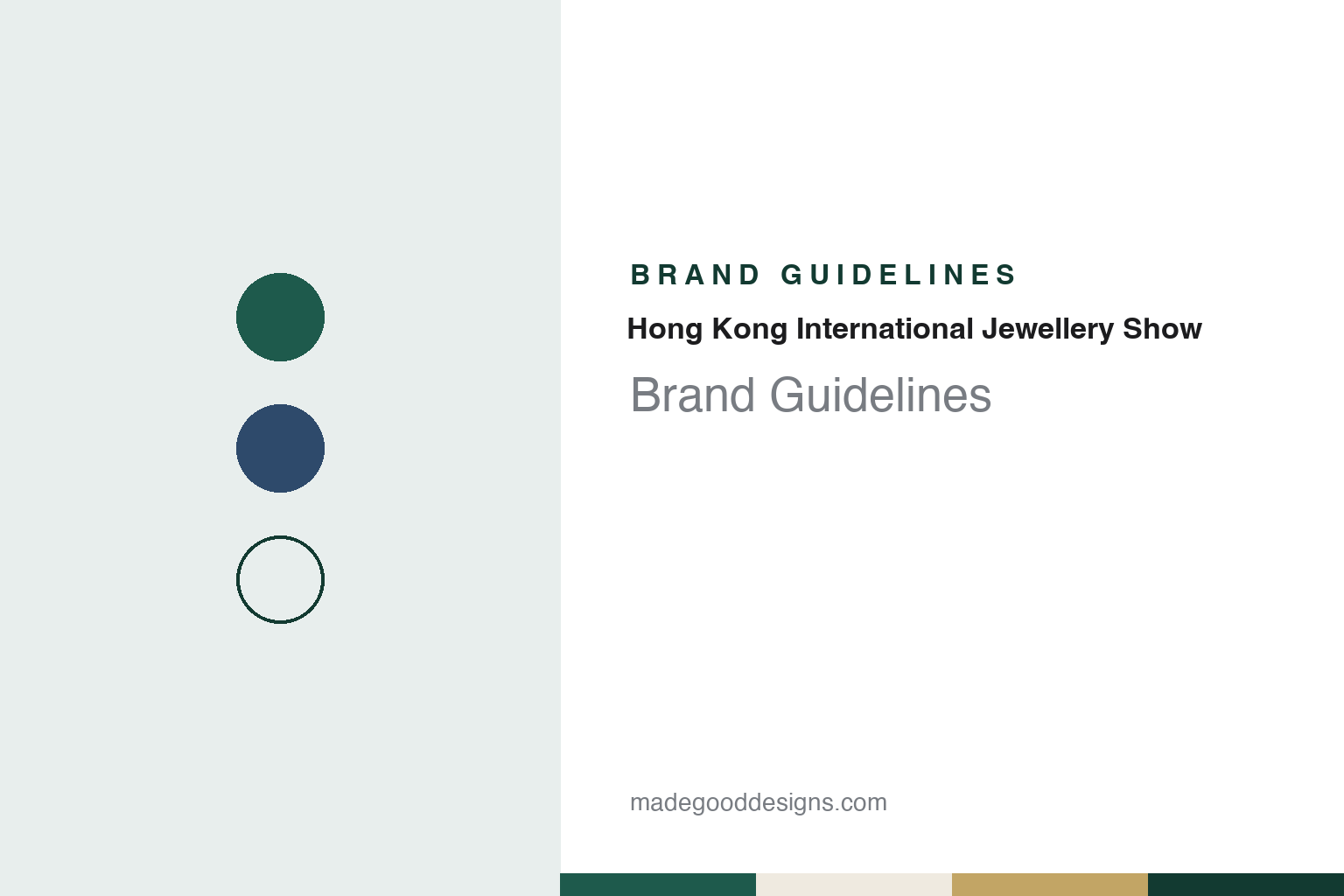
This guide’s Hong Kong International Jewellery Show palette is Jade green #1E5A4C, Deep jade #123A31, Harbour blue #2E4A6B, Pearl #EFEAE0 and Pale gold #C2A565. The tones are the guide’s own unofficial interpretation, not official Hong Kong International Jewellery Show hex codes.
When was Hong Kong International Jewellery Show founded?
Hong Kong International Jewellery Show was founded in 1984, in Hong Kong.