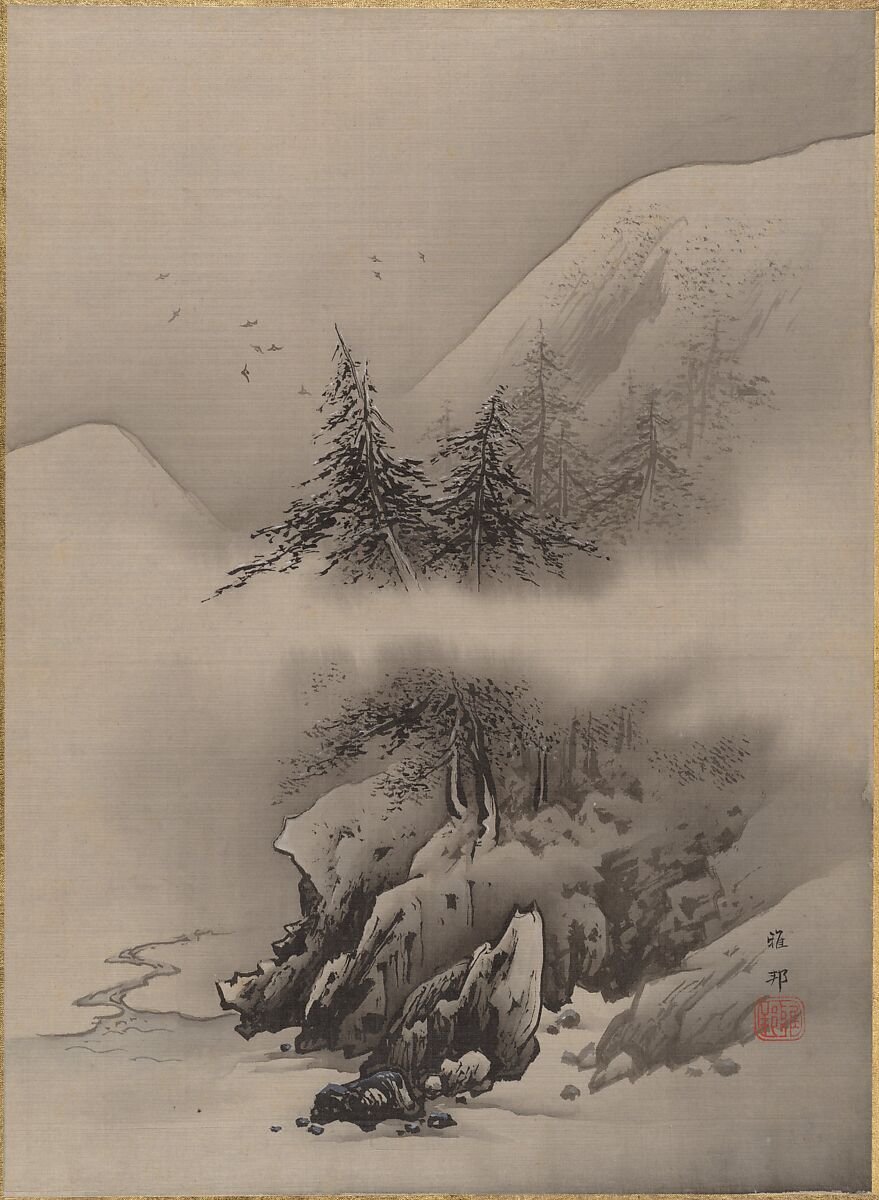
Ike no Gyokuran painted the way a good sketcher writes: fast, with a loaded brush, trusting the paper to hold the rest. A peony becomes a few looping outlines, bamboo leaves are single pressed strokes, a mountain is a cluster of dots in red and green. Nothing is fussed over, yet each picture has a clear shape and a calm centre of gravity. For designers who work with hand-drawn marks, brush lettering or loose illustration, her scrolls are a study in how much finish a picture actually needs.
Who was Ike no Gyokuran?
Her birth year is given as 1727 by the Philadelphia Museum of Art’s 2007 exhibition and by the Denver Art Museum, and as 1728 by the Metropolitan Museum of Art’s collection data and the Philadelphia museum’s own object records. All agree that she died in 1784. She appears under several names: Machi as a child, Tokuyama Gyokuran from her family name, and Ike Gyokuran after her marriage.
She came from a family of women in Kyoto’s Gion district. The Denver Art Museum describes three generations, Kaji, her adopted daughter Yuri, and Yuri’s daughter Machi, who later became Gyokuran, as the “Three Women of Gion”, linked to a teahouse called Matsuya where lovers of art and poetry met. Kaji and Yuri were poets and calligraphers, and the museum calls the line a matriarchal artistic lineage.
Gyokuran married the painter Ike Taiga (1723–1776). The Philadelphia Museum of Art’s exhibition materials describe the couple living and working in a small studio next to the Gion shrine in Kyoto, and the Met’s catalogue entries place their home and studio by the shrine as well. They made some calligraphy jointly and explored Chinese themes such as the scholar-recluse together, according to the Philadelphia museum. Our guide to Ike no Taiga covers his side of that partnership.
A label at the Philadelphia Museum of Art notes that she was one of very few women included in the Edo-period directory Heian jinbutsu shi (Who’s Who of Kyoto), recognised mainly as an artist, though she also composed waka poetry.
Key works and dates
- Spring Landscape, c. 1750–1760, Philadelphia Museum of Art. A lake scene with pale blue-green willows and white plum blossom.
- Blossoming Plum, mid-1700s, ink on paper, Denver Art Museum (2018.208).
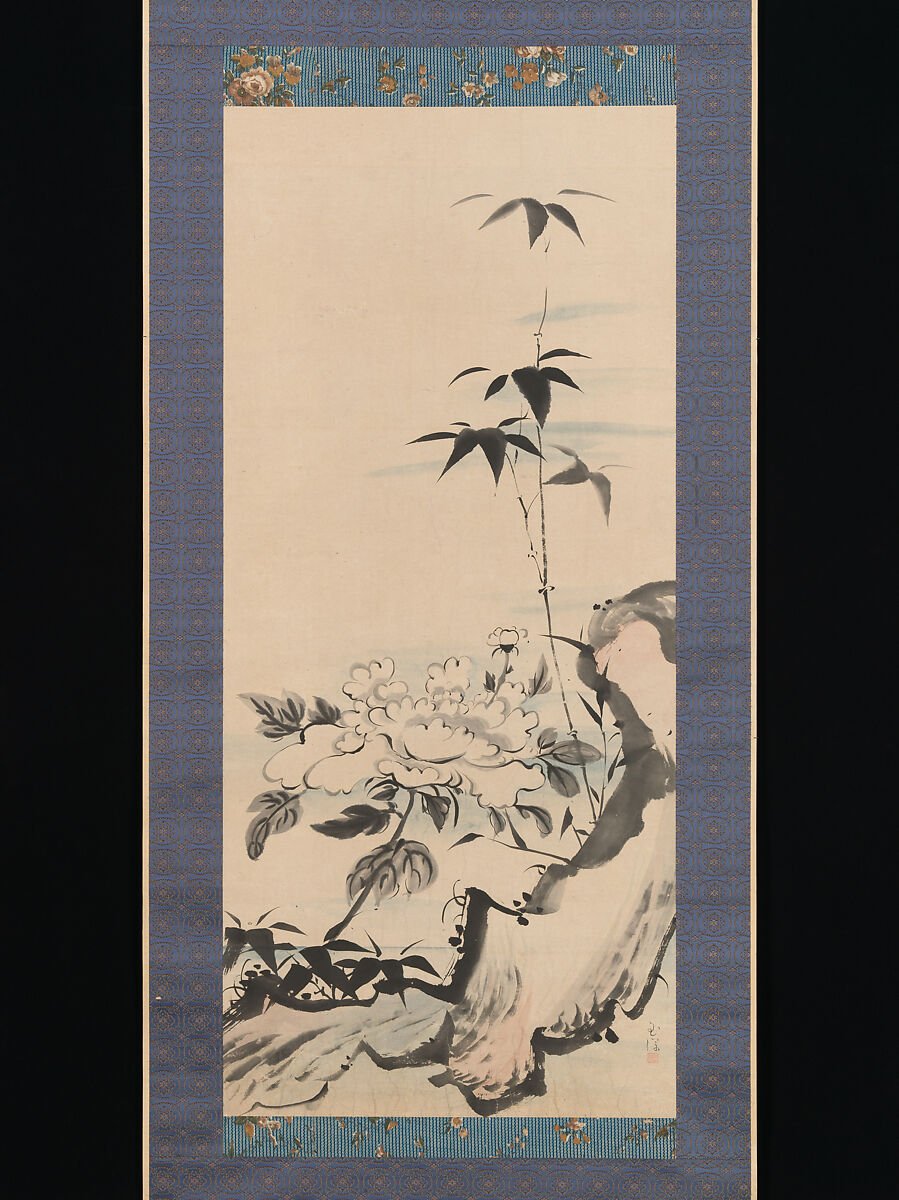
- Peony and Bamboo, ca. 1768, hanging scroll, ink and colour on paper, image 93 × 41.7 cm, the Metropolitan Museum of Art (2015.300.169).
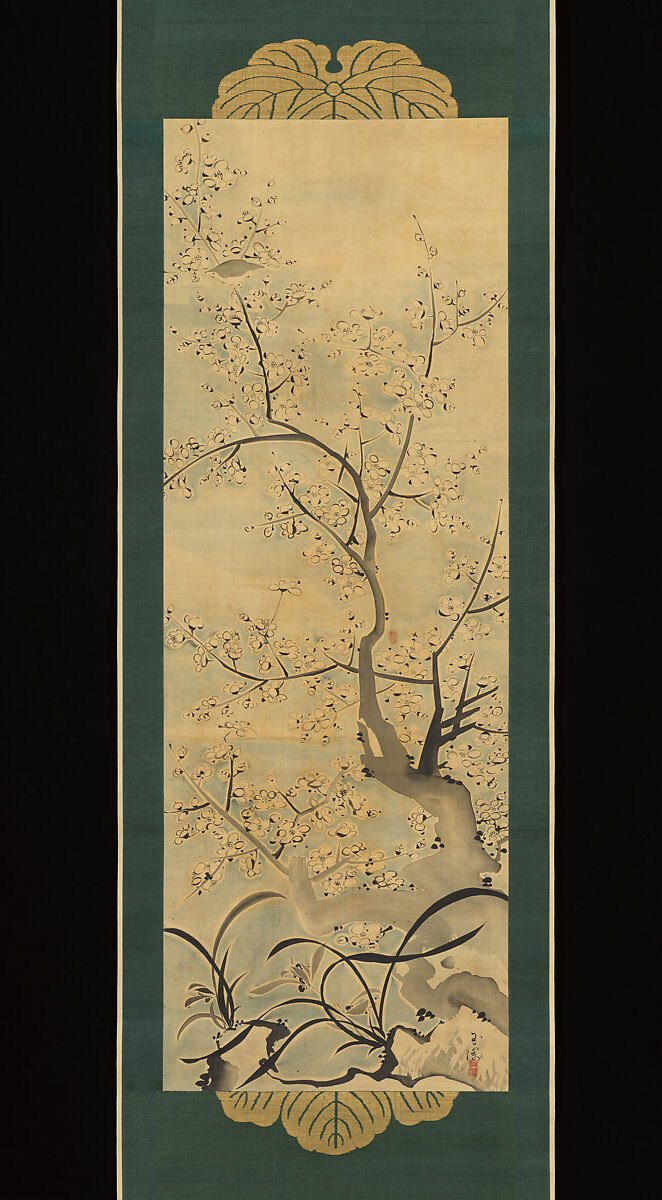
- Warbler in a Plum Tree, mid- to late 18th century, hanging scroll, ink and colour on silk, image 122.2 × 43.4 cm, the Met (2025.618.1).
- Autumnal Landscape with a Waterfall, second half of the 18th century, fan painting mounted as a hanging scroll, ink and colour on paper, 19.1 × 52.3 cm, the Met (1975.268.95).
What to look at in Ike no Gyokuran’s paintings
A tall format, weighted low
Peony and Bamboo is a narrow vertical. The heavy shapes, a grey rock and the peony, sit in the lower third; the bamboo rises from there in a thin line to a few dark leaves near the top. The upper half is almost empty. That arrangement gives the tall format a firm base and lets the eye travel upward along one stem, the same way a good poster leads from a heavy image to a light headline.
Two speeds of ink
The peony petals are pale, wet outlines, barely there; the bamboo leaves are dense, dark strokes made with one press and lift of the brush. The rock is a broad grey wash with a few darker marks. Measured from the museum’s scan of this scroll, the paper reads around #ddc5aa and the mid ink around #7f7364, with the bamboo leaves much darker. The contrast between the faint flower and the crisp leaves gives the picture its rhythm.
Pattern from repetition
In Warbler in a Plum Tree, the white blossoms are small, near-identical marks scattered over the branches, and they turn the whole upper scroll into an even, all-over pattern. A single small bird near the top gives the eye a place to land. The trunk zigzags up the centre, and grasses and orchids close the composition at the bottom. Measured from the museum’s scan, the toned silk reads around #d1b57e and #b09f72, with the branches near #806e4f.
Signature as part of the layout
On both Met scrolls, a short signature and small seal sit low at the right edge, tucked next to the rock or the roots. They are small enough not to compete, but placed where the composition would otherwise feel open, which is a good model for where to put a credit, a logo or a caption.
Technique: Nanga brush, paper and silk
Gyokuran worked in Nanga, the Japanese version of Chinese literati painting, which the Philadelphia Museum of Art describes Taiga and Gyokuran as developing together, adapting Chinese sources rather than copying them. The literati tradition favoured subjects tied to poetry and scholarship; the Denver Art Museum notes that the plum, one of her subjects, is among the Four Gentlemen of literati painting, with bamboo, chrysanthemum and orchid.
Her works at the Met show the range of grounds she used: paper for Peony and Bamboo, silk for Warbler in a Plum Tree and a folding-fan sheet for the autumn landscape. On paper, the ink spreads and leaves soft edges; on silk, washes lie more evenly and the ground colour shows through.
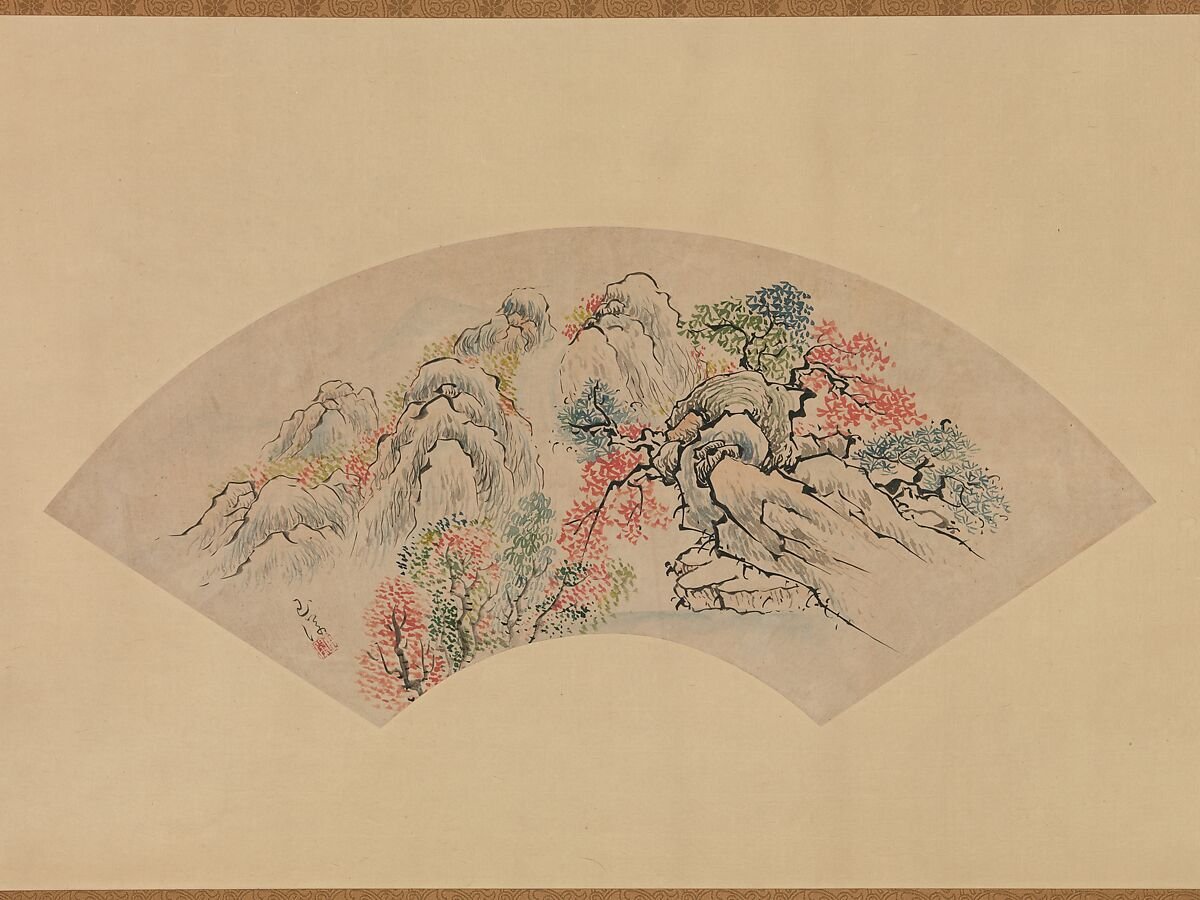
The fan painting is the clearest lesson in her colour. The rocks and waterfall are outlined in quick, broken ink; the autumn trees are built from separate dabs of red, green and blue placed side by side, with paper showing between them. The dense, coloured trees gather in the centre and right of the curved sheet, while the left end holds only faint, pale peaks, so the fan reads from light to heavy. Measured from the museum’s scan, the paper sits near #cdb38d, the ink outlines near #8a7259 and the muted red foliage near #9b6f56. The Philadelphia Museum of Art’s 2007 exhibition included album and fan paintings by the couple alongside screens and scrolls, a reminder that small formats were central to this kind of painting.
How designers can borrow from Ike no Gyokuran
- Weight tall layouts at the bottom. For vertical banners, phone screens or book covers, put the heaviest shape low and let one thin element lead upward into open space.
- Mix wet and dry marks. Pair a faint, loose outline with a few dense, decisive strokes. Hand-drawn icons and brush illustrations gain clarity when not every line has the same weight.
- Make pattern from one repeated mark. Scatter a simple shape, like her blossoms, to create texture, then add one different element as a focal point.
- Build colour from separate dabs. The fan’s foliage keeps red, green and blue apart on a pale ground. Try the same approach for lively illustration palettes, and sample the museum scans with our image colour picker.
- Place the signature where space needs anchoring. Treat a logo or credit as a compositional weight, not an afterthought.
Brush lettering is a natural companion to this kind of painting; our guide to Japanese calligraphy covers the brush and the script, and our overview of Japanese art sets Nanga in its wider history.
Where to see Ike no Gyokuran’s work
The Metropolitan Museum of Art holds the three works shown here, flagged public domain in its open-access data. The Philadelphia Museum of Art and the Denver Art Museum also hold paintings by her; check each museum’s rights statement before reproducing their images. For more cleared works from Japan and beyond, browse the MGD museum inspiration collection.
Frequently asked questions
Who was Ike no Gyokuran?
Ike no Gyokuran (1727 or 1728–1784), also known as Tokuyama Gyokuran, was a painter, calligrapher and poet in Kyoto who worked in the Nanga, or literati, style with her husband, Ike Taiga.
Who were the Three Women of Gion?
The Denver Art Museum uses the name for Kaji, her adopted daughter Yuri, and Yuri’s daughter Machi, who became Gyokuran, a family of poets, calligraphers and painters linked to the Matsuya teahouse in Gion.
Where can I see Ike no Gyokuran’s paintings in the United States?
The Metropolitan Museum of Art, the Philadelphia Museum of Art and the Denver Art Museum all hold works by her.
Are Ike no Gyokuran’s paintings in the public domain?
The three Met works shown here are flagged public domain in the museum’s open-access data. Other museums set their own image rules.