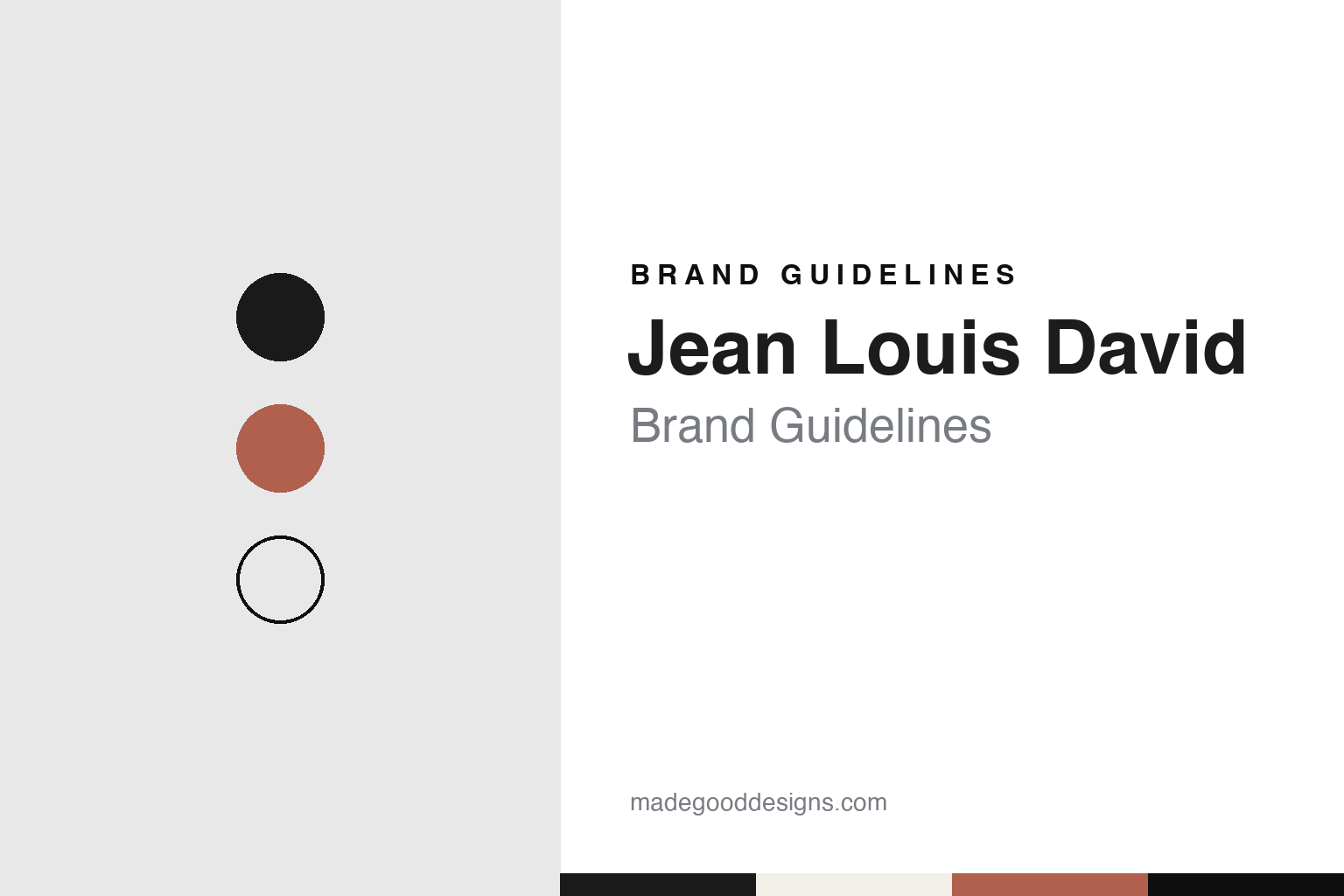
Jean Louis David Brand Guidelines
The 1961 Paris salon that became a franchise network.
Aa
Two constants: a black, ivory and rose clay palette and a Parisian serif register. Abstract homage — not a Jean Louis David salon, product or mark; no logo is reproduced.
Avenue de Wagram
A hairdresser’s own name above a Paris door.
Jean Louis David takes its name from its founder, the hairdresser Jean-Louis David. French Wikipedia says he started out in his family’s salon in Grasse, came to Paris in the 1950s and was recruited by the Gabriel Garland salon near the Champs-Élysées. In 1961 he opened the first salon under his own name, on the avenue de Wagram in Paris.
His reputation grew in the 1960s with the coupe dégradée, a layered cut, and later with other techniques such as the résille, a light highlighting method, French Wikipedia says. The company today writes its name without the hyphen, as Jean Louis David, and says its hairstylists have been reinventing their trade “for more than 60 years.”
The business became a network in 1976, when the Jean-Louis David group was formed and began applying the franchise system to its salons, a model French Wikipedia says he had discovered in the United States two years earlier. By 1995 the group counted 378 salons in France, run by 227 franchisees, and about 700 worldwide, the same article says, in countries including Switzerland, Italy, Spain, Poland, Brazil and Quebec, later followed by Russia and South Korea. The founder’s son, Jean-Christophe David, had been running the company since 1993. The group also launched a range of hair products sold in supermarkets, including shampoos and hair accessories.
Colour
From Regis to Provalliance.
In 2002 Jean-Louis David sold the group, French Wikipedia says. English Wikipedia says Regis Corporation of the United States acquired Jean Louis David in April 2002, when it had about 1,200 locations in France, Italy, Spain, Brazil, Belgium, Switzerland, Poland and the United States; French Wikipedia notes that Regis was then associated with the French Franck Provost group.
That association became formal. In October 2007 Regis agreed to merge its continental European franchise salons with the Franck Provost salon group, and the combined company, Provalliance, began in January 2008, according to English Wikipedia. Twin Cities Business reported in April 2012 that Regis had agreed to sell its minority stake to the Provost family, the majority owners, and that Provalliance ran its salons mainly under the Jean Louis David, Franck Provost and Saint Algue brands.
Jean Louis David has stayed within Provalliance since. In a July 2024 interview with Journal du Luxe, the group’s chief executive, Marc Aublet, listed it among the group’s brands with Franck Provost, Saint Algue and the professional-products distributor Bleu Libellule. He said the group’s salons spread across 30 countries on five continents, that it kept a large share of company-owned salons alongside its franchisees, and that the Jean Louis David salon concept had been reworked and modernised.
Training remains part of the brand. In December 2024 Premium Beauty News reported that Provalliance was launching a training programme for curly, frizzy and coily hair, starting in Jean Louis David salons and extending to the group’s other brands and volunteer hairdressers from 2025. The trade magazine put the group at around 3,000 salons, more than 1,700 of them in France. According to the magazine, the course runs in two cycles of two days each, the first on texture and styling and the second on cutting and colour, and the group has run a separate curl-specialist brand, Niwel, since 2007.
The group behind it has its own starting point. Journal du Luxe dated Provalliance’s story to 1975, when the first Franck Provost salon opened in Saint-Germain-en-Laye, and said the group now works in two divisions, salons and the sale of professional hair products through Bleu Libellule. Its chief executive said the group trains company-owned and franchised teams through its own training centres and an Academy management programme across France.
Typography
Design and documentation.
Hair-salon chains present themselves less through products than through the sign above the door. The names in this guide come from the United States, France, Germany, England, Australia and Japan, and each company publishes its own salon signs, logos and colour schemes; the palettes here are our own reading, not official colours.
The formats vary widely. At one end are walk-in salons built around quick cuts with no appointment, often in strip centres, shopping malls or inside larger stores; at the other are high-street and department-store salons that sell an appointment with a named stylist. Some companies run several banners at once, each aimed at a different customer, so the corporate name and the name on the shopfront are not always the same.
Ownership is just as varied. Some chains are franchise groups, where a franchisor licenses its name to independent salon owners; others are run by their founders’ families or by larger salon groups that combine company-owned and franchised salons. Several have changed hands more than once, and this guide gives those changes as dated facts. For each company it notes when and where the business was founded, who owns it today, how many salons a dated source counts and which banners it trades under, along with any restructuring, closure or change of owner.
Many chains also describe their own training academies, seasonal collections and own-label product ranges, using the names the companies give them, and keep corporate pages on their founders and owners. This guide sets out what each company says about itself, what independent sources record, and the points where the two differ.
Aa
A high-contrast serif for a Paris hairdressing name. (Specimen set in DM Serif Display, a serif STAND-IN; NOT the Jean Louis David logo.)
Jean Louis David
A brand that speaks in campaigns.
The brand presents itself through seasonal collections and campaigns. Its French website, read in November 2026, leads with the Autumn-Winter 2025/2026 collection, the third part of a campaign called “Make a Difference,” and says Jean Louis David worked backstage at the Kenzo spring-summer 2026 show as a beauty partner. On its recruitment page the company calls itself “feminist, bold and committed” and gives its purpose as “freeing the plurality of identities and styles,” in our translation, and states that it is a brand of the Provalliance group.
The salon offer is named in the company’s own terms. Its website describes a Bar à Styles run with the styling-tool maker GHD, a set of curl-focused services, a styling range under the JLD initials and a three-step Gamme Experte professional range. The same site links to separate Jean Louis David websites for Spain, Italy, Portugal, Poland, Mexico and the United States, and invites hairdressers to open a salon under the name.
Across six decades the name on the door has stayed the founder’s, even as ownership passed from the David family to Regis and then into Provalliance alongside Franck Provost.
For a design guide, Jean Louis David shows how a single hairdresser’s name can carry a franchise network through changes of owner, alongside seasonal campaigns. Compare Franck Provost, its sister brand within Provalliance, and Regis, which owned it from 2002. For this guide we use black, ivory and a rose clay with a serif, an unofficial interpretation; no product or logo is reproduced.
Explore & save
Keep Jean Louis David’s identity on hand — save it to a board in the Made Good inspiration library.
Jean Louis David identity set
Pin the Jean Louis David black, ivory and rose clay palette and the Parisian serif register to your own board.
Source & notes
Frequently Asked Questions
What font can I use to match the Jean Louis David look?
This guide describes Jean Louis David’s type as “A high-contrast serif for a Paris hairdressing name”. Its type specimen is set in DM Serif Display from Google Fonts as a stand-in; DM Serif Display is not Jean Louis David’s own lettering.
What colours are in the Jean Louis David palette?
This guide’s Jean Louis David palette is Wagram black #1A1A1A, Ink #0E0E0E, Ivory #F2EEE8, Rose clay #B0604D and Paper #FAF8F5. The tones are the guide’s own unofficial interpretation, not official Jean Louis David hex codes.
When was Jean Louis David founded?
Jean Louis David was founded in 1961 (first salon, avenue de Wagram), in Paris, France.
Who founded Jean Louis David?
Jean Louis David was founded in 1961 (first salon, avenue de Wagram) by Jean-Louis David, hairdresser.
Who owns Jean Louis David?
Jean Louis David today: A brand of the Provalliance group.