Joseph Ducreux spent much of his career painting polite likenesses for the French court, then turned the same skills on his own face and pulled it into a yawn, a grin and a conspiratorial hush. They hold up as design lessons: one face, one gesture, a plain ground and a direct look out of the frame. For illustrators, poster designers and anyone building expressive characters or reaction imagery, Joseph Ducreux is a compact course in how a single pose can carry a whole message.
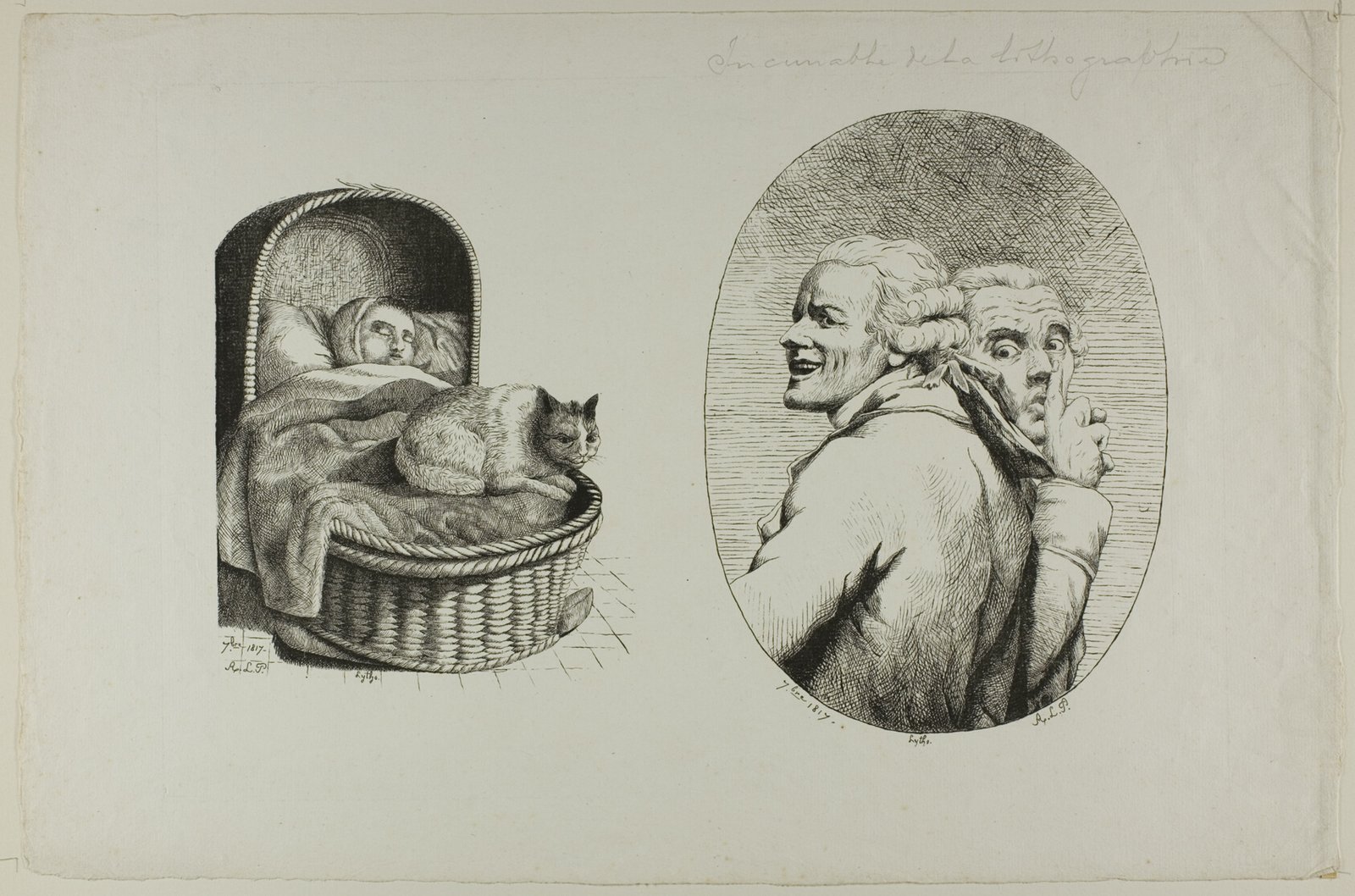
His own self-portraits are not in the open-access collections of the Met, the Art Institute of Chicago or the Cleveland Museum of Art, so this guide pairs a public-domain lithograph made after two of them with a portrait by his daughter. For more public-domain portraits to study, browse the MGD museum inspiration collection.
Who was Joseph Ducreux?
Ducreux was born in Nancy in 1735, as the National Gallery in London and Neil Jeffares’s Dictionary of Pastellists before 1800 both record, and died in 1802. Jeffares traces a family of artists in Nancy and has him moving to Paris around 1760.
The National Gallery and the Musée des Beaux-Arts in Rouen both call him a pupil of the pastellist Maurice Quentin de La Tour. Jeffares notes that the evidence for this is thin and rests largely on a Salon catalogue of 1796, while treating his study of oil painting with his friend Jean-Baptiste Greuze as far more credible; the National Gallery also names Greuze as an influence.
In 1769 he was sent to Vienna to portray the young Marie-Antoinette before her marriage to the future Louis XVI, according to the Rouen museum, the Nationalmuseum in Stockholm and Jeffares, who dates his arrival to February 1769 and his departure to November. Rouen and the National Gallery describe him as the queen’s painter, and Jeffares finds him calling himself “premier peintre de la Reine” by 1780. The Nationalmuseum says he was also made a baron; Jeffares notes that the title is not corroborated. Jeffares adds that he never joined the Académie royale.
In 1791 he was in London and showed work at the Royal Academy, as the National Gallery, the Nationalmuseum and Jeffares all record; Jeffares counts five portraits. Back in Paris, he exhibited at the Salon from 1791 to 1801, according to the Rouen museum, and the Spencer Museum of Art notes that after the Revolution he had to find new patrons in a very different climate. Rouen records that his sitters in these years included Mirabeau, Robespierre and Saint-Just.
Key works by Joseph Ducreux
Self-Portrait, Yawning, by 1783
The J. Paul Getty Museum in Los Angeles dates this oil on canvas to by 1783 (object 71.PA.56), and the Getty’s catalogue gives it at about 114 by 89 centimetres. The Getty describes the artist mid-yawn in a turban and red jacket, one arm stretched out, his body filling the picture. Jeffares connects it with the yawning self-portrait that Ducreux showed in 1783.
Le Discret (Silence), around 1791
The Spencer Museum of Art at the University of Kansas owns this self-portrait, which it records as shown at the Paris Salon of 1791; Jeffares and the Nationalmuseum agree. Ducreux raises a finger to his pursed lips. The Nationalmuseum bought a related canvas in 2019 and describes it as probably a later version of the Salon picture.
The Artist in the Guise of a Mocker, around 1793
In this type Ducreux grins and points straight out of the picture. Jeffares lists a version in the Louvre dated around 1793 and compares the pose to La Tour’s self-portrait pointing to one side; here the finger aims at us instead.
Self-Portrait as a Naval Officer, around 1795
The Musée des Beaux-Arts in Rouen holds this oval oil on canvas and dates it to around 1795; Jeffares lists it as shown at the Salon of 1795. Rouen notes that Ducreux was not a naval officer, so he dressed up for it.
Court portraits and the 1790s
Jeffares lists a chalk drawing of Louis XVI made in the Temple prison on 2 January 1793, now in the Musée Carnavalet in Paris. The National Gallery in London holds a Portrait of a Man that it catalogues as probably by Ducreux and possibly one of the pictures he showed at the Royal Academy in 1791.
What to look at: gesture, gaze and the close crop
Ducreux’s self-portraits fall into four basic types, according to Jeffares: Le Rieur laughing, Le Bâilleur yawning, Le Discret with a finger to his mouth, and Le Moqueur smiling and pointing straight at us. The Spencer Museum adds crying to the repertoire and calls his direct engagement with the audience unusual for the time. The Nationalmuseum counts fewer than twenty known self-portraits, about six of them physiognomic in character.
Look at how little else is in the frame. The 1817 lithograph above, after two of these types, keeps only the grinning head, the hushing figure and an oval of hatching. A single gesture, a hand at the lips or a finger aimed at the viewer, does all the narrative work.
Behind this was the eighteenth-century interest in physiognomy, the idea that character can be read in the face. The Getty, the Spencer and the Nationalmuseum all frame his self-portraits this way, and Jeffares places them in a line from Charles Le Brun’s expression heads to Johann Caspar Lavater. Jeffares also quotes a letter of 1794 in which Ducreux argued that these “tableaux de caractère” were closer to history painting than to portraiture.
Technique: pastel, oil and the view from below
Ducreux worked in pastel and in oil. Jeffares describes his pastel flesh as alternating layers of white chalk, scumbled on, with browns and ochres, giving a distinctive, slightly muddy effect, and notes that he combined smooth, stumped passages with areas of exposed, bold strokes. He also points out that a low viewpoint, looking up at the sitter, recurs throughout the work. Jeffares adds that the same types appeared in pastel, oil and three etchings of himself made in London.
For colour, the lithograph above gives a simple graphic scheme. Measured from the Art Institute’s scan of this impression, the paper reads as a soft warm grey, #c6c4b6, the mid hatching as #a09e8d, and the densest ink as a greenish near-black, #504e40. They describe a photograph of an aged sheet, not the original materials. Test them in the image colour picker against your own scans.
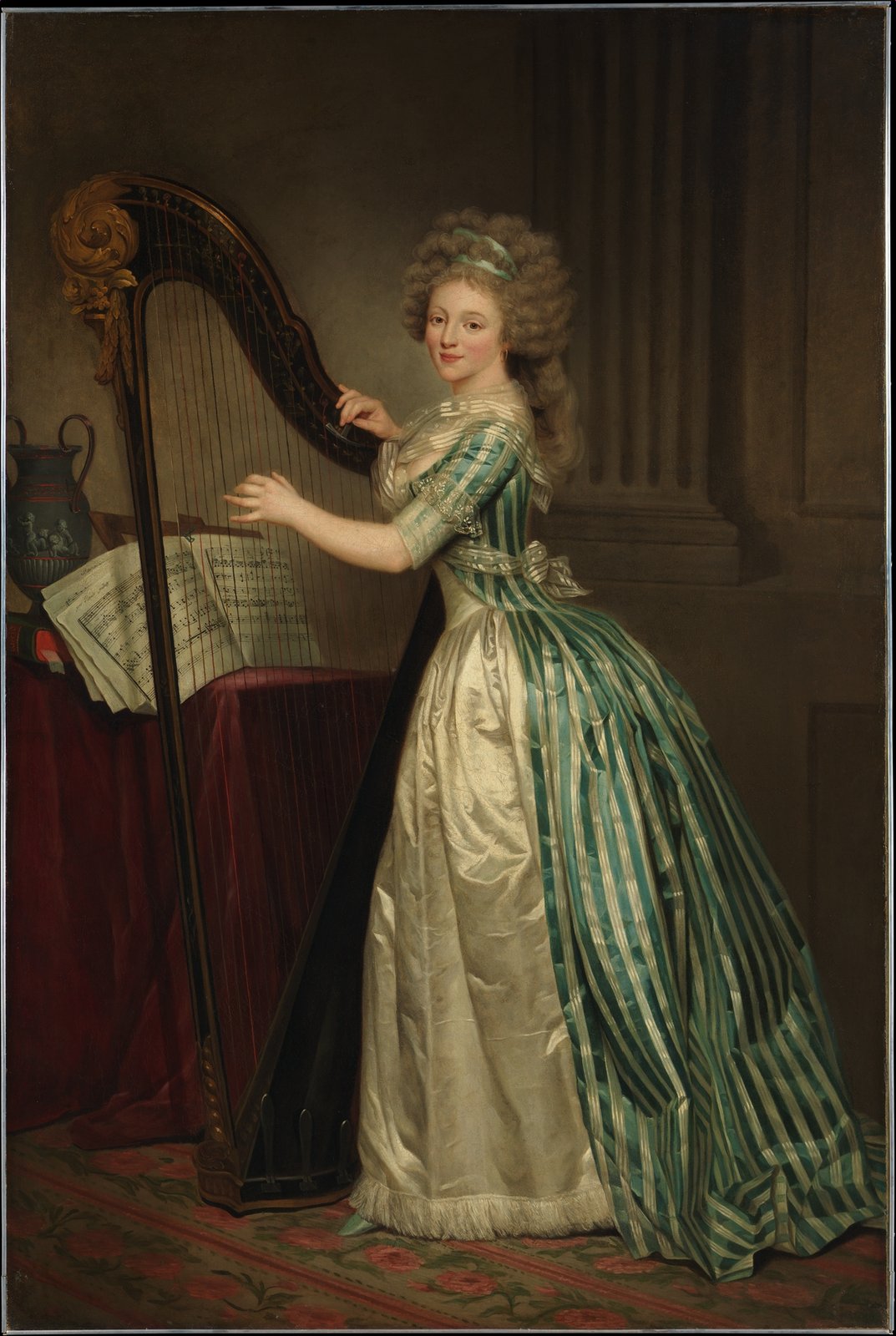
The Met dates Rose-Adélaïde Ducreux’s self-portrait at the harp to 1791; Jeffares records that Ducreux’s daughters Antoinette and Rose were both pastellists. Like her father, she turns from her task to look straight at us.
How designers can borrow from Joseph Ducreux
- One face, one gesture. Build reaction images, stickers or avatars around a single readable action: a yawn, a hush, a point. Crop to head and hand and drop the props.
- Make eye contact. A sitter who looks and points out of the frame turns a portrait into a call to action. The pointing pose works for campaign posters and onboarding screens alike.
- Design an expression set. His four types behave like a character sheet. Plan a family of expressions for a mascot or illustrated guide, drawn at the same scale and crop so they read as a system.
- Keep the ground quiet. A flat or lightly hatched background, like the oval in the 1817 lithograph, gives an expressive face room. Pair a warm grey ground with one dark ink colour.
- Mix smooth and rough. Following Jeffares’s account of his pastels, blend the face smoothly and leave clothing and edges in loose, visible strokes, so attention lands on the expression.
For the court style around him, see our guide to Rococo art, and for the pastellist he is most often linked with, our guide to Maurice Quentin de La Tour. The 1817 sheet above is an early lithograph; our lithography guide explains the process.
Where to see his work
Self-Portrait, Yawning is at the Getty in Los Angeles and Le Discret at the Spencer Museum of Art in Lawrence, Kansas. Jeffares lists versions of the mocking self-portrait in the Louvre’s collection, the naval-officer self-portrait is in Rouen, and the Nationalmuseum in Stockholm holds its later Silence with a companion picture of surprise and terror. The Nationalmuseum also notes that its hushing self-portrait has become a popular online meme, which is how many people first meet the work of Joseph Ducreux today.
Frequently asked questions
What is Joseph Ducreux known for?
He is known for expressive self-portraits in which he yawns, laughs, hushes the viewer or points straight out of the frame, and for court portraits, including his 1769 portraits of Marie-Antoinette made in Vienna.
Where is the yawning self-portrait by Joseph Ducreux?
Self-Portrait, Yawning, an oil on canvas dated to by 1783, is in the J. Paul Getty Museum in Los Angeles.
Was Joseph Ducreux a pupil of Maurice Quentin de La Tour?
The National Gallery in London and the Rouen museum call him La Tour’s pupil. Neil Jeffares notes that the evidence is thin and that his study of oil painting with Greuze is better supported.
Why are his self-portraits so exaggerated?
They reflect the eighteenth-century interest in physiognomy, the reading of character from facial expression. Ducreux used his own face as the model and called these works pictures of character.