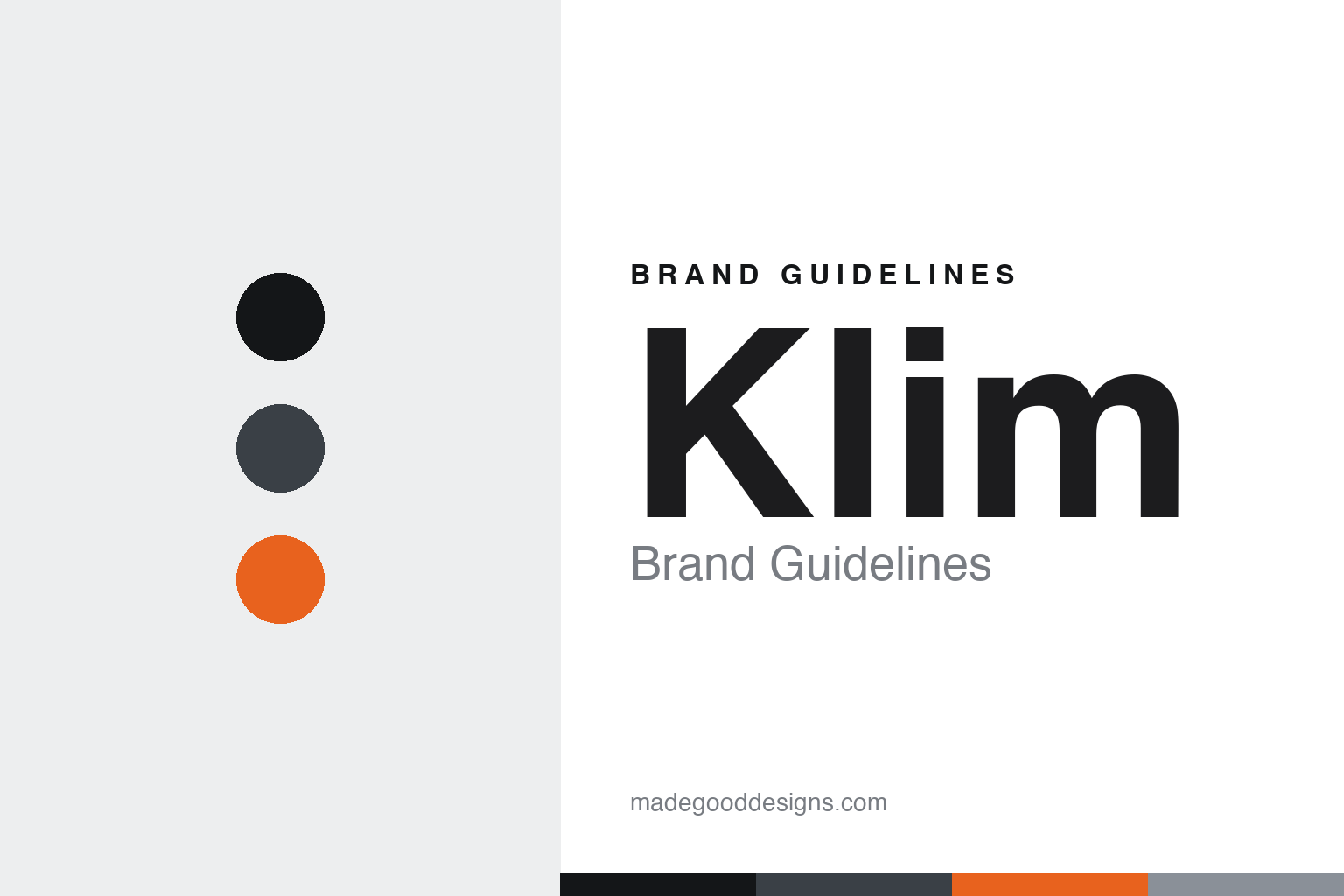
Klim Brand Guidelines
Built for what’s next.
Aa
Two constants: a graphite + hi-vis palette and a condensed technical register. Abstract homage — not the KLIM wordmark or logo.
Built for what’s next
Klim makes serious technical powersports gear.
Klim is a lesson in protection as the whole story. Founded in 1994 by Justin Summers as “Teton Outfitters” (in Salt Lake City), rebranded KLIM in 1999, and based in Rigby, Idaho, it makes serious, high-end technical apparel — starting in snowmobile gear and expanding into off-road and adventure motorcycling.
Its brand identity is technical, aggressive and protection-first — no-compromise gear for snow, off-road and adventure moto, and side-by-side, with a functional, tactical aesthetic (articulated cuts, mapped protection, hi-vis and stealth colourways). It is one of the most GORE-TEX-heavy brands in all of powersports, with D3O armour throughout.
(Honest notes: Klim is not a fashion or lifestyle brand — it’s technical performance and protection. It isn’t independent, either: it has been a wholly-owned subsidiary of Polaris Inc. since 2012. And there’s no official brand hex, so the tones here are an unofficial interpretation.)
Colour
Klim lives in a graphite-and-hi-vis palette. Click a swatch to copy the hex.
Klim’s identity is technical, tough and high-contrast — an ink, a graphite, a hi-vis orange, a steel, and a snow. The palette pairs a hard graphite with a hi-vis orange — the register of protective powersports gear and safety visibility. It signals toughness, protection and performance rather than fashion. The honest caveat: with no published brand hex, these tones are an original, unofficial interpretation, not first-party values.
The lesson is graphite plus a hi-vis accent signals protective, technical gear. Klim’s world is an adventure bike at speed in bad weather. For designers, it is a reminder that a hard grey with a hi-vis pop reads as technical and safety-first — right for a powersports brand. The takeaways: work in a hard grey scale; add a hi-vis accent; and treat any single hex as unofficial — using ink for small text so the palette stays tough.
Typography
The register is a condensed technical sans — tough and utilitarian.
Klim’s identity carries a technical, tough, utilitarian spirit — protection and performance. A bold, condensed technical sans captures the mood: it is high-impact and industrial, the register of a protective gear brand. Set in a graphite-and-hi-vis palette, the condensed technical sans feels tough and utilitarian — exactly the personality Klim carries. It is engineered rather than styled, mirroring armoured gear. (Klim’s real bold all-caps wordmark is a trademark we describe but do not reproduce, and the exact brand typeface is not ours to use.) Because the mark is not ours to use, the honest description is “a condensed technical spirit,” shown here in a stand-in. The type behaves like the brand: technical, tough and utilitarian.
Aa
A condensed technical spirit — tough and utilitarian. (Specimen set in Saira Condensed, a condensed technical STAND-IN; NOT the KLIM wordmark, which is a trademark.)
Protection as identity
Klim stands for technical powersports protection.
Klim is a lesson in making protection the identity. A graphite-and-hi-vis palette, an aggressive technical aesthetic and no-compromise gear make protection the whole brand — tough, technical, performance-first. The protection is the differentiator. The differentiator is a technical, powersports, protection identity.
For designers and brand-builders, Klim offers a clear takeaway: a job to be done can be a brand. The lessons: solve a hard problem (staying dry, warm and protected at speed); partner for the best tech (GORE-TEX, GORE-TEX Pro, D3O armour); and look the part (functional, tactical, high-vis). It is also a reminder to stay accurate: it’s a Polaris subsidiary since 2012 (not independent), it was founded as Teton Outfitters in 1994 (renamed 1999), and the palette here is an unofficial interpretation. Klim made protection the brand — proof that a job can be the difference.
Explore & save
Keep Klim’s identity on hand — save it to a board in the Made Good inspiration library.
Klim identity set
Pin the graphite-and-hi-vis palette and the condensed-technical register to your own board.