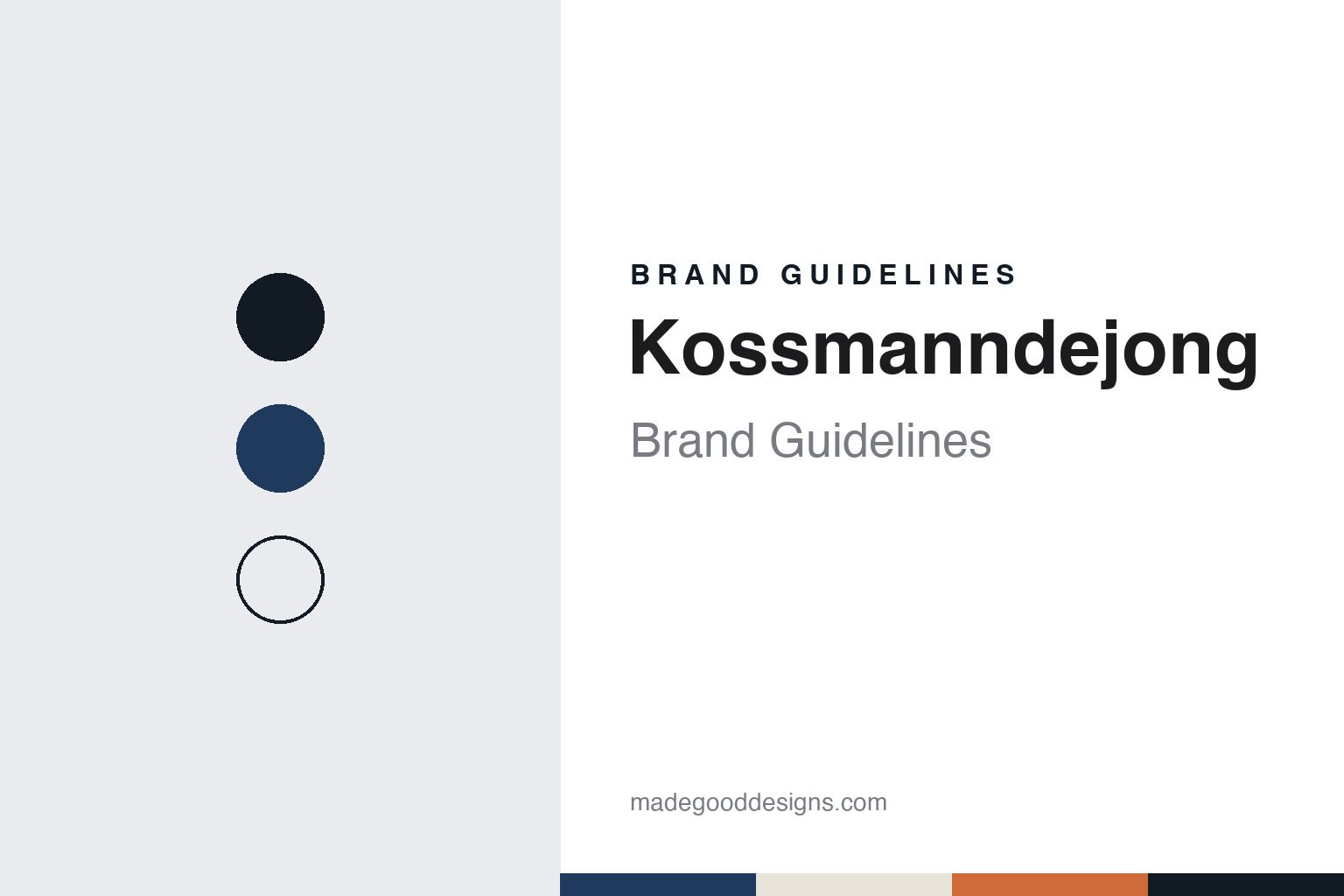
Kossmanndejong Brand Guidelines
The Amsterdam studio that turns stories into rooms.
Aa
Two constants: a Kossmanndejong harbour blue and brick orange palette and a Grotesque sans register. Abstract homage — not a Kossmanndejong project or mark; no exhibition, logo or graphic is reproduced.
Two founders
Herman Kossmann and Mark de Jong in Amsterdam.
Kossmanndejong is an exhibition design studio in Amsterdam, named after its two founders, Herman Kossmann and Mark de Jong. Sources differ on the year it began. The studio itself says it was founded by the pair in 1995, and its Dutch-language website says that what began with Kossmann and De Jong in 1995 has grown into a practice with more than thirty years in the field. Dutch Wikipedia gives the founding year as 1998. Both dates are given here.
The name has been written in more than one way. The studio now spells it as a single word, Kossmanndejong, and Dutch Wikipedia adds that it is often shortened to KDJ. Older press coverage, such as a 2016 report by Museums + Heritage, and the project pages of collaborators wrote it with a dot, as Kossmann.dejong. This guide uses the single-word form the studio uses today.
By the studio’s account, its early work was not for museums but for municipalities: projects, it says, without collections, curators or even buildings. Its later portfolio, as Dutch Wikipedia describes it, covers exhibitions, museums, visitor centres and temporary presentations, for cultural institutions as well as commercial and public organisations, mainly in Europe and Asia. The studio describes its own subject as the “spatial story,” and its website lists services in three groups: strategy, design and production, from master planning and content development to graphic design, wayfinding and production supervision.
The practice remains based in Amsterdam, near the central station. Its team page lists spatial designers, graphic designers, content developers, project managers and office staff, and the studio says it has a team of more than 30 people.
Colour
Microbes, rain and a theatre’s history.
Among the studio’s projects is Micropia, the museum of microbes at Artis, the Amsterdam zoo. The Berlin media studio ART+COM, which worked on the project, says on its project page that the exhibition was designed by Kossmanndejong in close collaboration with ART+COM: Kossmanndejong was responsible for the overall exhibition concept and scenography, while ART+COM conceived, designed and built the media exhibits. Kossmanndejong dates the project to 2014 and gives its area as 850 square metres. It says it chose a dark, theatrical setting rather than white walls and sterile lighting, so that the space would feel nothing like a laboratory and the light would come from the exhibits themselves.
In December 2016 Museums + Heritage published an account of The Play’s The Thing, a permanent exhibition about the Royal Shakespeare Company in the Swan Wing of its theatres in Stratford-upon-Avon, the oldest part of the complex, built in 1879. The studio acted initially as concept designer and later as creative director, working with the company’s exhibitions team and the fit-out firm The Hub. The main exhibition room measured 120 square metres; Mark de Jong, then the studio’s creative director, described a central core of interactive pieces surrounded by walls of stories and objects from the company’s collection.
For Expo 2020 Dubai, which ran from 1 October 2021 to 31 March 2022, the studio designed the visitor experience of the Netherlands pavilion. Dezeen reported in October 2021 that the pavilion, by V8 Architects, was built around a cone with its own water, energy and food system, and that the elements were tied together by Kossmanndejong, which, according to De Jong, wanted to “tell the building’s story in a poetic and sensorial way.” Inside the cone, Dezeen wrote, water harvested from the desert air fell as rain on visitors. The studio says it made the pavilion’s multimedia sequence with the film company BIND, projecting a story onto white umbrellas before the rain fell from 18 metres up.
More recently the studio credits itself with the permanent exhibition at the Haus der Geschichte in Bonn, which it dates to 2025 and which it divides into four eras, each with its own spatial metaphor, starting from personal objects.
Typography
Design and documentation.
Exhibition, museum and experience-design studios rarely sell a product with their name on it. What they publish instead is a body of work: galleries, visitor centres, pavilions and installations, each credited to the studio by the museum, the client or the trade press. A guide to their identity therefore starts with how they present that work, and with the names and wordmarks on their own websites.
Several of these practices are named after their founders or partners, and some shorten a longer name to initials: Ralph Appelbaum Associates calls itself RAA on its own site. Their websites show a wordmark, a project list and a few pages on the practice. Founders and partners appear in a professional role, as creative directors or principals, and team pages can list designers, content developers and model-makers alongside them, as Casson Mann’s does.
The project case study is the core format. A typical page names the client and the opening date, then shows the gallery graphics, wayfinding, display furniture, projections and interactive installations that make up the scheme; Casson Mann’s pages call this mix its scenography. Independent coverage, in titles such as Museums Journal, Blooloop and national newspapers, is the surest way to date and credit a project, because a single building can involve more than one design firm: English Wikipedia credits the conversion of the IKEA Museum in Älmhult to both WilkinsonEyre and Ralph Appelbaum Associates.
Corporate pages fill in the rest: office locations, practice history, renamings and, where it has happened, a change of ownership. This guide sets out what dated sources say about each studio, keeps company statements attributed, and leaves out awards and any claims about what an exhibition does for its visitors.
Aa
A grotesque sans — rooms built from stories. (Specimen set in Archivo, a sans STAND-IN; NOT the Kossmanndejong logo.)
Kossmanndejong
A handover to a second generation.
The studio has changed hands within its own ranks. It says that in 2023 it took on three new partners, Robert van der Linde, Femke Bijlsma and Niels de Jong, who now lead it with the rest of the team. In April 2026 the Dutch design news site Dutch Design Daily described the same transition, writing that the founders had stepped back about three years earlier to hand the studio to a new generation. The studio’s team page now lists Kossmann and De Jong as co-founders, designers and advisers, and Van der Linde and Niels de Jong as creative directors.
That transition also produced a book. Make Space for Change, written by Bijlsma and published in 2026 by Jap Sam Books with graphic design by Haller Brun, sets out the studio’s approach to exhibition design, Dutch Design Daily reported.
Its working method, as the studio describes it, runs from strategy through design to production, and many of its projects are made with partner firms: architects such as V8 in Dubai, media studios such as ART+COM at Micropia, and fit-out contractors. Its project pages name the client, year and service for each job, from concept and spatial design to graphic design and production management.
No brand guidelines are published by the studio, and its colours and typefaces are not documented in the sources used here, so the tones and the type below are this guide’s own.
For a design guide, Kossmanndejong shows how an exhibition studio can build a name on the story a room tells rather than on a house style. Compare Atelier Brückner, the Stuttgart scenography studio, and Casson Mann, the London exhibition designers. For this guide we use a harbour blue and a brick orange on a stone ground with a sans, an unofficial interpretation; no product or logo is reproduced.
Explore & save
Keep Kossmanndejong’s identity on hand — save it to a board in the Made Good inspiration library.
Kossmanndejong identity set
Pin the Kossmanndejong harbour blue and brick orange palette and the Grotesque sans register to your own board.
Source & notes
Frequently Asked Questions
What font can I use to match the Kossmanndejong look?
This guide describes Kossmanndejong’s type as “A grotesque sans — rooms built from stories”. Its type specimen is set in Archivo from Google Fonts as a stand-in; Archivo is not Kossmanndejong’s own lettering.
What colours are in the Kossmanndejong palette?
This guide’s Kossmanndejong palette is Harbour blue #1F3A5C, Night ink #121A24, Canal stone #E9E4DA, Brick orange #D06A3A and Paper #F7F5F0. The tones are the guide’s own unofficial interpretation, not official Kossmanndejong hex codes.
When was Kossmanndejong founded?
Kossmanndejong was founded in 1995 (studio’s date); 1998 (Dutch Wikipedia), in Amsterdam, Netherlands.
Who founded Kossmanndejong?
Kossmanndejong was founded by Herman Kossmann and Mark de Jong in 1995 (studio’s date); 1998 (Dutch Wikipedia).