Laura Alma-Tadema painted rooms where very little happens, and that is the point. A child visits a woman resting in bed; a girl dances while her mother watches; someone knocks at a door. Laura Theresa Alma-Tadema, born Laura Epps, set most of these scenes in interiors modelled on seventeenth-century Dutch painting, with panelled walls, tiled floors, maps and leaded windows. For designers, her pictures are a study in how architecture, pattern and light can carry a quiet story without any drama at all.
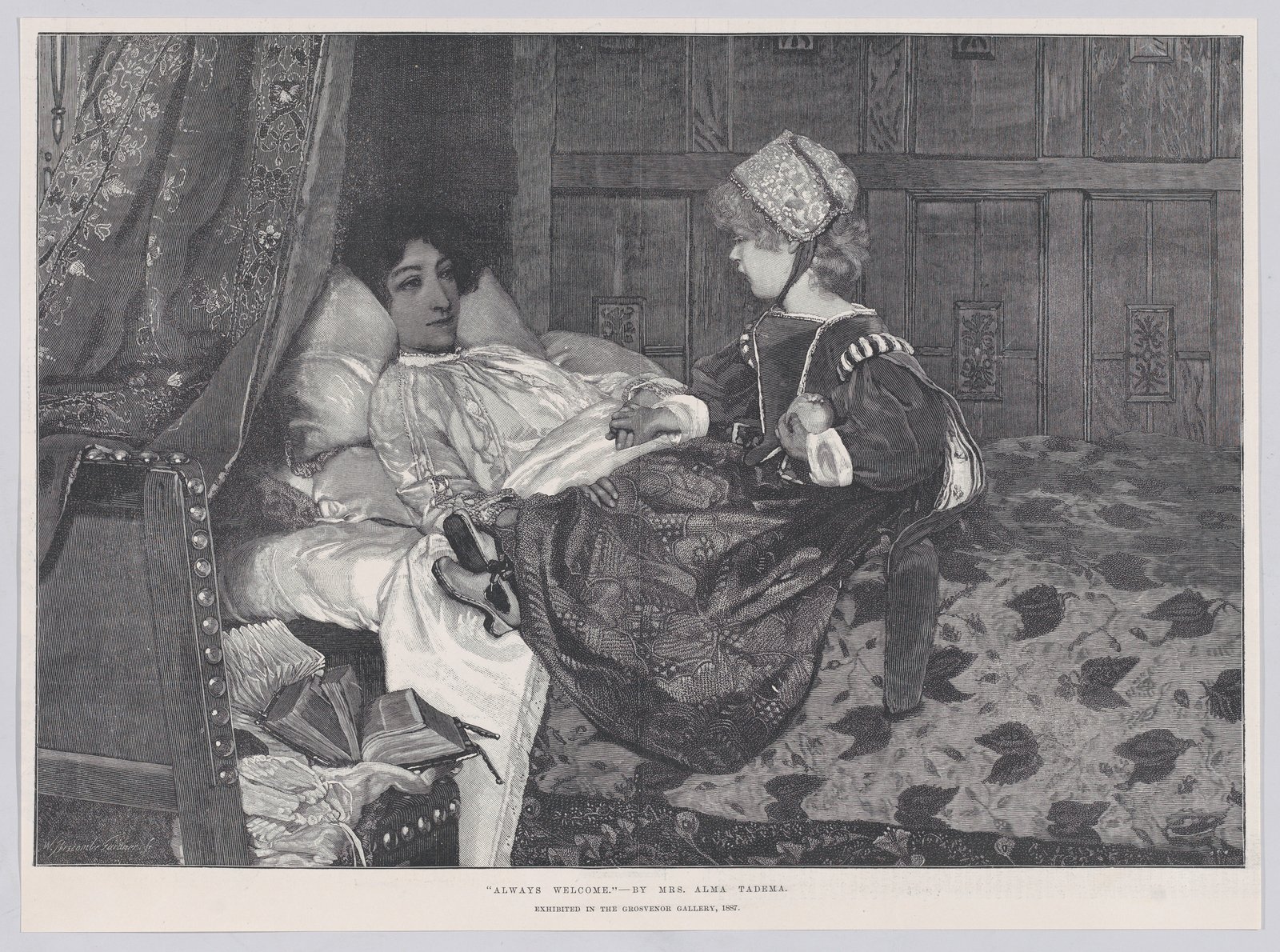
The Metropolitan Museum of Art holds a public-domain wood engraving that reproduced one of her paintings in the Illustrated London News in 1888. It is the only image here; her paintings themselves are described in text with the collections that hold them. For more cleared imagery from the period, browse the MGD museum inspiration collection.
Who was Laura Alma-Tadema?
She was born Laura Theresa Epps in London in 1852, the youngest daughter of the homeopathic doctor George Napoleon Epps, as recorded by Jacqueline Banerjee for the Victorian Web and by Howard Oakley in his essay on her work. An older sister, also a painter, married the writer Edmund Gosse.
She met the Dutch-born painter Lawrence Alma-Tadema in December 1869 at the London home of Ford Madox Brown. When Alma-Tadema settled in London in 1870, he took her as a pupil, and they married in July 1871, when she was nineteen. She became stepmother to his two daughters from his first marriage, Laurence and Anna; Anna also became a painter.
Her exhibiting career began in 1873, when, Oakley records, she showed at the Paris Salon and began exhibiting at the Royal Academy in London. In 1878 she showed at the Exposition Universelle in Paris, where, according to Oakley, she was one of only two British women artists included; Banerjee also records her as one of two women shown. She also exhibited at the Grosvenor Gallery, as the caption of the Met’s engraving records. The couple later lived in a large house in Grove End Road, St John’s Wood.
Banerjee notes that illness broke her health in the years before her death. She died at Hindhead, Surrey, in August 1909, three years before her husband. A memorial exhibition of her paintings was held at the Fine Art Society in London in 1910, and The Studio published a tribute to her work the same year.
What to look at in a Laura Alma-Tadema interior
- The room as the frame. Her figures sit inside a clearly built space: panelled walls, doorways, alcoves and windows. The architecture does the job a border does on a page, holding the scene together and telling you where to look.
- Thresholds. Doors and windows recur in her titles, from A Knock at the Door to At the Doorway and A Looking Out o’ Window. A threshold divides the picture into inside and outside, near and far, and gives the eye a second destination.
- Pattern against plain. In Always Welcome, an embroidered bed curtain and a coverlet scattered with large leaf motifs sit against flat, plain panelling. Busy surfaces are kept to textiles, while walls stay calm.
- Dutch props with a purpose. The Rijksmuseum’s description of Airs and Graces notes that its clothing, jewellery and setting draw on seventeenth-century Dutch painting, with light and a wall map that recall Vermeer. Oakley points out Dutch painted tiles in The Bible Lesson and family monograms worked into the floor tiles of Battledore and Shuttlecock.
- Children at eye level. Banerjee describes her treatment of child life as showing “tender sensibility”. In Always Welcome, the child is placed at the same height as the woman’s face, and their joined hands sit near the centre of the composition.
- An inscription as a signature system. She numbered her paintings with Roman opus numbers. The Rijksmuseum records the inscription “Op CX” on Airs and Graces, signed in full “Laura Theresa Alma Tadema”.
Reading the engraving: Always Welcome
The print in the Met was engraved on wood by William Biscombe Gardner and published in the Illustrated London News on 19 May 1888. Its printed caption names the picture as “Always Welcome” by Mrs. Alma Tadema, exhibited at the Grosvenor Gallery in 1887. It is a reproduction of her painting, translated into line by a specialist engraver, not a print she made herself.
The composition is a lesson in layering. On the left, a heavy embroidered curtain and a studded chair frame the bed. In the middle, a woman rests against pillows, turning towards a small child in a patterned cap and puffed, striped sleeves who sits on the coverlet holding an apple. Behind them, square wooden panels run across the whole top half of the picture, a quiet grid that steadies everything below. Books and papers spill from a stool in the lower left corner, the one patch of disorder.
Measured from the museum’s scan of this impression, the paper reads as a warm off-white around #EAE1D9, the deepest ink areas as a soft charcoal around #484649, and the main mid-tones as greys near #8C8988 and #B7B4B0. These are the tones of a printed newspaper page today, not the colours of her original oil.
Gardner had to render satin pillows, carved panels, embroidery and a leaf-patterned coverlet using nothing but black lines of different weights. Look at how the satin is built from long, fine parallel strokes, while the coverlet uses short hatching broken up by solid dark leaves. Texture is created by changing line rhythm, not by adding colour.
Key works, with dates and collections
- Always Welcome, exhibited at the Grosvenor Gallery in 1887 and engraved for the Illustrated London News in 1888 (engraving in the Metropolitan Museum of Art).
- Airs and Graces, Opus CX, oil on canvas, Rijksmuseum, Amsterdam. A girl dances while her mother and a lute player look on. The museum records it as a gift from E. Gosse-Epps.
- A Knock at the Door (1897), oil on panel, Currier Museum of Art, Manchester, New Hampshire. Oakley lists it as Opus 90.
- Sweet Industry (1904), oil on canvas, Manchester Art Gallery, England, purchased in the year it was painted.
- With a Babe in the Woods (about 1879–80), oil, Brooklyn Museum, according to Oakley, who notes it as a rare outdoor subject in her work.
Technique: small panels and close finish
Oil on panel and canvas. Many of her recorded works are modest in size and painted on wooden panel, a smooth support that suits fine detail. Airs and Graces measures 56.5 by 41 centimetres, according to the Rijksmuseum.
Restraint. The 1910 tribute in The Studio, as quoted by Banerjee, describes “a curious restraint in her methods which comes of long schooling”. That restraint is visible in the engraving: no exaggerated gestures, no theatrical lighting, just evenly lit forms in a carefully arranged space.
Light from a side window. Oakley observes that in A Looking Out o’ Window she kept the interior pale, so the room reads brighter than it would in reality. A similar play of window light and interior appears in our guide to Pieter de Hooch, whose courtyards and doorways make a direct comparison.
How designers can borrow from Laura Alma-Tadema
- Build the room before the figure. In editorial layouts, set up a strong architectural grid first, such as columns, rules or a panelled background, then place the subject inside it.
- Use a threshold. A doorway or window inside an image gives a second focal point. In web hero images, a lighter opening behind the subject adds depth without clutter.
- Restrict pattern to one layer. Let textiles or a single surface carry the ornament, and keep the rest plain, as she kept the panelling calm against busy fabric.
- Translate texture into line. For one-colour printing, engraving-style illustration or icon sets, follow Gardner: vary line length and spacing to tell silk from wood from wool. Pull greys from the engraving with our image colour picker to build a warm monochrome palette.
Laura Alma-Tadema and her circle
Her husband’s classical scenes are the obvious comparison; our guide to Lawrence Alma-Tadema covers his marble terraces and Roman interiors. She chose the Dutch home over the ancient world. She met her husband at Ford Madox Brown’s house, and his daughter, the painter in our guide to Lucy Madox Brown, was exhibiting in London in the same early 1870s.
Frequently asked questions
Who was Laura Alma-Tadema married to?
She married the painter Lawrence Alma-Tadema in July 1871, after studying with him. She was his second wife and stepmother to his daughters Laurence and Anna.
What did Laura Alma-Tadema paint?
She painted domestic scenes of women and children, often set in seventeenth-century Dutch-style interiors with panelled walls, tiled floors and windows. Examples include Airs and Graces in the Rijksmuseum and Sweet Industry in Manchester Art Gallery.
Where can I see Laura Alma-Tadema’s work?
Her paintings are held by the Rijksmuseum in Amsterdam, Manchester Art Gallery and the Currier Museum of Art in New Hampshire, among others. The Metropolitan Museum of Art holds a wood engraving of Always Welcome.
Is the Always Welcome engraving public domain?
The Metropolitan Museum of Art flags its impression of the 1888 wood engraving as public domain and offers the image through its Open Access programme. Images of her paintings held elsewhere come under each museum’s own terms.