Legacy Audio Brand Guidelines
The Springfield speaker maker that began as Reel To Real.
Aa
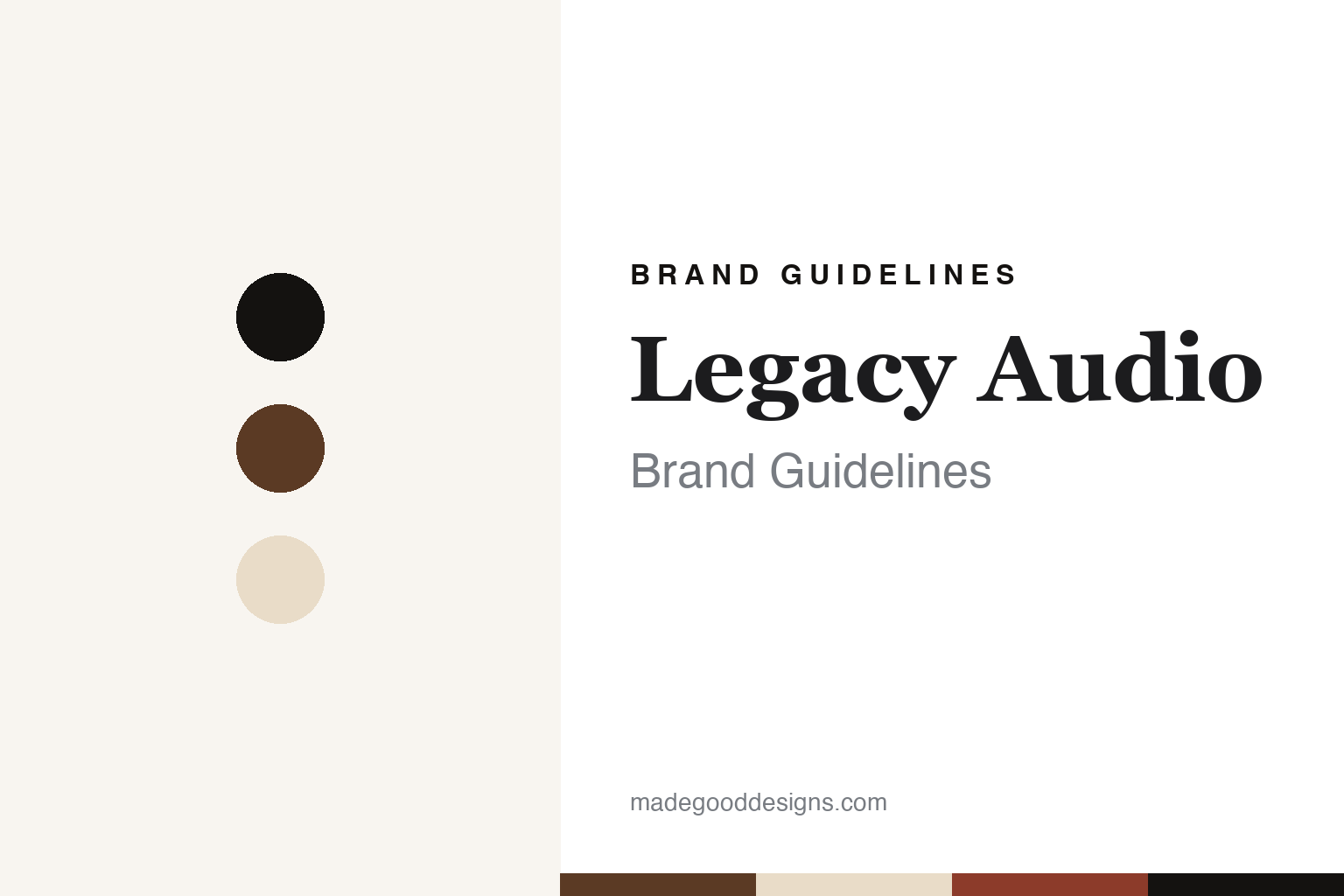
Two constants: a Legacy Audio walnut, cherry and maple palette and a Classic serif register. Abstract homage — not a Legacy Audio product or mark; no loudspeaker, logo or nameplate is reproduced.
Reel To Real
A chemical engineer, a woodworker and a garage.
Legacy Audio began in 1983 in Springfield, the Illinois state capital. Its founder, Bill Dudleston, grew up in the city, and the Illinois Times reported in 2016 that he earned a chemical engineering degree at the University of Illinois in 1981 and took a job at a chemical plant in Tuscola before deciding that a desk-bound career was not for him. He told Audioholics in 2012 that he had been building loudspeakers since he was 13 and recording live performances since 16 on a Revox open-reel machine.
The company did not start under its present name. According to the Illinois Times, Dudleston started it as Reel To Real, in the garage of his father-in-law, Jacob Albright, an accomplished woodworker who signed on as his business partner; Dudleston described Albright to Audioholics as “a seasoned craftsman.” That pairing — physics on one side, cabinetmaking on the other — still sums up the company’s pitch. Its own history credits an early model, the Legacy-1, with spreading word through the audiophile community of “a little company in Illinois” that offered unusual performance for the money.
Growth was steady rather than fast. By 1996 The Wall Street Journal had written about the firm’s attention to customer service, the Illinois Times noted, and a 2001 USA Today profile put it at 25 employees and $3 million in annual revenue. By 2016 Dudleston had 15 employees and said he preferred it that way: “What happens is, it gets industrialized, and I just don’t like that.” The paper counted 18 dealers in the United States and 20 abroad, and a range running from a $1,000 centre speaker to a pair costing nearly $53,000.
Colour
Cabinets in Springfield, drivers from Europe.
Legacy is unusually specific about what it makes itself. In the 2012 Audioholics interview Dudleston said the cabinets are fabricated in Springfield from 1.125-inch MDF, with thicker front baffles on the large towers, and finished in hand-rubbed lacquer over North American cherry, walnut and oak veneers. The Illinois Times reported that cabinets and crossovers are made on site, that each speaker is tuned and played for about two hours before it ships, and that the drive units Legacy does not make are custom-built in Europe to Dudleston’s specifications. The company names its driver suppliers as B&C of Italy, Beyma of Spain, Eton of Germany and Focal of France, with Eminence in the United States for larger woofers, and says its coils are hand-wound and crossover boards assembled in-house.
The engineering has moved steadily toward active speakers. The current range is split between passive models such as the Focus SE, Classic HD and Studio HD and powered “XD” versions of the Focus, Signature, Calibre and Aeris, built around internal amplifiers and digital signal processing. The flagship is the Valor; Legacy also makes the Wavelet preamplifier and room-correction processor and its own iV amplifiers. The Absolute Sound gave the Wavelet II a 2022 Golden Ear award, the company says, and in April 2026 it used AXPONA in Chicago to launch the six-driver Talos tower, the Outkast subwoofer tower and an Artist Series of Aeris XD speakers painted by visual artists.
Studios are part of the story. The Illinois Times reported that the remastering engineer Steve Hoffman used Legacy speakers on reissues of Frank Sinatra, Nat King Cole and Elvis Presley, and that Dudleston counts L.A. Reid and Rick Rubin among his customers. The company also says Aeris XD speakers appear in the season finale of HBO’s The Penguin.
Dudleston told Audioholics that Legacy is “almost purely engineering-driven instead of marketing-driven,” that he rarely designs to a price point or a box size, and that the Springfield facility includes an 1,800-square-foot recording studio, used to voice speakers against live instruments recorded on the spot. The company backs its speakers with a seven-year warranty.
Typography
American loudspeakers, made in America.
The seven loudspeaker makers in this guide are small American companies, most of them built around a single designer. The oldest is Legacy Audio, which Bill Dudleston started in 1983 in Springfield, Illinois, where it remains. It sells through authorized dealers and online, and in 2025 it introduced Jay McArdle as its new owner and chief executive.
Two are in Utah. Tekton Design, run by Eric Alexander, gives its address as Orem and calls its business model “strictly direct-to-consumer.” Spatial Audio Lab, founded by Clayton Shaw, also sells direct, saying dealers “often want a double digit mark-up rate”; the company says Shaw sold its assets to Sam and David Whitt in 2023.
In the Midwest, Salk Sound, Jim Salk’s company, built speakers to order in Pontiac, Michigan, by its own account, and sold them direct. On 15 September 2023 it said it had stopped taking orders and sold its woodworking equipment.
On the coasts, Stereophile places Jeff Joseph’s Joseph Audio on Long Island, New York, and the company’s website sends buyers to dealers. Daedalus Audio, which Lou Hinkley founded in 1992, works from Ferndale, Washington; it says its speakers are sold only direct in the US, with dealers in Australia and Singapore.
The South has Volti Audio. Greg Roberts, who started out rebuilding Klipschorns in Maine, now builds horn loudspeakers in Baxter, Tennessee, selling almost entirely direct.
This guide sets out what can be checked about each brand — who founded it, who owns it, and what it says about where its products are made — and marks clearly what rests only on the company’s own word.
Aa
A classic serif — the register of veneer and hand-rubbed lacquer. (Specimen set in Libre Baskerville, a serif STAND-IN; NOT the Legacy Audio logo.)
Legacy Audio
A new owner, the same factory.
For four decades Legacy was, in its own words, “privately held, family owned and operated.” That has changed. On the company’s About page, published in December 2025, Dudleston introduces Jay McArdle as Legacy’s “new CEO and owner.” He describes McArdle as a businessman based about 65 miles away who built a family business with his brothers into a global audio-integration company, and says the deal came together after his January 2025 trip to Dubai for the Sound Culture Project; the handover began at AXPONA that April. Dudleston says he stays on as chief designer, that the staff were retained, and that “the factory would remain rooted in Springfield with no fundamental changes.” We found no independent trade-press report of the sale in the sources we checked, so these are the company’s own statements; English Wikipedia still lists Dudleston as president.
Legacy’s visual identity leans on the objects themselves: book-matched veneers, solid hardwood corner mouldings and high-gloss finishes that the company says are cured for weeks before hours of hand polishing. No official brand colours or typefaces are published.
For a design guide, Legacy Audio shows how a small Midwestern maker turns workshop credibility — veneer, bracing, hand-tuned crossovers and an open factory door — into its brand. Compare Vandersteen and Thiel. For this guide we use walnut, cherry and maple tones with a classic serif, an unofficial interpretation; no product or logo is reproduced.
Explore & save
Keep Legacy Audio’s identity on hand — save it to a board in the Made Good inspiration library.
Legacy Audio identity set
Pin the Legacy Audio walnut, cherry and maple palette and the Classic serif register to your own board.