Lili Elbe is remembered today mostly through her life story, retold in the 2015 film The Danish Girl. She was also a working artist for more than two decades, and one small drawing from her student years shows how carefully painters of her generation were taught to see. This guide looks at Lili Elbe as a painter: what survives, what it teaches about light and form, and how designers can use those lessons.
Her early work was signed with her birth name, Einar Wegener, and museum records list it that way. This guide uses the name she chose. For more public-domain drawings and paintings to study, browse the MGD museum inspiration collection.
Who was Lili Elbe?
She was born in Vejle, Denmark, on 28 December 1882, according to Denmark’s national encyclopedia, lex.dk, and Biography.com; the Art Institute of Chicago (AIC) gives her birth year as 1883. Biography.com and the Wiscasset Bay Gallery both say she studied at the Royal Danish Academy of Fine Arts in Copenhagen, and Biography.com adds that she met the artist Gerda Gottlieb there.
The two married in Copenhagen on 18 June 1904, as lex.dk records; ARKEN Museum of Modern Art and Biography.com also give 1904. They settled in Paris in 1912, according to lex.dk, Biography.com, AWARE (Archives of Women Artists) and the Lili Elbe Digital Archive at Loyola University Chicago.
Gerda Wegener became known for fashion illustration and stylish portraits of modern women, and Lili was often her model, as the Lili Elbe Digital Archive, AWARE and ARKEN’s exhibition text all record. Lex.dk adds that Lili painted the backgrounds and settings in many of Gerda’s figure paintings. Our guide to Gerda Wegener covers her work in detail.
Transition and later life
In March 1930 Lili went to Magnus Hirschfeld’s Institute for Sexual Science in Berlin, as the Lili Elbe Digital Archive and Biography.com both record. Over the following months she had a series of operations, the first in Berlin and the later ones by Kurt Warnekros at the women’s clinic in Dresden; the Digital Archive counts four over sixteen months. Lex.dk records that she took the name Lili Ilse Elvenes on 9 December 1930, and that the marriage was later declared invalid. Biography.com says she chose the name Elbe after the river that flows through Dresden.
She died in Dresden on 13 September 1931, after her final operation, as lex.dk, Biography.com and the Digital Archive all record. Daily Art Magazine says she sold many of her paintings to pay for the operations and gave up painting in her last years.
Man into Woman and later retellings
Her story was published after her death. According to the Lili Elbe Digital Archive, it appeared in Danish in 1931 as Fra Mand til Kvinde, in German in 1932, and in English in 1933 as Man into Woman, edited under the pseudonym Niels Hoyer by her friend Ernst Harthern. Biography.com also dates the English edition to 1933 under the Hoyer name. The Digital Archive is the companion to a 2020 scholarly edition.
The 2015 film The Danish Girl was directed by Tom Hooper, as Biography.com and the BFI both record; Biography.com notes that it was adapted from David Ebershoff’s 2000 novel. Both are fiction loosely based on her life, not documentary sources.
Key work: Still-Life with Geometric Forms, 1901
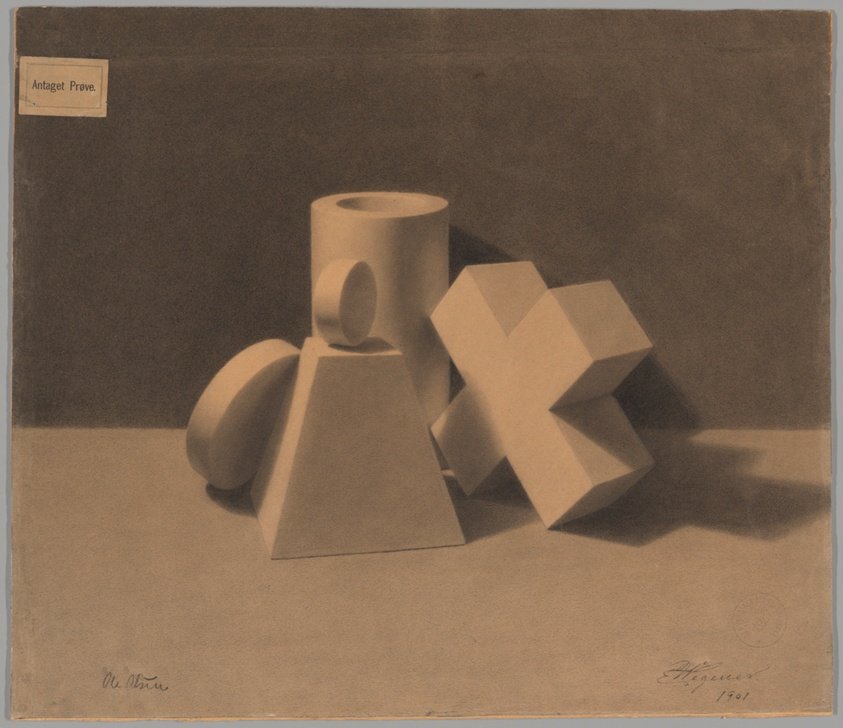
This is the only work by Lili Elbe in the three museum open-access collections used for this guide. The AIC catalogues it as black chalk on tan wove paper, 38 by 44.5 centimetres, signed and dated “E. Wegener 1901” at lower right. According to the AIC, the name at lower left was written by her drawing professor, Ole Olsen, and the label at upper right reads “Antaget Prøve”, which the museum translates as “Accepted Example”. The AIC bought it in 2022, after a sale at Bruun Rasmussen in Copenhagen in 2021, and flags it as public domain.
What to look at:
- Plain solids, one light. A hollow cylinder, a cross, a tapered block, a disc and a small ring sit together on a table, lit from the left. Each surface takes one value: light, half-tone or shade.
- Cast shadows as shapes. The cross throws a long dark shadow to the right. The shadow is drawn as firmly as the objects themselves and balances the composition.
- Overlap for depth. The blocks lean on and cover one another, so the eye reads front to back without any perspective lines on the table.
- A dark, even ground. The wall behind is a smooth, almost flat dark field, which makes the pale blocks read like cut paper.
The exercise is about seeing, not inventing. Nothing in the sheet is decorative: there is no pattern, no colour and no story, only how light falls on plain geometry. That is why it is useful to designers. The same reading of planes and edges sits under every convincing icon, packaging render and isometric illustration, and the drawing shows it at its simplest. The slightly worn edges of the sheet and the label pinned in the corner are a reminder that this was a classroom piece, assessed and kept, rather than a finished picture for sale.
Landscapes and colour
As a mature artist she was known as a landscape painter: ARKEN’s exhibition text calls her “the landscape painter Einar Wegener”, and Biography.com and Daily Art Magazine both say landscapes were her preferred subject. Lex.dk records joint exhibitions with Gerda at Ole Haslunds Hus in Copenhagen in 1919, 1921, 1924, 1927 and 1931. None of her paintings is in the open-access collections of the Met, AIC or Cleveland, so they are described here only in general terms; see our guide to landscape painting for the wider tradition.
Interest in her as an artist has grown with interest in Gerda. ARKEN’s large Gerda Wegener exhibition near Copenhagen ran from 7 November 2015 to 8 January 2017, according to the museum’s text as reproduced by Art Blart, and its text stresses how often Lili posed for Gerda. The 1901 drawing is the only work by her catalogued in the AIC’s collection.
The drawing has no colour as such, but its tones make a ready-made earthy palette. Measured from the AIC’s scan of this sheet (not the original paper and chalk), the dark wall sits near #4d3f35, the table near #9f8063, the lit faces near #b78c64 and the paper overall near #aa8d71. Build a palette from those values in the colour palette generator; it suits packaging, editorial pages and interfaces that want warmth without bright colour.
How designers can borrow from Lili Elbe
- Practise with primitives. The academy exercise of drawing cubes and cylinders is still the quickest way to learn light. Icon designers and 3D artists can start every new style with the same set of solids.
- Limit values. The drawing uses roughly three tones plus paper. Restrict an illustration or UI to three or four values first, then add colour.
- Treat shadow as a design element. A long cast shadow can anchor a product shot or a logo mark and add depth without extra detail.
- Use a tinted ground. Tan paper sits between light and dark, so both highlights and shadows show. A mid-tone background does the same in a slide deck or poster.
- Group simple forms. Overlapping, leaning blocks make a lively arrangement from very little. The same approach works for still-life photography and for composing geometric logos.
Our guide to still-life painting shows how other artists used arranged objects to study form.
Frequently asked questions
Was Lili Elbe a painter?
Yes. She trained at the Royal Danish Academy of Fine Arts and worked as a painter, mainly of landscapes, exhibiting in Copenhagen and living in Paris from 1912. Her 1901 academy drawing is in the Art Institute of Chicago.
What is Lili Elbe known for?
She is known as one of the early recipients of gender-affirming surgery, in 1930–31, and for the book Man into Woman (1933), based on her own papers. She is also known as the partner and frequent model of the artist Gerda Wegener.
Is The Danish Girl a true story?
It is a 2015 film directed by Tom Hooper, adapted from David Ebershoff’s 2000 novel. Both are fiction inspired by the lives of Lili Elbe and Gerda Wegener.
Are Lili Elbe’s works in the public domain?
She died in 1931, and the Art Institute of Chicago flags her 1901 drawing as public domain. Check each museum’s own record for other works before reusing them.