London Toy Fair Brand Guidelines
The BTHA’s trade-only January toy show, from Brighton hotels to Olympia.
Aa
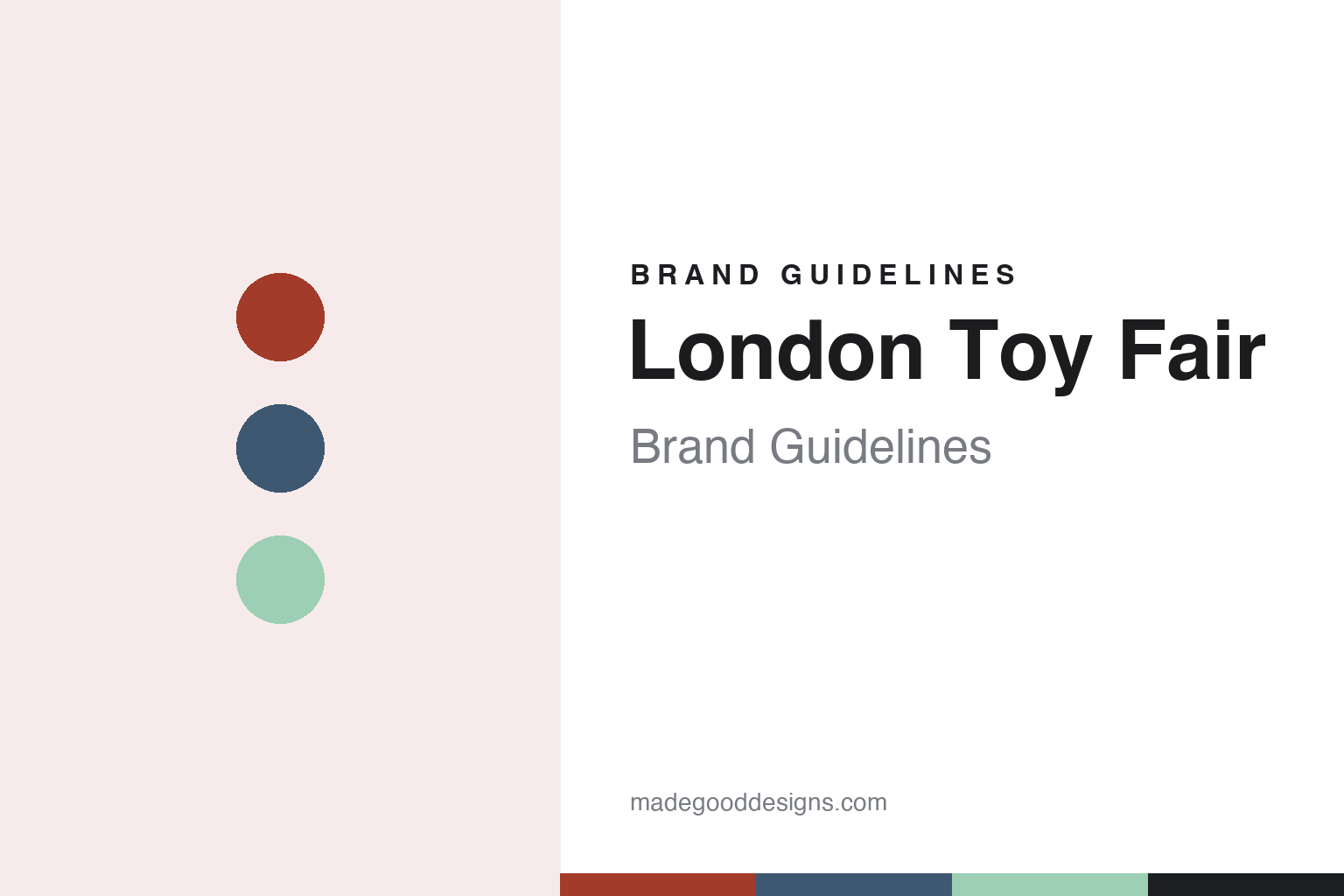
Two constants: a brick red, slate blue and mint palette and a friendly grotesque register. Abstract homage — not a BTHA or Toy Fair asset or mark; no logo or product is reproduced.
Brighton, 1954
A fair that began in hotel rooms by the sea.
London Toy Fair is the trade show for toys, games and hobbies held each January at Olympia London. Its organiser is the British Toy & Hobby Association (BTHA), which Olympia names as organiser on its event page and which holds the copyright on the show’s website. That website calls the show simply “Toy Fair” or “The Toy Fair”; the trade magazine Toys n Playthings files its coverage under the London name.
The fair did not begin in London. According to the history published by the organiser, the first British Toy and Hobby Fair was organised by Jack Watkins for the British Toy Manufacturers Association and held in Brighton from 22 to 26 February 1954. It had no single hall: the exhibits filled rooms in seven hotels, among them the Metropole and the Grand, as well as the town’s Corn Exchange.
The show moved quickly at first. Over the next two years, the organiser says, it went to Olympia and then to Earls Court, as part of the British Industries Fair, before a decision in 1957 to return to Brighton. In the 1960s the fair opened its doors to European manufacturers, and in 1960 it took the name British International Toy Fair.
The 1970s brought a second round of moves and new names. In 1977, the organiser’s history says, the fair moved to the National Exhibition Centre in Birmingham and the association took the name British Toy & Hobby Association; in 1978 the show became the British Toy & Hobby Fair, and in 1979 it moved to Earls Court in London. By its 40th birthday in 1993 it was called the British International Toy & Hobby Fair, and in 1994 it moved to the Grand and National Halls at Olympia.
The next move was to ExCeL London: the organiser says the decision was taken in 1999, and the first Toy Fair there was held in 2001. The show celebrated its 50th birthday in 2003 and returned to Olympia’s Grand Hall in 2010, where it has been held since. It added the gallery level in 2011, part of the new Upper West Hall for its 60th edition in 2013, and the whole Upper West Hall in 2014.
Colour
Strictly trade, three days in January.
Toy Fair is a trade show and says so plainly. Its website describes it as a strictly trade event for members of the toy, game and hobby industry, not for the general public. A children’s policy goes further: exhibitors and visitors may not bring children aged 5 to 15 to the fair unless they are working at the show, in which case the child needs the proper licence from the local authority.
The fair runs for three days in the second half of January. The 2026 show opened at Olympia on 20 January, according to Olympia’s event page. Toys n Playthings reported on 20 January 2026 that more than 250 suppliers were at Olympia that morning for three days of product selection, networking and trend-spotting, and the BTHA’s own release afterwards called it the 72nd annual Toy Fair.
The organiser spells out who comes. Majen Immink, the BTHA’s director of fairs and events, told Toys n Playthings in January 2026 that the audience included buyers, retailers, licensors, inventors and media, and that more than 40 exhibitors would be showing for the first time. The same interview described the Gold Zone, an area for emerging brands, and the return of a Student Design Seminar, in which university design students hear from toy inventors and in-house designers. The organiser later said about 100 product-design undergraduates from five UK universities took part in 2026, and that the show’s final day was again an Influencer Day, when content creators met exhibitors and filmed demonstrations.
The show floor is organised around new product. In its release on the 2026 edition, the BTHA listed the trends it saw on the stands: wearable toys and accessories, plush toys shaped like characters or food, games for all ages and a run of deliberately silly humour across categories, with licensed toys, toys for adult collectors and sensory play products prominent. Those are the organiser’s own observations. The show also has an app for setting up meetings, searching exhibitors and finding a way round the halls, according to both the organiser and Olympia.
Seasonality explains the timing. A January date lets retailers see the year’s new ranges early and plan their buying for the following twelve months, which is how the organiser’s visitor page presents the show’s purpose.
Typography
Trade fairs for play, sound and sport.
Trade fairs for toys, musical instruments and sporting goods tend to name themselves plainly. Most pair the product field with a city or with a single word such as fair, show or expo, so that the name alone tells a buyer what is on offer and where to go. Some keep a word in the language of their home city even when most visitors come from abroad; others have shortened longer official titles to the form people already used.
Many of these events are built for the trade rather than the public. Trade days are usually reserved for retailers, buyers, distributors, manufacturers and press, and some fairs check credentials or set a minimum age at the door. Others are open to the public, either throughout or on particular days, and present themselves more like festivals for players, musicians or riders.
Behind the fairs stand different kinds of organiser: trade associations representing an industry, cooperatives owned by the exhibitors themselves, and exhibition companies that run the halls and sell the space. Dates matter as much as names. A fair tied to the buying calendar may move between seasons when the industry’s order cycle changes, and the month becomes part of how the event is known.
Inside, the halls are usually arranged by product group, so that a visitor can walk from one category to the next. Demonstration areas, play areas, sound booths and test tracks let products be tried rather than only seen. The visual identity often follows a simple pattern: a wordmark or emblem kept from year to year, set beside a key visual, edition number and dates that change with each edition. This guide describes those identities from dated sources and uses colours and type of our own choosing.
Aa
A friendly grotesque for a short, plain show name. (Specimen set in Bricolage Grotesque, a sans STAND-IN; NOT the Toy Fair or BTHA logo.)
London Toy Fair
Four long names, then two short words.
The name has changed more often than the idea. Over seven decades the fair has been the British Toy and Hobby Fair, the British International Toy Fair, the British Toy & Hobby Fair and the British International Toy & Hobby Fair, according to its own history, before arriving at the short form the organiser uses today: Toy Fair. The city is added by others: trade press and visitors quoted on the show’s own website call it London Toy Fair.
Its venues have changed with it. From hotel rooms and a corn exchange in Brighton, the fair moved through Olympia, Earls Court, the Birmingham NEC and ExCeL before returning to Olympia in 2010. Since 2015, the organiser says, it has filled the Grand and West Halls including their upper levels. The organiser marked its 70th anniversary in 2024 with a video on its website.
What stays constant is the format: three days, trade visitors only, new ranges for the year ahead shown in January, and a children’s policy that keeps the halls for working adults even though the products are made for play. The Gold Zone, the student seminar and the Influencer Day are additions around that core rather than changes to it, and each is presented by the organiser as a named area or day of the show.
For a design guide, London Toy Fair shows how a trade show can shed a long official title for two plain words and let the venue city supply the rest. Compare Spielwarenmesse, the toy fair in Nuremberg, and the Hong Kong Toys & Games Fair, two other toy trade fairs. For this guide we use a brick red, a slate blue and a mint on cream with a sans, an unofficial interpretation; no product or logo is reproduced.
Explore & save
Keep London Toy Fair’s identity on hand — save it to a board in the Made Good inspiration library.
London Toy Fair identity set
Pin the brick red, slate blue and mint palette and the friendly grotesque register to your own board.
Source & notes
Frequently Asked Questions
What font can I use to match the London Toy Fair look?
This guide describes London Toy Fair’s type as “A friendly grotesque for a short, plain show name”. Its type specimen is set in Bricolage Grotesque from Google Fonts as a stand-in; Bricolage Grotesque is not London Toy Fair’s own lettering.
What colours are in the London Toy Fair palette?
This guide’s London Toy Fair palette is Brick red #A23B2A, Slate blue #3E5872, Mint #9CCFB4, Ink #1C1E22 and Cream #F6F1E6. The tones are the guide’s own unofficial interpretation, not official London Toy Fair hex codes.