SPIEL Essen Brand Guidelines
The Essen board-game fair that began as a readers’ meeting.
Aa
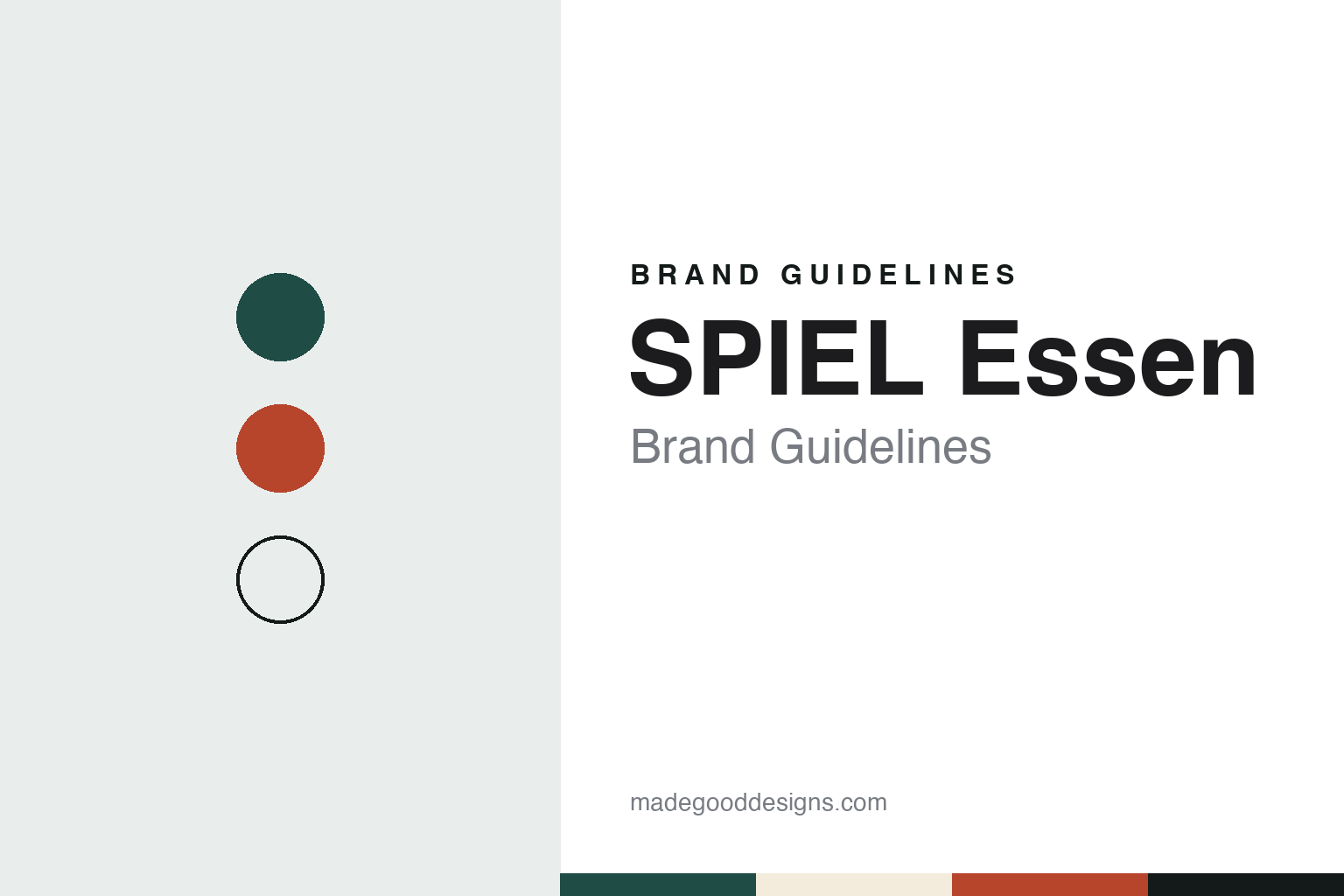
Two constants: a table green, card cream and dice red palette and a rounded sans register. Abstract homage — not a SPIEL Essen asset; no logo, game or key visual is reproduced.
Deutsche Spielertage
A readers’ meeting in an Essen adult-education centre.
SPIEL Essen began as a gathering of magazine readers. According to the fair’s own history page, the first event took place from 14 to 16 October 1983 under the title Deutsche Spielertage (“German Gamers’ Days”) at the Volkshochschule, the city’s adult-education centre, on Hollestraße in Essen. It was organised as a meeting for readers of a games magazine published in Bonn, and the history page names its hosts as Reiner Müller, an editor of the magazine Spielbox, and Friedhelm Merz, then head of the Bonn publishing house Vorwärts-Verlag. About 700 readers registered in advance and twelve exhibitors were invited; the organiser says a short notice on a WDR 2 morning radio programme brought around 5,000 further visitors from Essen and the Ruhr. German Wikipedia gives a range of 4,500 to 5,000 for that year.
The meeting grew quickly. The organiser counts 15,000 visitors in 1984, and German Wikipedia says the event soon outgrew the adult-education centre. After Merz and Vorwärts-Verlag parted, the history page says, Merz acquired the rights to the Spielertage and set up his own company, the Friedhelm Merz Verlag, to concentrate on the fair. From 25 to 29 September 1985 the third Spielertage moved into halls 2, 3 and 4 of Messe Essen, the city’s exhibition centre, with 110 exhibitors and 36,000 visitors, the organiser says.
The name changed the following year. The fourth fair, held from 23 to 26 October 1986, was called SPIEL ’86, with the subtitle “Internationale Spieltage” (“International Game Days”), according to the history page, and German Wikipedia records the same renaming. For more than three decades the event kept that pairing of a short, capitalised SPIEL with the year and the longer German subtitle. German Wikipedia says it has carried the name SPIEL Essen since 2023, and the games journal kulturgutspiel.de noted in January 2022 that the event styles its own name in capitals, as SPIEL.
Colour
A public fair for board and card games.
Unlike a trade-only fair, SPIEL Essen is open to the public. German Wikipedia describes it as a consumer fair held every October, from Thursday to Sunday, on the Essen exhibition grounds, showing analogue games of all kinds, with new board and card games at its centre. Visitors can try most of a year’s releases at publishers’ stands, where staff, rules explainers or the designers themselves teach the games, and most stands also sell them. That sets it apart from Nuremberg’s Spielwarenmesse, which kulturgutspiel.de described in January 2022 as a purely trade fair.
The fair has spread across the halls over the years. The organiser’s history page records a fourth hall in 1987, called the Kinderhalle (children’s hall); nine halls by 1994; a comics section, COMIC ACTION, from 1999; and a move in 2013 into halls 1, 2 and 3 and the Galeria, which made that year’s edition, at 48,000 square metres, the largest in the fair’s history up to then, according to the organiser. In 2019, it says, the fair brought 1,200 exhibitors and 209,000 visitors to Essen and added an Educators Day for teachers.
The 2020 edition was held online as SPIEL Digital; the organiser says around 400 exhibitors from 41 countries took part on a platform built for the purpose. The fair returned to the Essen halls in 2021, with 620 exhibitors and more than 93,000 visitors, and in 2022 the organiser counted 980 exhibitors from 56 countries and 147,000 visitors.
The latest figures come from Spielbox, which reported on 26 October 2026 that the edition just ended had counted 230,000 visitors on 81,200 square metres, both new highs according to the organiser, against 220,000 visitors in 2025. Every day was sold out, the magazine reported, even though an additional hall, Hall 8, raised capacity; the organisers set their own ceilings on visitor numbers. Exhibitors rose from 948 to 997, from 53 countries, with 2,012 new releases, and the fair filled the whole Essen exhibition grounds for the first time, the magazine said. Under a new programme called “Essen spielt!” (“Essen plays”), game evenings were held at Essen’s city hall, at the Red Dot Museum on the Zollverein site and on a boat of the Weiße Flotte on the Baldeneysee lake, Spielbox reported.
Typography
How toy, music and sporting-goods fairs present themselves.
Trade fairs for toys, musical instruments and sporting goods tend to name themselves plainly. Most pair the product field with a city or with a single word such as fair, show or expo, so that the name alone tells a buyer what is on offer and where to go. Some keep a word in the language of their home city even when most visitors come from abroad; others have shortened longer official titles to the form people already used.
Many of these events are built for the trade rather than the public. Trade days are usually reserved for retailers, buyers, distributors, manufacturers and press, and some fairs check credentials or set a minimum age at the door. Others are open to the public, either throughout or on particular days, and present themselves more like festivals for players, musicians or riders.
Behind the fairs stand different kinds of organiser: trade associations representing an industry, cooperatives owned by the exhibitors themselves, and exhibition companies that run the halls and sell the space. Dates matter as much as names. A fair tied to the buying calendar may move between seasons when the industry’s order cycle changes, and the month becomes part of how the event is known.
Inside, the halls are usually arranged by product group, so that a visitor can walk from one category to the next. Demonstration areas, play areas, sound booths and test tracks let products be tried rather than only seen. The visual identity often follows a simple pattern: a wordmark or emblem kept from year to year, set beside a key visual, edition number and dates that change with each edition. This guide describes those identities from dated sources and uses colours and type of our own choosing.
Aa
A rounded sans for a one-word name in capitals. (Specimen set in Rubik, a sans STAND-IN; NOT the SPIEL Essen logo.)
SPIEL Essen
From a Bonn publisher to a Nuremberg cooperative.
For almost four decades the fair was organised from Bonn by the Friedhelm Merz Verlag, which passed to new managing directors in 1996, according to the organiser’s history page; German Wikipedia says the company gradually gave up its publishing business to concentrate on the fair. That arrangement changed in 2022. kulturgutspiel.de reported on 10 January 2022 that Spielwarenmesse eG, the Nuremberg cooperative that organises the toy trade fair Spielwarenmesse, had taken over the Friedhelm Merz Verlag, and with it the Internationale Spieltage SPIEL, with effect from 1 January 2022. Neither side disclosed terms, the journal said, citing the news agency dpa. It reported that the fair would stay on the Essen exhibition grounds as a separate event, with the existing team continuing to organise it from Bonn and a member of the cooperative’s board joining as an additional managing director.
A change of leadership followed. According to kulturgutspiel.de, Carol Rapp, formerly a managing director at the German company of the games publisher Asmodee and before that a marketing manager at Kosmos, joined the Friedhelm Merz Verlag as an additional managing director on 15 November 2022, and the organiser’s history page says she took over the full management in January 2023. In October 2026 Spielbox named her as managing director of the Merz Verlag and described the Nuremberg Spielwarenmesse as the owner of SPIEL.
The fair’s current look dates from that handover. The organiser’s history page says a new logo and a new website were presented in January 2023 as the start of a careful modernisation, and German Wikipedia dates the change of name to SPIEL Essen to the same year. Through every version the constant is the single capitalised word SPIEL, German for “game” or “play”, first paired with a year and the subtitle Internationale Spieltage and, since 2023, with the name of the city.
For a design guide, SPIEL Essen shows how a readers’ meeting can grow into a public fair while keeping a one-word name in capitals. Compare Spielwarenmesse, the Nuremberg trade fair whose organiser now owns it, and Toy Fair New York, another fair for the toy and games trade. For this guide we use a deep table green, a card cream and a dice red with a rounded sans, an unofficial interpretation; no product or logo is reproduced.
Explore & save
Keep SPIEL Essen’s identity on hand — save it to a board in the Made Good inspiration library.
SPIEL Essen identity set
Pin the SPIEL Essen table green, card cream and dice red palette and the rounded sans register to your own board.
Source & notes
Frequently Asked Questions
What font can I use to match the SPIEL Essen look?
This guide describes SPIEL Essen’s type as “A rounded sans for a one-word name in capitals”. Its type specimen is set in Rubik from Google Fonts as a stand-in; Rubik is not SPIEL Essen’s own lettering.
What colours are in the SPIEL Essen palette?
This guide’s SPIEL Essen palette is Table green #1F4D45, Ink #141A19, Card cream #F3ECDD, Dice red #B6452C and Box board #D9CBB0. The tones are the guide’s own unofficial interpretation, not official SPIEL Essen hex codes.
Who owns SPIEL Essen?
SPIEL Essen is owned by Spielwarenmesse eG (since 2022).