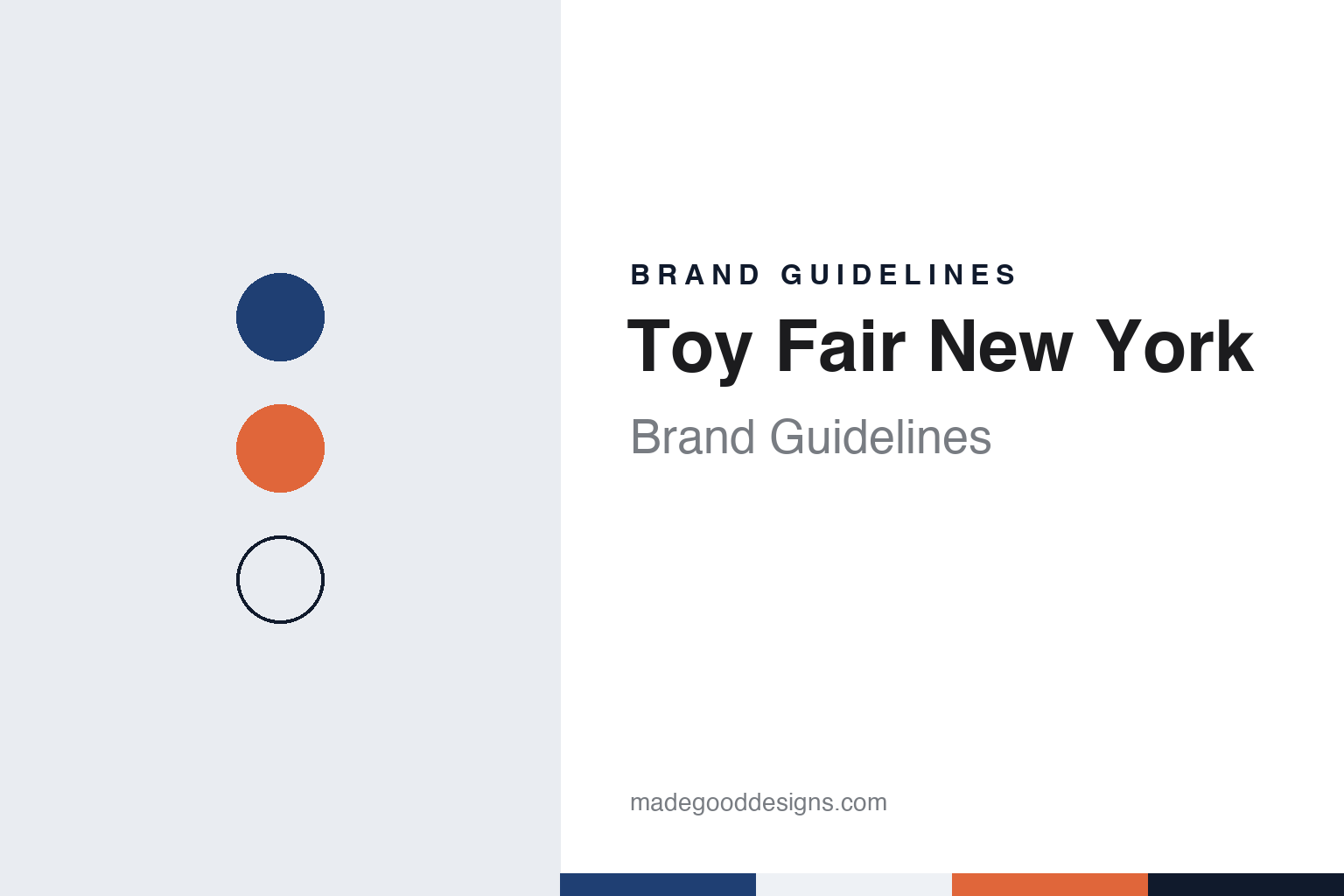
Toy Fair New York Brand Guidelines
The New York toy trade show, held since 1903.
Aa
Two constants: a blue, orange and grey palette and a rounded sans register. Abstract homage — not a Toy Fair or Toy Association asset; no logo or product is reproduced.
Fifth Avenue to the Javits
A trade show older than the association that runs it.
Toy Fair New York is the annual toy trade show held in Manhattan. It began in February 1903. A Reuters report carried by the Los Angeles Times in February 2003, the year the fair marked its hundredth anniversary, said that fewer than ten toy companies took part in that first fair, with Lionel trains among the items on show.
For much of the twentieth century the fair was tied to a single building. English Wikipedia says toy companies began taking space at 200 Fifth Avenue, then the Fifth Avenue Building, in 1910, and that by 1925 so many were there that it was renamed the International Toy Center. Showrooms in that district, near the Flatiron Building, let buyers meet manufacturers’ sales staff in a quieter setting than the main floor.
The show grew into the Jacob K. Javits Convention Center on Manhattan’s West Side. In 2003, the Los Angeles Times report said, a typical year brought about 1,350 companies to the Javits Center and 250 official exhibitors to the Toy District showrooms, with as many as 20,000 buyers. At that time the event was called the American International Toy Fair; it has also been known as the North American International Toy Fair, and today it is promoted simply as Toy Fair, or Toy Fair New York.
The show is produced by The Toy Association, the trade body for the American toy business. The association says it was founded on 9 June 1916 as the Toy Manufacturers of America, Inc. It later became the Toy Industry Association, and on 24 April 2017 it announced the name The Toy Association, together with a new look, a new tagline and a move to new Manhattan offices, Associations Now reported the next day. Its president and chief executive at the time, Steve Pasierb, told the magazine the group wanted to drop the word “industry” and the old acronym.
Colour
February, then autumn, then February again.
For most of its history Toy Fair was held in February. The 117th fair ran from 22 to 25 February 2020 at the Javits Center; the association said afterwards that it filled about 445,800 net square feet of exhibit space and drew visitors from about 100 countries. The 2021 and 2022 editions did not take place; ComicBook.com noted in February 2022 that these were the only two years without the fair in more than a century.
In early 2022 The Toy Association announced that the show would move to the autumn. Toys n Playthings reported on 31 March 2022 that the association’s board had shifted the timing from February to the fall, citing longer production lead times and changing retailer buying cycles, after member surveys and research by the consultancy mdg. The 118th fair ran from 30 September to 3 October 2023 at the Javits Center, and the association’s separate Dallas fall event was retired. Pasierb told The Toy Book, as ComicBook.com reported, that autumn offered toy companies a pre-holiday moment in front of the news media, and suited licensors who already held meetings in the city at that time of year.
The autumn date did not last. Publishers Weekly reported on 4 March 2025 that there was no show in 2024, to allow a move back to a winter slot, and that the 2025 fair had just finished a four-day run at the Javits Center ending on 4 March. The association told the magazine that close to 850 companies exhibited, compared with just over 1,000 in 2018, 2019 and 2023. The 120th fair returned to February, running from 14 to 17 February 2026 at the Javits Center, according to the association; Engadget reported from the show floor that week.
Toy Fair is trade only. English Wikipedia says registration is limited to toy-industry professionals, retailers and press, that buyers must show proof of working in the toy business and that attendees must be at least 18. The association says the show now runs for four days, from Saturday to Tuesday, and alongside the exhibition floor the association runs an education programme it calls Toy Fair University. At the 2026 show the association’s president and chief executive was Greg Ahearn, the association says.
Typography
How toy, music and sporting-goods fairs present themselves.
Trade fairs for toys, musical instruments and sporting goods tend to name themselves plainly. Most pair the product field with a city or with a single word such as fair, show or expo, so that the name alone tells a buyer what is on offer and where to go. Some keep a word in the language of their home city even when most visitors come from abroad; others have shortened longer official titles to the form people already used.
Many of these events are built for the trade rather than the public. Trade days are usually reserved for retailers, buyers, distributors, manufacturers and press, and some fairs check credentials or set a minimum age at the door. Others are open to the public, either throughout or on particular days, and present themselves more like festivals for players, musicians or riders.
Behind the fairs stand different kinds of organiser: trade associations representing an industry, cooperatives owned by the exhibitors themselves, and exhibition companies that run the halls and sell the space. Dates matter as much as names. A fair tied to the buying calendar may move between seasons when the industry’s order cycle changes, and the month becomes part of how the event is known.
Inside, the halls are usually arranged by product group, so that a visitor can walk from one category to the next. Demonstration areas, play areas, sound booths and test tracks let products be tried rather than only seen. The visual identity often follows a simple pattern: a wordmark or emblem kept from year to year, set beside a key visual, edition number and dates that change with each edition. This guide describes those identities from dated sources and uses colours and type of our own choosing.
Aa
A rounded sans for a show that has used the plain words Toy Fair. (Specimen set in Rubik, a sans STAND-IN; NOT the Toy Fair logo.)
Two words and a city
A name that outlasted its longer versions.
The show’s identity has narrowed over time to two words. The longer names, American International Toy Fair and North American International Toy Fair, set out who it was for; the association’s own pages now use the short form Toy Fair, with Toy Fair New York as the longer title. English Wikipedia keeps an image of the Toy Fair logo used in 2006, and the association’s announcements number each edition, from the 117th in 2020 to the 120th in 2026.
The old Toy District left its own mark. The building at 200 Fifth Avenue took the name International Toy Center from the companies inside it, English Wikipedia says, and for decades the fair was split between the convention floor and those showrooms. Today the Javits Center is the fixed point, with the show described by the association as four days in New York City.
For a design guide, Toy Fair New York shows how a trade show can let its name shrink to the plainest possible words once its place on the calendar and its city carry the rest. Compare Spielwarenmesse, the Nuremberg toy trade fair held in the same winter weeks, and Hong Kong Toys & Games Fair. For this guide we use an avenue blue, a showroom orange and a pavement grey with a rounded sans, an unofficial interpretation; no product or logo is reproduced.
Explore & save
Keep Toy Fair New York’s identity on hand — save it to a board in the Made Good inspiration library.
Toy Fair New York identity set
Pin the Toy Fair New York blue, orange and grey palette and the rounded sans register to your own board.
Source & notes
Frequently Asked Questions
What font can I use to match the Toy Fair New York look?
This guide describes Toy Fair New York’s type as “A rounded sans for a show that has used the plain words Toy Fair”. Its type specimen is set in Rubik from Google Fonts as a stand-in; Rubik is not Toy Fair New York’s own lettering.
What colours are in the Toy Fair New York palette?
This guide’s Toy Fair New York palette is Avenue blue #1F3F73, Night ink #101A2C, Showroom orange #E0663A, Pavement grey #EEF1F5 and Paper #F9F9F7. The tones are the guide’s own unofficial interpretation, not official Toy Fair New York hex codes.