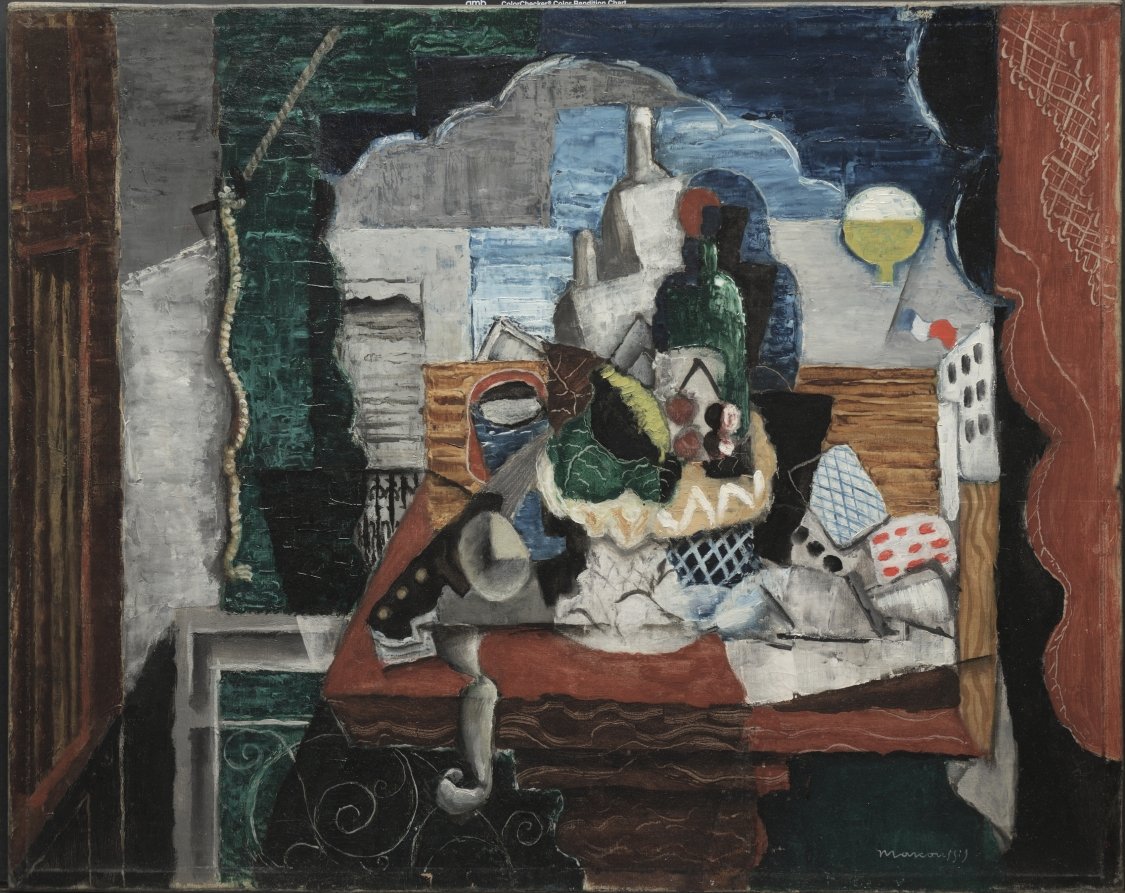
Louis Marcoussis built pictures the way a designer builds a layout. In his café still lifes a bottle, a glass, a newspaper and a sign are cut into flat panels and stacked, and words such as VINS or PARIS sit inside the picture as part of the structure. Later he turned almost entirely to etching, where the same ideas became a matter of line and tone. The Cleveland Museum of Art holds two of his works flagged CC0, a painting and a print, and both are shown below.
Who was Louis Marcoussis?
He was born in Warsaw as Ludwik Kazimierz Markus; the Cleveland Museum of Art gives the French form Louis Casimir Ladislas Markus. His birth year differs between museums: Tate and the Art Institute of Chicago give 1878, the Cleveland Museum of Art gives 1883, and the École de Paris site records both. According to the Annex Galleries and the École de Paris, he studied from 1901 at the Academy of Fine Arts in Kraków under Jan Stanisławski, moved to Paris in 1903 and spent a short time at the Académie Julian under Jules Lefebvre.
In Paris he met Apollinaire, Georges Braque and Pablo Picasso. The Cleveland Museum of Art, the Annex Galleries and the École de Paris all record that Apollinaire suggested he take the name Marcoussis, after a village near Montlhéry, south of Paris; the date is given as 1910 or about 1911. He moved from an Impressionist manner to Cubism around 1910, and the Annex Galleries notes that he showed at the Salon de la Section d’Or in 1912. The École de Paris dates his marriage to the painter Alice Halicka to 1913.
He served in the French army through the First World War, from 1914 to 1919 according to the Annex Galleries. From the early 1930s until 1937 he worked mainly as a printmaker; the two sources give the start as 1930 and 1931. He left Paris in 1940 and died on 22 October 1941 in Cusset, near Vichy, as both sources record.
For the circle around him, see our guides to Georges Braque and Juan Gris.
Key works by Louis Marcoussis
- The Glass of Absinthe, 1912. Oil on canvas, Art Institute of Chicago.
- The Beautiful Woman of Martinique, 1912. Drypoint, Art Institute of Chicago.
- Portrait of Guillaume Apollinaire, 1912–20. Etching, drypoint and aquatint, Art Institute of Chicago, which also holds a 1912 study for it.
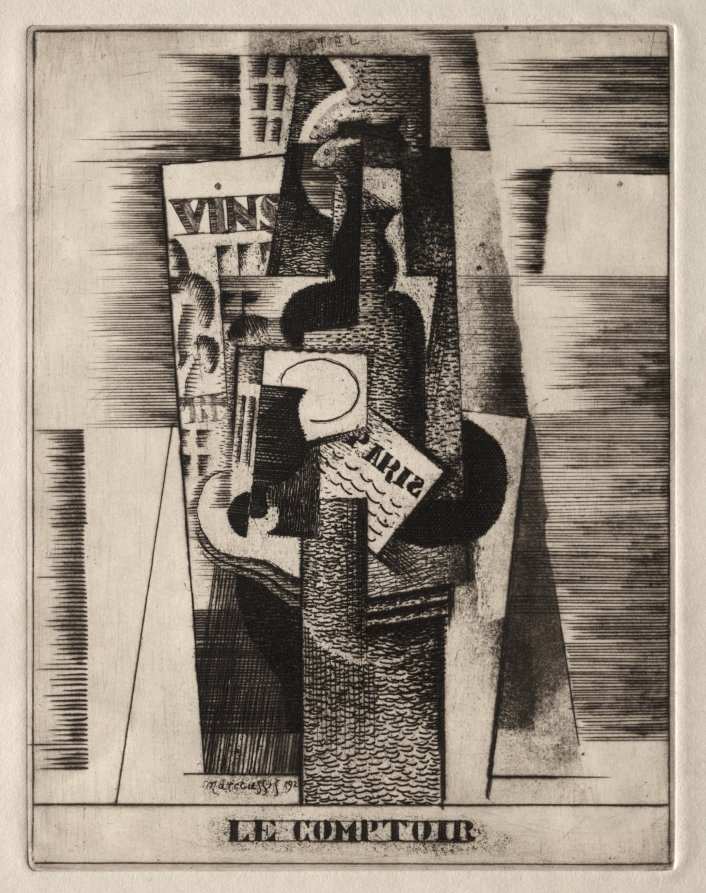
- The Bar (Le Comptoir), 1920. Catalogued by Cleveland as aquatint, etching and drypoint, and by the Art Institute of Chicago as drypoint.
- Night Café, about 1923. Oil on canvas, 70.5 by 88.1 cm, Cleveland Museum of Art.
- Interior with a Double Bass and Rain, both 1929, Tate.
- The Cello, 1930, oil on canvas, and The Table, 1930, colour etching, both Art Institute of Chicago.
- Les Planches de Salut, 1931. A book of etchings and engravings published by Éditions Jeanne Bucher, Paris, according to the Art Institute of Chicago.
- Etchings for Apollinaire’s Alcools, 1934. Plates such as Clair de Lune and La Loreley are in the Metropolitan Museum of Art and the Art Institute of Chicago.
What to look at in a Louis Marcoussis still life
Flat panels, stacked in shallow space
In Night Café, a table, a bottle, a fruit bowl, cards and a pipe are broken into overlapping planes. Cleveland’s record notes that the table is seen from several viewpoints at once. Look at how the panels stay roughly parallel to the picture surface: depth is suggested, but the composition reads as a flat arrangement of shapes, much like layers in a layout file.
A frame inside the frame
A vertical rope on the left and a red curtain on the right act like margins. Behind the table a window, outlined with a scalloped, cloud-like edge, opens onto a night sky with a yellow balloon and a small French flag, which Cleveland reads as a nod to his adopted country. The device keeps the eye inside the canvas and centres the still life between two strong verticals.
Pattern as texture
Marcoussis fills planes with pattern: dots on playing cards, a criss-cross lattice, wood grain and scrolling ironwork under the table. Each pattern tells you what a surface is without modelling it, and together they give the picture rhythm.
A muted palette with one warm accent
Measured from the museum’s scan of this painting, the main tones are a rust red (#663d32), a warm umber (#775f52), a mid grey (#888a85), a pale grey (#b1b2aa) and a blue-black (#263033). The rust red of the curtain and table carries most of the warmth, set against greys and dark greens. You can sample your own swatches with our image colour picker.
Lettering inside the picture
The Bar shows Marcoussis’s use of words as building blocks. Fragments of a sign read VINS and HOTEL, a card printed PARIS sits slanted across the centre, and the title LE COMPTOIR is set in capitals in the margin beneath the image, like a caption on a poster. The letters are part of the structure: they flatten the space, tell you where you are and add a crisp contrast to the hatched tone around them.
The lesson for designers is that type can be part of an image rather than laid over it. A word on a sign, a label or a ticket can anchor a composition and set the scene in one stroke. For broader lettering references, browse our museum inspiration collection.
Technique: line, hatching and the etched plate
Marcoussis made prints throughout his career, and they are central to his work. Cleveland catalogues The Bar as aquatint, etching and drypoint: the plate mark is only 18.6 by 14.3 cm, yet it combines several kinds of mark. Fine parallel lines streak out horizontally from the central motif, cross-hatching builds dark masses in the bottle, and small scalloped strokes suggest liquid or reflection. Measured from the museum’s scan of this impression, the range runs from a warm black (#332e29) through a mid grey-brown (#74695d) to a pale paper tone (#cec1b0).
His etched portraits, such as the Apollinaire portrait dated 1912–20, and his illustrations for Alcools in 1934, show the same economy in a literary setting. The École de Paris records that he taught engraving in 1933. For more on the process, read our guide to etching.
How designers can borrow from Louis Marcoussis today
- Build in flat layers. Cut objects into simple overlapping panels and keep them parallel to the page. This works well for editorial illustration, packaging and posters.
- Put words in the scene. Set a short word on a sign, label or ticket inside the illustration so the type does structural work.
- Frame with verticals. Use a strong element at each side, a curtain, a column or a band of colour, to hold the eye in the centre.
- Use pattern instead of shading. Dots, grids and stripes can describe surfaces without gradients and print cleanly at small sizes.
- Limit the palette. Work in greys and umbers with one rust or brick accent, as in Night Café.
- Add a caption line. A title set in capitals below the image, as in The Bar, turns an illustration into something closer to a poster.
Copyright and where to see Louis Marcoussis’s work
Marcoussis died in 1941. The Cleveland Museum of Art flags Night Café and The Bar as CC0, which is why they appear here. Many of his other works in the Art Institute of Chicago, the Metropolitan Museum of Art and Tate are not flagged public domain, so they are described in text only and are not offered as free to use. For more cleared works, see the printmaking collection.
Frequently asked questions
What is Louis Marcoussis known for?
He is known for Cubist still lifes of café and bar tables, for his etchings, including those for Apollinaire’s Alcools (1934), and for his portrait of Apollinaire.
Why did Louis Marcoussis change his name?
Born Ludwik Markus in Warsaw, he took the name Marcoussis on Apollinaire’s suggestion, after a village near Montlhéry, south of Paris.
When was Louis Marcoussis born?
The museums give two dates. Tate and the Art Institute of Chicago give 1878; the Cleveland Museum of Art gives 1883. He died in 1941 in Cusset, near Vichy.
Was Louis Marcoussis married to Alice Halicka?
Yes. Halicka was a Polish-born painter who worked in France, and the École de Paris dates their marriage to 1913.