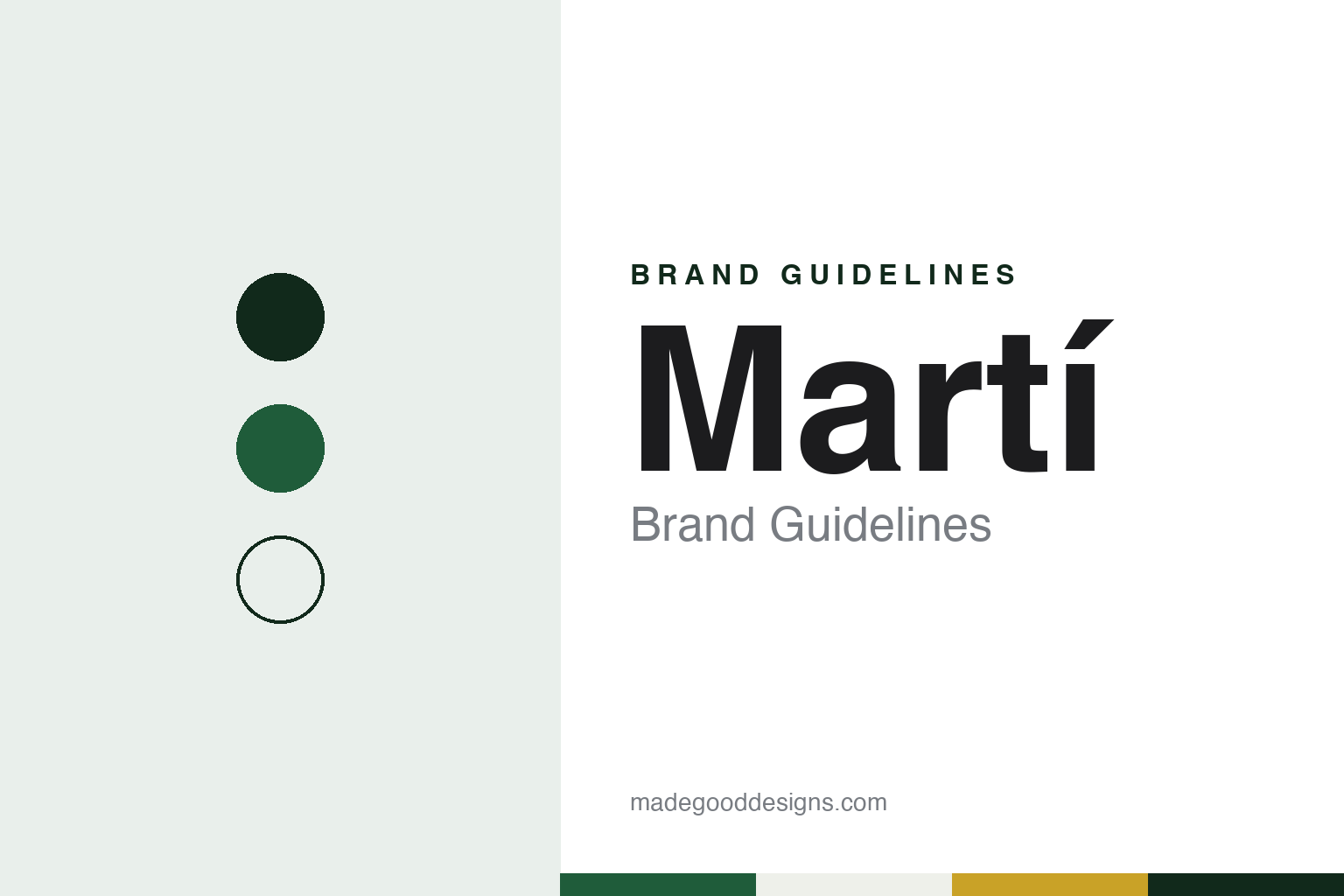
Martí Brand Guidelines
A 1936 Mexico City sports shop that grew into stores, outlets and Sport City clubs.
Aa
Two constants: a green, chalk and gold palette and a condensed sports sans register. Abstract homage — not a Martí product or mark; no logo, shop sign or product is reproduced.
A shop in 1936
A father and son in Mexico City.
Martí traces its story to the mid-1930s. El Financiero, drawing on the company’s own website in July 2023, wrote that the business began through the work of Domingo Martí Riera and his son Domingo Martí Fortún, and that its first branch opened in 1936 in Mexico City. El CEO gave the same year in September 2026, describing Martí as born in 1936 with the aim of opening a sporting-goods shop in the capital.
The family name has stayed on the door ever since. In the press the chain appears both as Martí and as Deportes Martí, and the business that runs it as Grupo Martí. The company writes its name with an acute accent on the final letter, and this guide follows that spelling.
A turning point came with the 1968 Olympic Games in Mexico City. According to El Financiero, Alejandro Martí, the founder’s grandson, managed to sell the shop’s products from a stand inside the Olympic venues. Publimetro wrote in July 2023 that he sold goods in the Olympic Village, to fans and to some athletes, on behalf of the store run by his grandfather and his father.
Both papers tie the chain’s growth to that moment. El Financiero said the exposure at the Games raised the shop’s profile and allowed it to open more branches across Mexico City. Publimetro named early locations at Plaza Universidad, on Insurgentes and at Plaza Satélite, followed by stores in other Mexican states, and described the chain as one of the country’s important sports retailers. In 2023 El Financiero observed that a Martí is a common sight inside Mexican shopping centres, selling goods for exercise that range from running shoes and gym backpacks to clothing and tents.
Colour
Shops, outlets and Sport City.
From the 1990s Martí moved beyond shops. El Financiero wrote that in 1991 the business opened its first sports centre, called Sport City; Publimetro dated the opening of the first Sport City club, Sport City Eureka, to 1995, describing it as a fitness-centre concept. The two papers give different years, and both are noted here. In the middle of the same decade, El Financiero said, the company entered the business of outlet warehouses, the origin of the format that now trades as Martí Outlet.
More partnerships followed. Publimetro reported that in 2007 the group formed an alliance with Emoción Deportiva, an organiser of running races. In February 2014 the marketing magazine Merca2.0 reported that Martí had become the official store of the Federación Mexicana de Futbol, Mexico’s football federation, with Sport City named the federation’s official gym ahead of that year’s World Cup in Brazil. It was the third agreement of its kind for Grupo Martí, after earlier ones with the Federación Mexicana de Natación, the swimming federation, and the World Boxing Council, the magazine said.
Store counts appear only now and then in the press. In September 2026 El CEO wrote that the brand had more than 200 locations across its formats, counting Martí Outlet stores and the Sport City clubs together. The same report linked the brand’s wider expansion to the arrival of new investors in the late 2000s.
Typography
Sports retail in Mexico.
Sporting-goods chains across the Americas, Asia and Oceania tend to present themselves through a few constant elements: a short name on the shop sign, a single strong colour carried from the storefront to the advertising, and a logo set in heavy or slanted capitals. In the United States, Big 5 Sporting Goods uses white capitals on a blue field and Dunham’s Sports a slanted red wordmark, as their logo files on Wikimedia Commons show. The guides in this group look at chains in the United States, Mexico, Argentina, the Philippines, Thailand, New Zealand, Singapore and the United Arab Emirates, and describe each sign, logo and colour scheme as the company itself publishes it.
Store formats range from small neighbourhood shops to large units in regional malls. Big 5’s stores averaged about 10,000 square feet in 1997, the Los Angeles Times reported, while Dunham’s has taken mall and plaza units, including former department-store spaces, according to SGB Media. Shop counts in these guides are always given with the date and the source that reported them.
Ownership takes several forms. Some chains have stayed in founding families or passed to private owners; some have been listed on a stock exchange and later taken private, as Big 5 was in October 2025; others sit inside larger retail or department-store groups. Each guide states the owner as a dated source gives it, and says plainly when a business has been sold, merged or closed.
Many chains also sell ranges under their own names alongside branded goods, and publish corporate pages about their founders and owners. Each guide separates what a company says about itself from what independent, dated sources record, and treats the palette shown as an unofficial interpretation rather than an official brand colour.
Aa
A condensed sports sans, the kind of lettering found on scoreboards and team kit. (Specimen set in Barlow Condensed, a sans STAND-IN; NOT the Martí logo or lettering.)
Grupo Martí
New investors and the Smart Fit agreement.
Ownership widened in the late 2000s. El Financiero wrote that in 2008 the business, by then grouped as Grupo Martí, entered a new stage with the arrival of the businessman Alfredo Harp Helú, who brought experience across several areas of sport and fitness. Publimetro also dated the alliance with Harp Helú to 2008, and El CEO wrote in 2026 that Martí’s expansion and consolidation came with him.
In May 2018 the group turned to the gym market. Forbes México reported on 11 May 2018 that Grupo Martí had signed an agreement with the Brazilian gym operator Smart Fit, under which Grupo Martí became one of the main shareholders of Smart Fit’s Brazilian parent, and that parent was to own all of Smart Fit México. The transaction was carried out through Corporación SportCity, a subsidiary of Grupo Martí, according to a company statement quoted by the magazine. Smart Fit’s own investor history dates its first Mexican gym to 2011, in Mexico City, and says that by the end of 2019 the group had also expanded to Chile, the Dominican Republic, Colombia, Peru, Ecuador, Argentina, Paraguay, Guatemala and Panama.
After that agreement, Forbes México reported, Grupo Martí would continue to work through its subsidiaries: the SportCity clubs, the Deportes Martí stores in all their formats, the City Café restaurants and Emoción Deportiva, and indirectly through Smart Fit. That puts the shops inside a wider group that spans retail, gyms and race events.
The chain now faces new arrivals. In September 2026 El CEO reported a franchise agreement between JD Sports and Grupo Axo covering Mexico, and named Martí and Innovasport as the established local sports chains in that market.
For a design guide, Martí shows how a family surname can carry a retail brand through nine decades, from a single shop to malls, outlet stores and gyms, while the group behind it changes shape. Compare Innovasport, the Monterrey chain founded in 1999, and Decathlon, the French sports retailer. For this guide we use a pitch green, a chalk white and a medal gold with a condensed sans, an unofficial interpretation; no product or logo is reproduced.
Explore & save
Keep Martí’s identity on hand — save it to a board in the Made Good inspiration library.
Martí identity set
Pin the Martí green, chalk and gold palette and the condensed sports sans register to your own board.
Source & notes
Frequently Asked Questions
What font can I use to match the Martí look?
This guide describes Martí’s type as “A condensed sports sans, the kind of lettering found on scoreboards and team kit”. Its type specimen is set in Barlow Condensed from Google Fonts as a stand-in; Barlow Condensed is not Martí’s own lettering.
What colours are in the Martí palette?
This guide’s Martí palette is Pitch green #1F5C3A, Deep forest #11291B, Chalk #EEF0EA, Medal gold #C9A227 and Paper #F8F8F5. The tones are the guide’s own unofficial interpretation, not official Martí hex codes.
When was Martí founded?
Martí was founded in 1936 (first branch), in Mexico City, Mexico.
Who founded Martí?
Martí was founded by Domingo Martí Riera and Domingo Martí Fortún in 1936 (first branch).