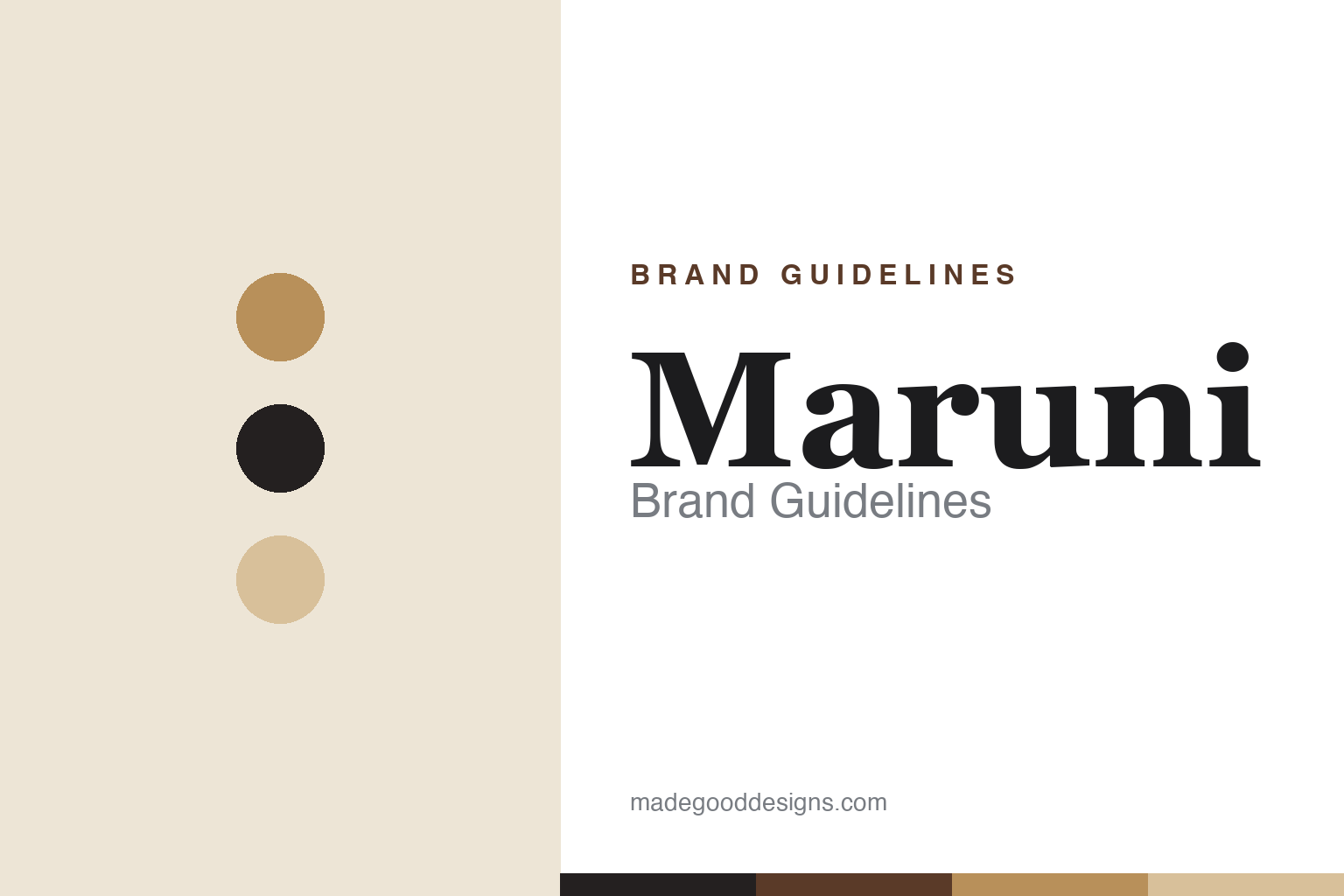
Maruni Brand Guidelines
Industrialized craftsmanship — bentwood roots in Hiroshima, and Fukasawa’s Hiroshima chair.
Aa
Two constants: a warm oak-and-sumi palette and a refined mincho serif. Abstract homage — not the Maruni wordmark.
Industrialized craftsmanship
Maruni makes craft repeatable.
Maruni is a lesson in making craftsmanship repeatable. Maruni Wood Industry was founded in 1928 in Hiroshima by Takeo Yamanaka, a mechanical-engineering graduate, as a pioneer of industrial bentwood and moulded-wood techniques in Japan. (A precise correction: it began as the Showa Bentwood Factory and was renamed Maruni Wood Industry in 1933 — “Maruni Bending Wood Factory” is a loose gloss.) Its stated ethos is the “industrialization of craftsmanship” — turning artisan-level woodworking into consistent, mass-producible quality. (Two honest notes: no official brand hex is published, and the wordmark typeface is undocumented.)
Its modern icon is the Hiroshima chair, designed by Naoto Fukasawa in 2008 — a sculpted, hand-finished solid-oak (or beech) chair with a gently curved armrest, the flagship of the relaunched Maruni Collection, with Fukasawa as art director. (A well-reported detail: Hiroshima chairs were chosen for Apple Park’s Steve Jobs Theater when the campus opened.) The relaunch had a run-up: the earlier “nextmaruni” (2004) project paired Maruni with international designers including Fukasawa, Jasper Morrison and Alberto Meda — a distinct milestone from the 2008 Maruni Collection.
Maruni’s designer roster is small and serious: alongside Fukasawa, Jasper Morrison is a lead voice (the Lightwood chair and other pieces), with later additions such as Cecilie Manz. (An important note to avoid a common mix-up: the Hiroshima chair is Maruni’s — Karimoku is a separate, larger Japanese wood-furniture company.) Postwar, Maruni was long known as Japan’s premier maker of “classic,” carved European-style furniture before Fukasawa took it global. It remains a family-linked, privately held Hiroshima company. Industrialized craftsmanship.
Colour
Maruni lives in a warm oak-and-sumi palette. Click a swatch to copy the hex.
Maruni’s identity leans on warm, natural, refined tones — the honey-brown of oak, the pale warmth of beech, deep sumi (ink) black and chestnut, on a soft kinari (unbleached) ground. The palette reads as calm, crafted and elegant: the tones of finely finished solid wood, restrained in the Japanese manner, warmth balanced by quiet ink-dark contrast. It’s a considered, material-led world that signals craft, precision and calm — the refined side of “industrialized craftsmanship.” It’s a warm, natural palette that signals wood, craft and refinement. The honest caveat: Maruni publishes no official brand hex, so the oak, sumi and beech tones here are an original, unofficial interpretation of its materials, not first-party values.
The lesson is a warm, refined wood palette signals craft and calm. Maruni’s oak-and-sumi world reads as elegant and grounded. For designers, it’s a reminder that natural wood tones with a single dark contrast can feel both warm and precise — craft without clutter. The takeaways: draw the palette from real timber; balance warm woods with a quiet ink-dark; and treat specific hexes as unofficial when there’s no published spec.
Typography
The wordmark is a refined mincho serif — precise and calm.
Maruni’s identity carries a refined, precise, quietly elegant spirit — a “Maruni” wordmark whose measured letterforms read as considered and craft-led. A refined mincho-style serif captures the mood: it’s balanced and exact, echoing the Japanese calligraphic tradition and the precision of Maruni’s hand-finished woodwork. Set against a warm oak-and-sumi palette, the type feels calm and elegant — exactly the crafted, “industrialized craftsmanship” personality Maruni cultivates around the Hiroshima chair. It’s precise and refined rather than loud or casual, mirroring furniture where every curve is carefully finished. Because the exact wordmark face isn’t publicly documented, the honest description is “a refined mincho spirit,” not a named font. The type behaves like the brand: precise, refined and calm.
Aa
A refined mincho spirit — precise and calm. (Specimen set in Shippori Mincho, a refined Japanese serif in the spirit of the Maruni identity; the real face is undocumented.)
Repeatable craft as the difference
Maruni scaled the handmade.
Maruni is a lesson in reconciling craft with production. The usual story treats fine woodworking and industrial manufacture as opposites — one artisanal and rare, the other consistent and mass. Maruni’s differentiator, stated since its early bentwood days, is the “industrialization of craftsmanship”: capturing the skill of a master woodworker in a repeatable process, so quality that once required a rare artisan can be produced reliably. The Hiroshima chair is the proof — a sculpted, hand-finished form with a sensuous curved armrest, made to a global standard and chosen for Apple’s Steve Jobs Theater. Guided by Naoto Fukasawa as art director and joined by Jasper Morrison, Maruni turned a Hiroshima wood factory into an internationally admired design house without abandoning the craft at its core. The lesson is that industry and craftsmanship need not be at odds — the real achievement is making the handmade repeatable. Anyone can mass-produce, or hand-carve one chair; Maruni did both at once. Industrialize the craft, and quality scales. Make the handmade repeatable.
For designers and brand-builders, Maruni offers a clear takeaway: a clear philosophy can unify craft and scale. The lessons: define the tension you resolve (“industrialized craftsmanship”); bring in designers who elevate it globally (Fukasawa, Morrison); and keep the history precise — Maruni was founded in 1928 in Hiroshima by Takeo Yamanaka (as the Showa Bentwood Factory, renamed Maruni in 1933), and the Hiroshima chair is Fukasawa’s 2008 design, distinct from the 2004 nextmaruni project. It’s also a reminder to keep the facts honest: the Hiroshima chair is Maruni’s (not Karimoku’s), and no official brand hex or typeface is published, so the palette and type here are an interpretation. Maruni scaled the handmade — proof that repeatable craft can be the difference.
Explore & save
Keep Maruni’s identity on hand — save it to a board in the Made Good inspiration library.
Maruni identity set
Pin the warm-wood palette and the refined-mincho spirit to your own board.