Nacra Brand Guidelines
A 1975 beach-catamaran acronym now based in The Hague.
Aa
Two constants: a sail blue, spray white and carbon palette and a condensed racing sans register. Abstract homage — not a Nacra product or mark; no boat, logo or sail insignia is reproduced.
An acronym becomes a brand
A racing series that failed and a catamaran that stayed.
Nacra’s name came before the company. English Wikipedia says the designer Tom Roland, who had drawn an 18-foot beach catamaran called the Alpha Cat in 1970, went on to design a 36-foot one-design catamaran for a professional racing series; about ten were built, and the series did not prove viable. The series supplied the acronym. English Wikipedia and the Australian magazine MySailing (February 2016) expand it as North American Catamaran Racing Association, while the company’s own timeline says the 36-footer of 1972 was designed for the North American Class Racing Association.
The company dates its founding to 1975, under Roland, and English Wikipedia says it launched that year with the Nacra 5.2, a 17-foot beach catamaran with plumb bows, daggerboards and a fully battened, loose-footed mainsail, citing The New York Times in 1978. A manufacturer profile on the Nacra 17 class website says Performance Catamarans took over the concept, created the 5.2 and kept the old acronym as the brand name. From 1979 until 1986 an Australian company in Sydney built the boats under licence, English Wikipedia says.
Ownership changed more than once in the United States. The company’s timeline says Nacra was acquired in 1987 by Frank Butler of Catalina Yachts. English Wikipedia says the company bought the competing Prindle brand in 1988, when it traded as Performance Catamarans Inc. and moved from Santa Barbara to Santa Ana, California. The class-site profile adds that in the early 1990s a recreational line without daggerboards or booms was added to the racing boats, for sailors who wanted simpler rigging.
Colour
Dutch owners and an Olympic multihull.
The brand later moved to the Netherlands, and the sources give three dates. The company’s timeline says Nacra came “in Dutch hands” in 2005; the manufacturer profile on the Nacra 17 class site says ownership of the brand and the factory passed into European hands in 2006, with the main office then run from the Netherlands; English Wikipedia says a group in the Netherlands acquired the company in 2007. MySailing referred to Nacra’s “Dutch owners” in 2016 and said the Nacra 15 was manufactured in Asia for them. Today the company, Nacra Sailing, gives its headquarters as The Hague, and English Wikipedia places it in Scheveningen, the city’s seaside district.
The Olympic boat came from this Dutch period. English Wikipedia says the Nacra 17 was designed in 2011 by Morrelli & Melvin with Nacra Sailing to meet the criteria for a new mixed-crew Olympic multihull event, went into production in 2012, and was chosen by the International Sailing Federation in May 2012 as the equipment for the mixed multihull at the 2016 Games in Rio de Janeiro. It was converted to a hydrofoiling boat for the Tokyo 2020 Games and for Paris 2024, whose sailing was held at Marseille. The company’s product page credits the design to Nacra Sailing and Morrelli & Melvin, describes a carbon-foam sandwich hull and a full carbon mast, and says the class moved to full foiling after the Rio Games.
The Nacra 15 followed as the youth boat. English Wikipedia says World Sailing adopted it in 2015 as a Youth World Championships class and as a class for the Youth Olympic Games, and that the RYA chose it as its youth multihull in 2016; MySailing called it “Dutch-designed.” The company’s timeline dates its launch to 2015.
Typography
Design and documentation.
Dinghy builders and sailmakers present themselves mostly through names and numbers. A builder’s name usually sits on the hull and on its website, while the sail carries the marks that racing needs: a class emblem and a sail number, placed as each class’s rules describe. When a class changes its name, the sail changes with it; in 2019 the International Laser Class Association said new class sails would carry its updated ILCA logo.
Much of this branding lives at the water’s edge rather than in shops. Builders and lofts show their boats and sails at boat shows and on regatta stands, and many of their news pages read like club noticeboards, carrying class championship calendars, results and event reports alongside new models. Class associations, which are often run separately from the builders, organise much of that racing and publish their own rules and websites.
Ownership in the trade takes several forms, and the companies describe it in different ways. Some are family businesses that name their founders and later generations on their own pages; some sailmakers work through franchised or licensed lofts that share one name across many countries; and some builders have passed to investors or merged with former rivals, or have sold individual boat designs and their production rights to other firms. Building is often shared: a brand may design its boats and buy hulls, sails and spars from specialist suppliers.
This guide sets out what can be checked about each company: who founded it, who owns it now, where its boats or sails are made according to dated sources, and how it presents its name. It marks clearly what rests only on the company’s own word, and it makes no claims about speed or safety.
Aa
A condensed racing sans for a lowercase name. (Specimen set in Barlow Condensed, a sans STAND-IN; NOT the Nacra logo.)
Nacra
Leisure, racing and Olympic lines from one Dutch office.
Nacra Sailing now arranges its boats in three groups on its website: Leisure, for recreational catamarans; Racing, for class boats; and Olympic, for the Nacra 17. It sells parts, sails, spars and apparel alongside the boats, and its site carries an event calendar, a charter service and a page for the International Nacra Class Association. The company says its sails are designed and made by Performance Sails, its own sail loft, and its team page lists a chief executive who leads both Nacra Sailing and Performance Sails, with sailmakers and a graphic designer among the loft staff. It says it works through a worldwide dealer network, with a dealer locator on its site.
The company’s timeline also reproduces the brand’s earlier marks. Its archive images show a rounded lowercase “nacra” wordmark on 1980s brochures and, beside the 2005 entry, a boxed “nacra catamaran” mark and an italic “NACRA sailing” logotype. The current site uses the Nacra Sailing name with the line “Empowering sailors since 1975,” and the timeline itself is headed “50 years of Nacra.”
Sails carry much of that identity on the water. The Nacra 17 product page says its mainsail and jib are made by Performance Sails in Pentex cloth, with a polyester spinnaker that can be ordered fully printed with flags or sponsor graphics. In Australia, MySailing reported in 2016 that Nacra’s agent, the Brisbane Catamaran Centre, ran its own manufacturing operation and had designed and built two smaller Nacra catamarans, introduced in 2010 and 2012.
For a design guide, Nacra shows how an acronym from an abandoned racing series can outlast its origin and become the name of a Dutch catamaran brand with American roots. Compare Hobie, whose beach-catamaran market English Wikipedia says Nacra was founded to tap into, and Topper, whose Topaz range also includes catamarans. For this guide we use a sail blue, a spray white, a carbon black and a foil teal with a condensed sans, an unofficial interpretation; no product or logo is reproduced.
Explore & save
Keep Nacra’s identity on hand — save it to a board in the Made Good inspiration library.
Nacra identity set
Pin the Nacra sail blue, spray white and carbon palette and the condensed racing sans register to your own board.
Source & notes
Frequently Asked Questions
What font can I use to match the Nacra look?
This guide describes Nacra’s type as “A condensed racing sans for a lowercase name”. Its type specimen is set in Barlow Condensed from Google Fonts as a stand-in; Barlow Condensed is not Nacra’s own lettering.
What colours are in the Nacra palette?
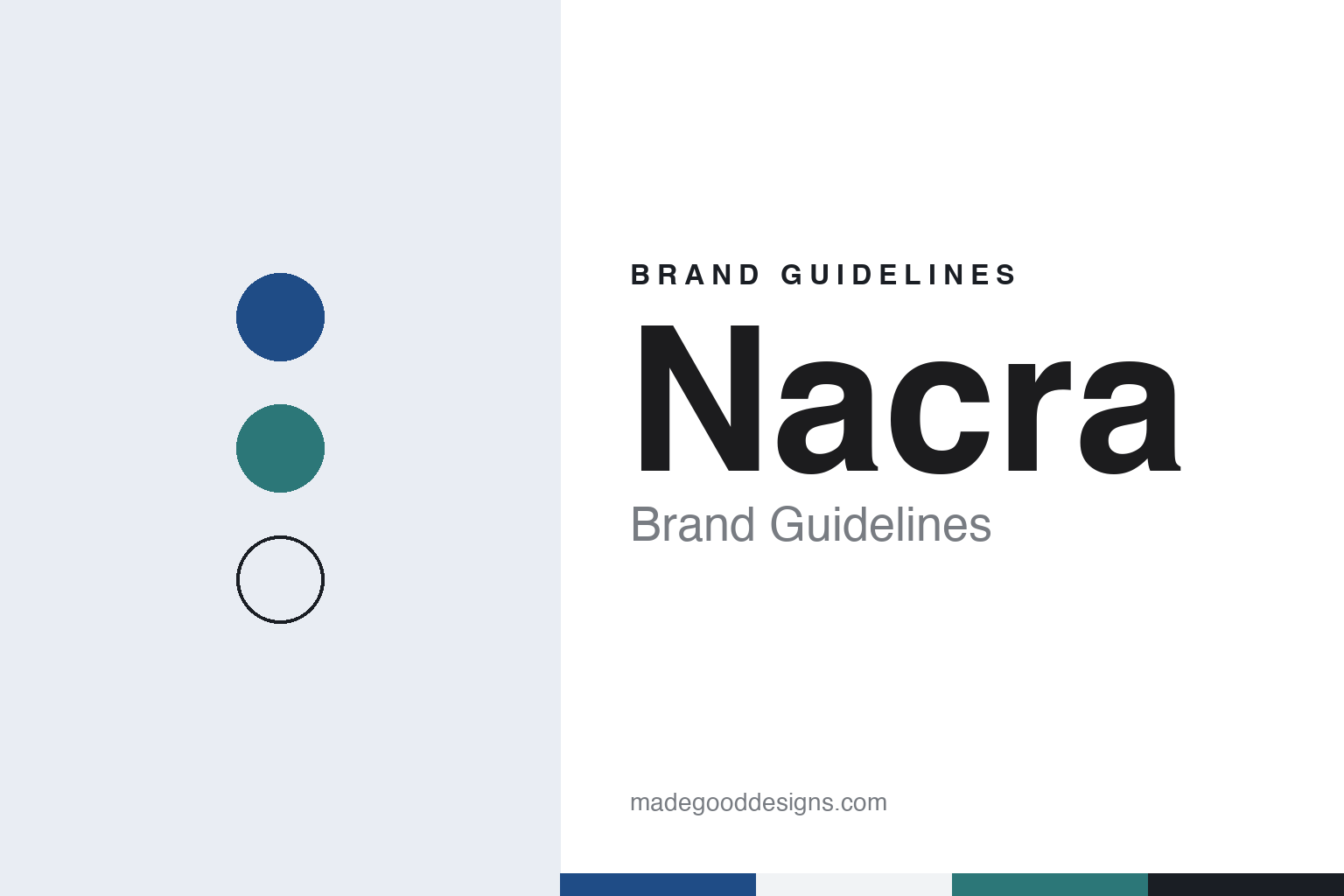
This guide’s Nacra palette is Sail blue #1F4C86, Carbon #1A1E24, Spray white #F1F3F5, Foil teal #2C7778 and Dune sand #ECE5D8. The tones are the guide’s own unofficial interpretation, not official Nacra hex codes.
When was Nacra founded?
Nacra was founded in 1975, in United States. Nacra is known for Nacra 5.2, Nacra 17, Nacra 15.
Who founded Nacra?
Nacra was founded by Tom Roland in 1975. Nacra is known for Nacra 5.2, Nacra 17, Nacra 15.