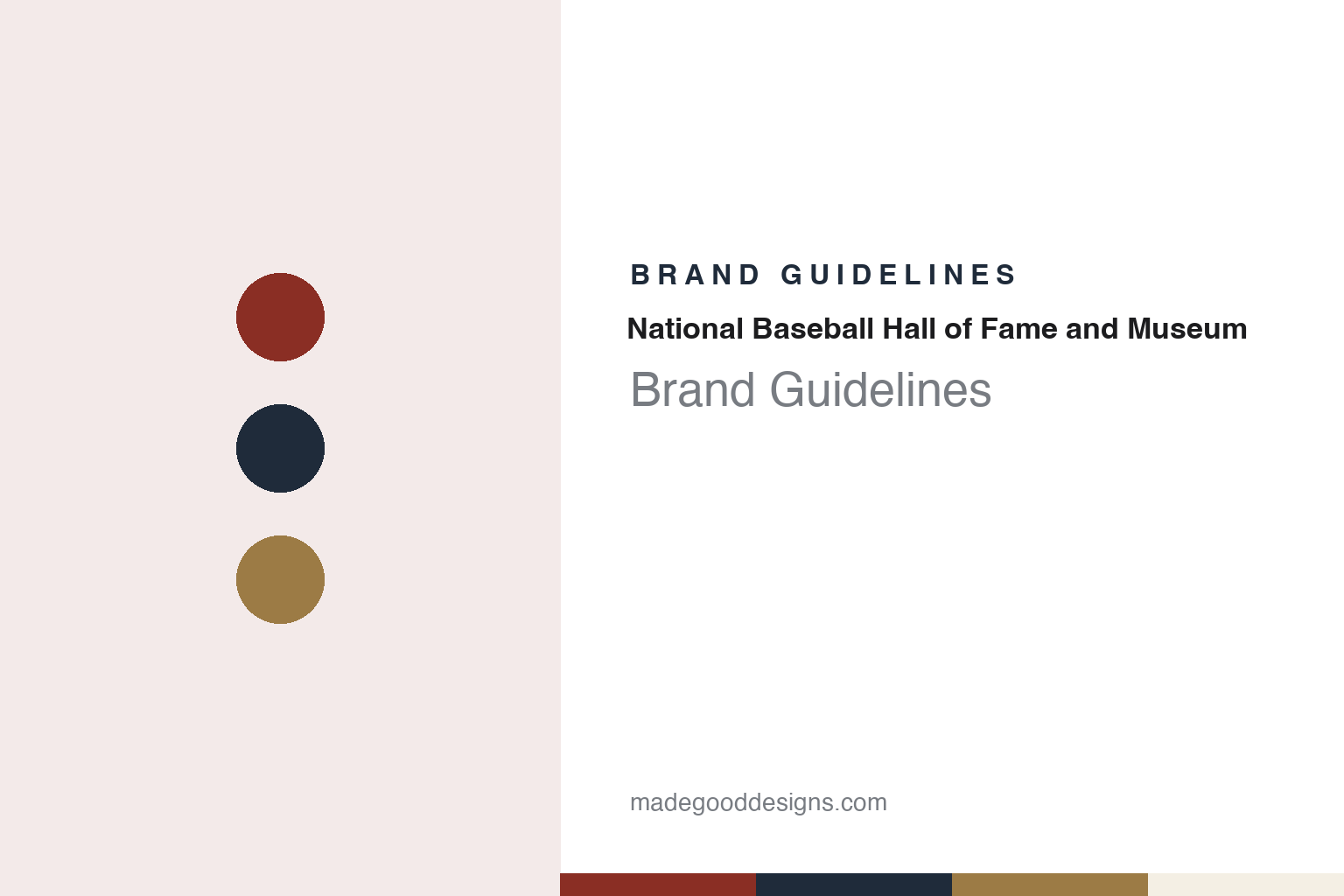
National Baseball Hall of Fame and Museum Brand Guidelines
A village museum dedicated for baseball’s centennial.
Aa
Two constants: a Main Street brick, Otsego navy and infield tan palette and a slab serif register. Abstract homage — not a National Baseball Hall of Fame and Museum asset; no logo, plaque or object is reproduced.
The Centennial
A founding story, a village and a centennial in 1939.
The National Baseball Hall of Fame and Museum is in Cooperstown, a village in upstate New York on the shore of Otsego Lake, and its location comes from a founding story. In 1905 a commission was set up to establish where baseball began. It concluded that the game had been devised by Abner Doubleday at Cooperstown in 1839; the Great Events from History series, published by Salem Press and carried in EBSCO’s Research Starters, dates its report to 30 December 1907, while the museum’s own timeline gives 1908. The same Salem Press account says the report rested largely on one former resident’s recollection and was questioned from the start, and that the game in fact grew out of earlier bat-and-ball games. An article reposted by the Society for American Baseball Research in July 2017 says doubts began soon after the commission proclaimed its finding on scant evidence, and that in 1938 baseball’s centennial organisers declined to induct Doubleday himself.
The story nevertheless shaped the village. Cooperstown bought the field said to be the site of the 1839 game in 1932 and dedicated it as a ballpark, Doubleday Field, in 1935, according to the Salem Press account. In the same years an old ball found near the village became known as the “Doubleday baseball.” The museum says Stephen C. Clark, a Cooperstown philanthropist, bought the ball in 1935 and created a one-room display of baseball objects in a local club, which drew wide attention. English Wikipedia says Clark, an heir to the Singer sewing-machine fortune, wanted to bring visitors back to the village.
As the centennial of 1839 approached, baseball’s leaders agreed to build a hall of fame and museum in Cooperstown. The first election was held in 1936, with members of the Baseball Writers’ Association of America as voters, and further votes before the opening added a committee to honour the game’s early organisers. A Cooperstown architect, Frank Whiting, designed the building, on the site of a former commercial block on Main Street beside Doubleday Field, and the plans were complete by July 1937, the Salem Press account says. Clark paid for its construction, English Wikipedia says.
The hall was dedicated on 12 June 1939, during baseball’s centennial celebrations. MLB.com, marking the seventy-fifth anniversary in June 2014, described the inductions held that day on the steps of the new red-brick building, a ceremony opened by Clark as the hall’s founder, with a crowd filling Main Street. A commemorative baseball stamp went on sale that year, and from 1940 an annual Hall of Fame Game was played on Doubleday Field until 2008, the museum says.
Colour
A gallery of plaques, three floors of objects and a library.
The red-brick building of 1939 has been extended many times. The museum’s timeline records a new wing in 1950 and a dedicated Plaque Gallery in 1958; the National Baseball Library in 1968; the Fetzer-Yawkey wing with the Grandstand Theater in 1989; and an expanded library with a research facility connected to the museum in 1994. A two-year renovation from 2003 updated the exhibits, improved access and upgraded preservation, and English Wikipedia says that work was completed in spring 2005.
The Plaque Gallery is the heart of the hall. English Wikipedia calls it the museum’s most recognisable space and says it holds the induction plaques of all members, each with a likeness in relief and a short text. Each plaque lists every team the member served, while the likeness is usually shown wearing one team’s cap. The rest of the museum is spread over three floors. English Wikipedia describes a first floor with the Plaque Gallery, a theatre, an art gallery and an Education Gallery for school groups; a second floor given mostly to “The Game,” a timeline of baseball from its beginnings to the present; and a third floor devoted to records, the post-season and the major-league clubs. According to the hall, as English Wikipedia reports, the collection numbers about 40,000 artifacts and 3 million library items, from newspaper clippings to photographs, together with about 140,000 baseball cards.
Members are chosen in two ways. Players may be elected by long-serving members of the Baseball Writers’ Association of America, with a set share of the ballots needed, or by committees that consider candidates from different eras of the game, including managers, umpires and executives, English Wikipedia says. New members are inducted each summer at an outdoor ceremony in Cooperstown; MLB.com reported in 2014 that the ceremony that July would be held in the grounds of the village’s Clark Sports Center, a short distance from the museum.
Typography
Halls of fame and sports and music museums.
A hall of fame or a sports or music museum usually has an organisation behind its name. Some are independent non-profit foundations that work alongside a league without belonging to it; others are run by a private foundation set up by a founding family, by a body linked to a league or an international federation, or with the support of a city. The founding body, the operator today and the date of the present building are often different things, and each is worth checking separately.
Many halls are tied to a place through a founding story. A town may be where a league was organised, where a sport is said to have begun, or where a musical genre took shape, and halls often present that story themselves, sometimes openly as a legend rather than as settled history. Local campaigns, newspaper headlines and civic fundraising feature in several of these histories, as cities competed to be chosen as the site.
The buildings range widely. Some halls moved into converted buildings, from a former bank to a nineteenth-century casino; others were purpose-built, from a modest red-brick hall on a village main street to rotundas, spheres and lakeside towers designed by named architects. Most have been extended or renovated several times, often to mark an anniversary, and the dates of each expansion are part of the record.
The honours themselves shape how these places look. Members may be marked with plaques bearing a likeness in relief, sculpted busts, jackets or rings, usually presented at an annual ceremony after a vote by writers, committees or panels. Identities in the category tend to borrow from those honours and from trophies, stars and crests, so a hall’s visual language often begins with the object it gives to each new member.
Aa
A sturdy slab serif, in the spirit of cast lettering. (Specimen set in Bitter, a slab serif STAND-IN; NOT the National Baseball Hall of Fame and Museum logo.)
National Baseball Hall of Fame and Museum
A private foundation on Main Street.
The hall is run by a private foundation, English Wikipedia says, and the chair of its board of directors is a granddaughter of its founder. It sits on Main Street in the centre of the village, a short walk from Doubleday Field and Otsego Lake, and its main entrance is close to the steps where the 1939 ceremony was held, the hall’s president told MLB.com in 2014.
Much of its work happens away from the galleries. The museum’s timeline describes a travelling exhibition, Baseball As America, which opened at the American Museum of Natural History in New York in March 2002 and then toured nine more museums across the country, and an electronic field trip for schools broadcast from Cooperstown in the same year. English Wikipedia says the hall also offers educational programmes online for pupils who cannot visit. The library and archive hold scorebooks, photographs and newspaper files for researchers, and the museum records an accession of more than 2,000 pieces from a single collection in 1963.
The museum adds new permanent exhibitions over time rather than rebuilding its core. Its timeline records galleries on the game in Latin America and the Caribbean in 2009, on the history of Black baseball in 2024, and on the exchange of the game between Japan and the United States in 2025. Traces of 1939 remain in the building itself: the red brick of the original front, the plaques in their long gallery, and the “Doubleday baseball” with its stitched cover and cloth stuffing, which the museum describes as a symbol of the legendary first game.
For a design guide, the National Baseball Hall of Fame and Museum shows how a hall can build an identity from a founding story it presents as a legend, a small-town setting and a single repeated object, the plaque. Compare MLB, the league whose players fill most of the gallery, and the Pro Football Hall of Fame, which honours its members with busts rather than plaques. For this guide we use brick red, navy and tan with a slab serif, an unofficial interpretation; no product or logo is reproduced.
Explore & save
Keep National Baseball Hall of Fame and Museum’s identity on hand — save it to a board in the Made Good inspiration library.
National Baseball Hall of Fame and Museum identity set
Pin the Main Street brick, Otsego navy and infield tan palette and the slab serif register to your own board.
Source & notes
Frequently Asked Questions
What font can I use to match the National Baseball Hall of Fame and Museum look?
This guide describes National Baseball Hall of Fame and Museum’s type as “A sturdy slab serif, in the spirit of cast lettering”. Its type specimen is set in Bitter from Google Fonts as a stand-in; Bitter is not National Baseball Hall of Fame and Museum’s own lettering.
What colours are in the National Baseball Hall of Fame and Museum palette?
This guide’s National Baseball Hall of Fame and Museum palette is Main Street brick #8A2E24, Otsego navy #1F2B3A, Infield tan #9C7B45, Scorecard ivory #F4EFE4 and Ink #18191C. The tones are the guide’s own unofficial interpretation, not official National Baseball Hall of Fame and Museum hex codes.
Who founded National Baseball Hall of Fame and Museum?
National Baseball Hall of Fame and Museum was founded by Stephen C. Clark.