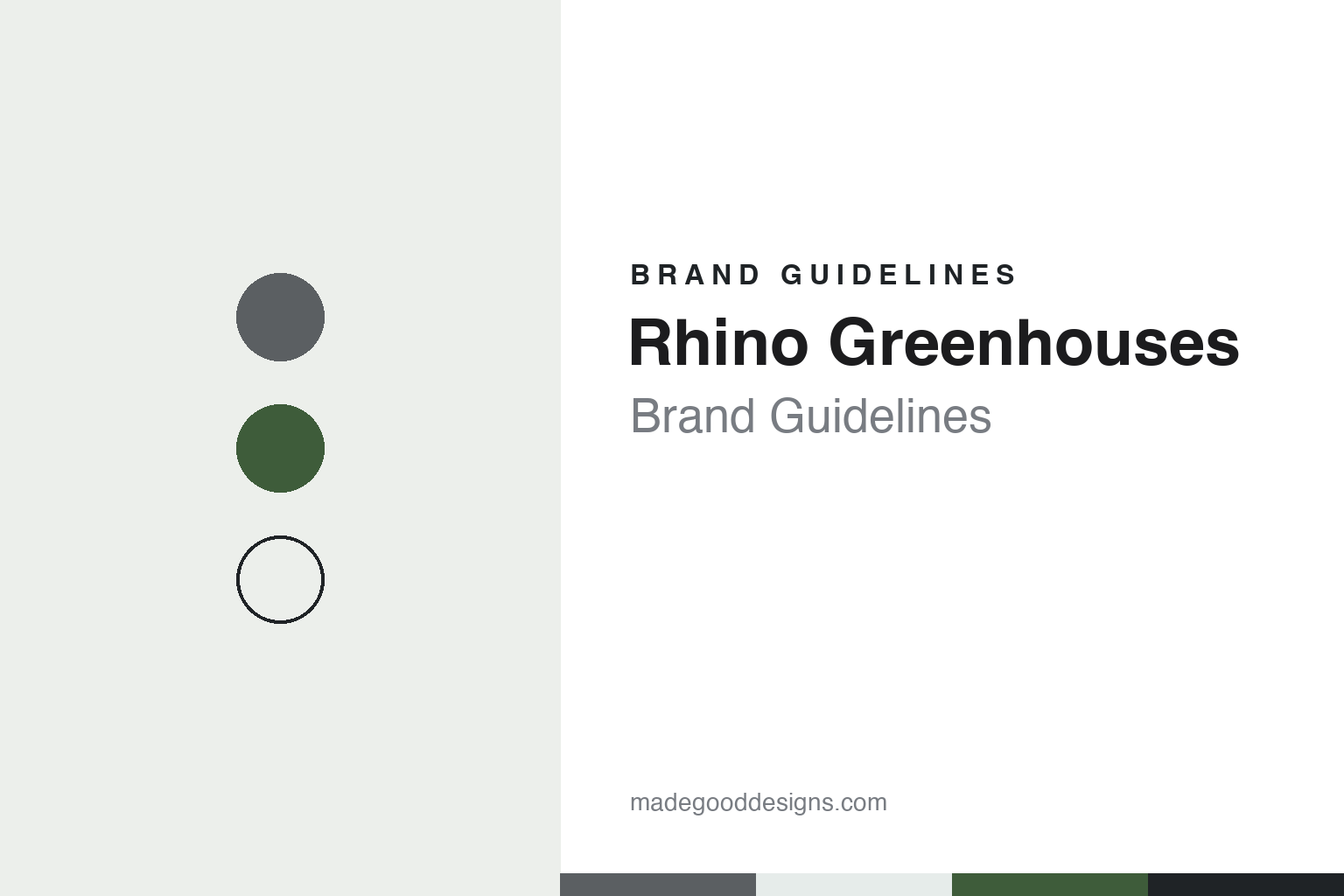
Rhino Greenhouses Brand Guidelines
The Norfolk greenhouse maker that sells straight to gardeners.
Aa
Two constants: a slate, allotment green and glass-pale palette and a sturdy grotesque register. Abstract homage — not a Rhino Greenhouses product or mark; no greenhouse, logo or nameplate is reproduced.
Greenhouses Direct
A Norfolk village, a direct-selling company and a strong animal name.
Rhino Greenhouses is a Norfolk maker of aluminium greenhouses, based in the village of East Harling. Its trading company, Greenhouses Direct Limited, was incorporated on 10 March 1995, according to the UK’s Companies House register, which gives East Harling as its registered office. The company’s own timeline matches that start — it lists 1995 as the year Greenhouses Direct “was born” — and dates the Rhino name to 1999.
The company tells the story as a reaction to what was already on sale. “Rhino was born out of our desire for something better,” its website says, adding that every model is “designed and manufactured by gardeners, for gardeners.” It says it began building greenhouses in East Harling and is still in the village, now in a purpose-built factory that its timeline dates to 2005. The name, it explains, was chosen because the rhinoceros is “one of the strongest, most resilient creatures on the planet.”
The range grew in stages. The timeline lists the Rhino Premium in 2010, the Rhino Ultimate in 2018 and the Rhino Ultimate Patio Greenhouse in 2024. Today the line-up is grouped as Classic, Premium, Ultimate and Patio models, sold in widths from 6ft to 12ft, and the company also sells cold frames, metal raised beds and greenhouse staging, as well as spare parts such as replacement glass panes and ventilation fittings.
Both names are still in use side by side. The register entry and the review platforms carry the Greenhouses Direct name, the brochure sign-up form refers to “Rhino Greenhouses Direct,” and the products, the website and the showroom carry the Rhino name alone.
Colour
Selling direct, made in Britain, written by gardeners.
Rhino’s brand is built on selling direct. “You can only get a Rhino from Rhino,” the website says, setting out its core values as provenance, durability, satisfaction and specification, and explaining that supplying customers itself lets it “cut out the middleman fees.” Its standard specification, the company says, includes ventilation, an integral base, 4mm toughened glass and water collection — features it says other makers charge extra for. Buyers are invited to request a brochure pack that, the company says, contains the full range, a price list and aluminium sample swatches in each of its colours, or to book a visit to a show site at the factory.
British manufacture is the other pillar. “Every Rhino we’ve ever sold has been designed and built in Britain,” the company says. It is listed as a member of Made in Britain, the membership organisation for British manufacturers, whose member profile for Rhino Greenhouses gives East Harling as its location and says it joined in March 2018; the profile lists Classic, Premium and Ultimate models in sizes such as 6×8 and 12×16.
The voice is that of a fellow gardener as much as a manufacturer. The website describes “working in a greenhouse on a dark January evening, fingers cold and breath steaming,” and the team calls itself “greenhouse designers, makers and sellers, but more importantly … gardeners like you.” Its pages carry monthly sowing guides and recipes by the cook and food writer Gill Meller, whom the company introduces as a River Cottage alumnus, and name brand ambassadors including the gardener Carol Klein, Jeska Herne of Lobster & Swan, the writer Sally Coulthard and Ellen Mary.
Locally, the company says it supports the Grapes Hill Community Garden in Norwich and other gardening projects in its area, and presents that work under the heading of community, alongside strength, durability and style, as one of the values the brand was built on.
Typography
The category.
Greenhouse makers sell a building, but they mostly sell a picture of a garden. The oldest visual language in the trade is Victorian: ridged roofs, finials, cast brackets and the steep pitch of a nineteenth-century glasshouse set against a brick wall. Some makers reproduce those proportions closely in aluminium; Alitex, for example, says it follows the width of Victorian glazing bars, a 45-degree roof pitch and traditional eaves heights. Others present slimmer, plainer frames as modern horticulture, and many sell polycarbonate kits that leave ornament out altogether.
Materials set the colour story. Timber greenhouses, often cedar, are shown in their warm natural tones, while aluminium frames are usually powder-coated in a short list of colours, from dark greens and blacks to softer creams and greys. The names attached to those structures borrow from gardens and estates: Alitex’s National Trust Greenhouse Collection is named after Trust gardens such as Hidcote, Scotney and Stourhead, and endorsements from bodies like the Royal Horticultural Society and the Royal Botanic Gardens, Kew are placed prominently.
The copy speaks the language of the kitchen garden & the potting shed: seed trays, tomatoes, pelargoniums, staging and benching, cold frames and walled gardens. Heritage is a common theme. Hartley Botanic, founded in Greenfield in 1938, has built its flower-show stands around vintage structures from each decade of its history, planted and propped to match.
Catalogue photography follows the same logic. Greenhouses are usually pictured planted up rather than empty, with terracotta pots, tools and sometimes a chair inside, so that the glass reads as a room as much as a structure. Flower shows such as RHS Chelsea, Hampton Court and Tatton Park act as live versions of those catalogues, and the makers’ stands are judged and reported on in their own right.
Aa
A sturdy grotesque for a brand named after a strong animal. (Specimen set in Archivo, a sans STAND-IN; NOT the Rhino Greenhouses logo.)
Rhino Greenhouses
From the factory village to the flower shows.
The flower-show circuit is where Rhino meets buyers in person. The Royal Horticultural Society’s list of Norfolk exhibitors at the 2026 RHS Chelsea Flower Show includes Rhino Greenhouses as a tradestand from East Harling, offering “greenhouses and greenhouse accessories,” and the company’s own pages report on its stand at the RHS Malvern Spring Festival the same year. The company says it has been represented at RHS flower shows for years and has received awards including from Which? and the Great British Growing Awards; it also says the review platform Feefo gave it Platinum status in January 2025.
The company describes itself as “Britain’s best loved greenhouse brand,” a title it says comes from customer and professional reviews; we give it as the company’s own description. Its marketing leans on recognisable faces and seasonal content rather than technical language: a garden blog with month-by-month guides, ambassador quotes on the product pages and recipes that put the greenhouse in the kitchen-garden story. On its reviews page the company says that, across more than nine years of Feefo data, it has kept an average of 4.9 out of 5 for product ratings, and it quotes its ambassadors beside the reviews: the writer Sally Coulthard, for one, says a Rhino “feels like it’s been designed by someone who really understands what a busy gardener needs.”
For a design guide, Rhino Greenhouses shows how a direct-selling maker can build a brand around one strong animal name, a factory village and a gardener’s voice. Compare Elite Greenhouses and Halls, two other greenhouse names in this guide. For this guide we use a slate grey, an allotment green and a glass-pale tint with a sans, an unofficial interpretation; no product or logo is reproduced.
Explore & save
Keep Rhino Greenhouses’s identity on hand — save it to a board in the Made Good inspiration library.
Rhino Greenhouses identity set
Pin the Rhino Greenhouses slate, allotment green and glass-pale palette and the sturdy grotesque register to your own board.