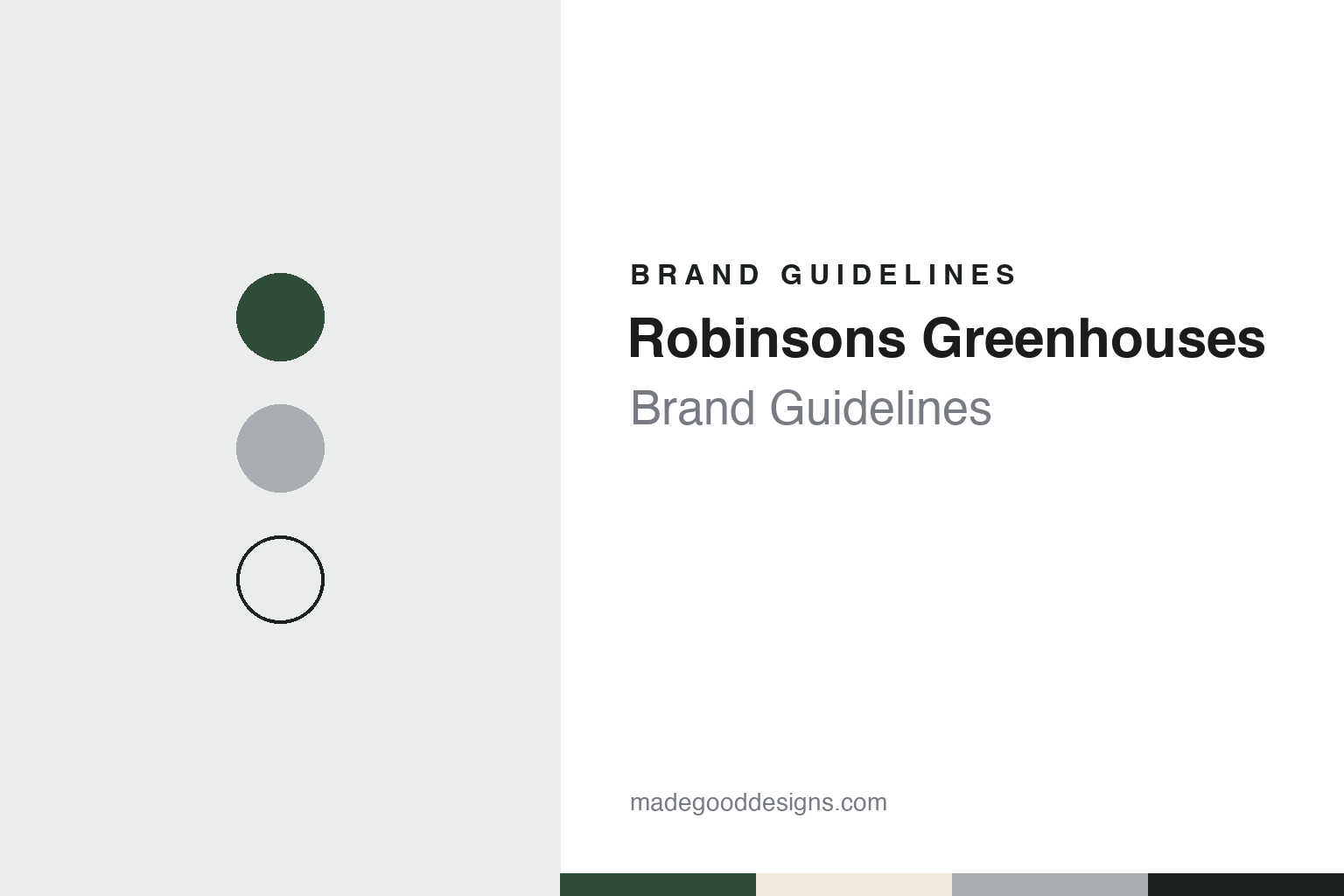
Robinsons Greenhouses Brand Guidelines
The 1947 greenhouse name built on a heavier aluminium frame.
Aa
Two constants: a Victorian green, aluminium and cream palette and a heritage serif register. Abstract homage — not a Robinsons Greenhouses product or mark; no greenhouse, logo or nameplate is reproduced.
Robinsons of Winchester
From cedar and commercial glasshouses to aluminium.
Robinsons Greenhouses is one of the older names in British greenhouses. The company says it was established in 1947, and its earliest archived website, captured in November 1999, already claimed “over 50 years” at “the forefront of the greenhouse market.” Its present owner describes the early business as Robinsons of Winchester, which “quickly grew to be a famous name in greenhouses — originally with cedar greenhouses and often with commercial greenhouses,” and adds that many well-known garden centres were once built by Robinsons.
The move to metal came later. In the late 1980s and 1990s, the same account says, Robinsons established itself in the domestic market by “insisting on using more aluminium in the frames for strength.” By the late 2000s the website was presenting the brand as “Robinsons Premier Aluminium Greenhouses,” with model names that nearly all began with R — among them the octagonal Renaissance, the 6ft-wide Regent, the 8ft Royale and the 10ft Rosette — plus lean-to and dwarf-wall versions. The 12ft Regal and the 8ft Riviera completed the range.
In those years the brand reached buyers through retailers rather than direct: the 2009 website pointed visitors to “display sites throughout the UK” and a retailer finder, and the present website still carries a “Where to Buy” page alongside online ordering.
For a time the brand sat inside a larger building-products group. An archived 2009 version of the website says Robinsons Greenhouses was “part of the Compton Group of companies,” alongside Compton Buildings, Marshalls Sectional Buildings, Alton Greenhouses, Alton Victorian Greenhouses and Ultimate Garages, and that Compton Buildings was “a Marshalls plc specialist company.”
The company register records the name moving between shells. Companies House shows that a dormant company called Robinsons Greenhouses Limited, so named from November 1997, was renamed Marshalls Newco No. 7 in May 2010 and dissolved in 2013, while a company formed in February 2010 as Marshalls Newco No. 7 took the Robinsons Greenhouses Limited name that May and is still registered, as a non-trading company, in Elland, West Yorkshire.
Colour
A dealer becomes the owner.
The present owner came from the brand’s own dealer network. The Greenhouse People, a Staffordshire greenhouse retailer, says it became a Robinsons agent in 1989, just after buying a Robinsons greenhouse for itself and finding there was no local agent, and grew into one of the brand’s largest distributors. “In July 2011 The Greenhouse People became the owners of Robinsons Greenhouses,” its website said in 2015, adding that the greenhouse it bought in 1988 was “still going strong.” Companies House shows The Greenhouse People Ltd was incorporated in December 2003, and the company is named as the operator in the footer of the Robinsons website.
Since then the brand has been run from Cresswell, near Stoke-on-Trent. Archived versions of the Robinsons website from the early 2010s give a Cresswell contact address, and the company now says that “all Robinsons greenhouses are made in our factory in Staffordshire” and that “the aluminium raw material is also extruded in the UK.” Its home page sums this up as “British Designed & Manufactured” and “Handmade in Britain.” Its heritage page adds that, for over 75 years, “amateur and professional growers alike” have recognised the name.
The product story centres on the frame. Robinsons describes a box-section framework that, it says, uses 25% more aluminium than similarly sized greenhouses, and traces its designs back to “the original blueprints crafted for the seasoned nurseryman.” The current range is grouped into Victorian, classic, small and commercial greenhouses, plus packages; the Victorian models add cast aluminium spandrels at the eaves and ridge, and the website also describes contemporary designs for uses including hydroponics and vertical farming.
The same owner has sold other makers’ greenhouses too: its 2015 website listed pages for Halls, Alton, Swallow and Simplicity greenhouses alongside Robinsons.
Typography
The category.
Greenhouse makers sell a building, but they mostly sell a picture of a garden. The oldest visual language in the trade is Victorian: ridged roofs, finials, cast brackets and the steep pitch of a nineteenth-century glasshouse set against a brick wall. Some makers reproduce those proportions closely in aluminium; Alitex, for example, says it follows the width of Victorian glazing bars, a 45-degree roof pitch and traditional eaves heights. Others present slimmer, plainer frames as modern horticulture, and many sell polycarbonate kits that leave ornament out altogether.
Materials set the colour story. Timber greenhouses, often cedar, are shown in their warm natural tones, while aluminium frames are usually powder-coated in a short list of colours, from dark greens and blacks to softer creams and greys. The names attached to those structures borrow from gardens and estates: Alitex’s National Trust Greenhouse Collection is named after Trust gardens such as Hidcote, Scotney and Stourhead, and endorsements from bodies like the Royal Horticultural Society and the Royal Botanic Gardens, Kew are placed prominently.
The copy speaks the language of the kitchen garden & the potting shed: seed trays, tomatoes, pelargoniums, staging and benching, cold frames and walled gardens. Heritage is a common theme. Hartley Botanic, founded in Greenfield in 1938, has built its flower-show stands around vintage structures from each decade of its history, planted and propped to match.
Catalogue photography follows the same logic. Greenhouses are usually pictured planted up rather than empty, with terracotta pots, tools and sometimes a chair inside, so that the glass reads as a room as much as a structure. Flower shows such as RHS Chelsea, Hampton Court and Tatton Park act as live versions of those catalogues, and the makers’ stands are judged and reported on in their own right.
Aa
A heritage serif for a name that dates from 1947. (Specimen set in Libre Caslon Text, a serif STAND-IN; NOT the Robinsons Greenhouses logo.)
Robinsons Greenhouses
The same promise, decade after decade.
The brand also looks beyond Britain. Its website is published in English, German, Norwegian and Finnish, with country settings for the UK, Germany, Norway and Finland, and it presents commercial greenhouses for retail and growing businesses alongside garden models, inviting buyers with special projects to contact the team directly.
The language has stayed close to its roots. In 1999 the website used the line “Growing Better Through Design” and promised “a lifetime of gardening success”; around 2012 it spoke of “a lifetime of gardening enjoyment” and “over 60 years” of experience; today it talks of “over 75 years,” calls a Robinsons “Your Garden’s Crown Jewel” and backs the frame with a 10-year guarantee, as the company describes it. The greenhouse maker is unrelated to Robinsons, the British soft-drinks brand.
For a design guide, Robinsons Greenhouses shows how a postwar name can be carried through changes of owner and material by keeping its R-named models, its slogans and its story of a heavier frame. Compare Halls, another greenhouse name The Greenhouse People sold in 2015, and Alitex. For this guide we use a deep Victorian green, aluminium grey and a cream with a serif, an unofficial interpretation; no product or logo is reproduced.
Explore & save
Keep Robinsons Greenhouses’s identity on hand — save it to a board in the Made Good inspiration library.
Robinsons Greenhouses identity set
Pin the Robinsons Greenhouses Victorian green, aluminium and cream palette and the heritage serif register to your own board.