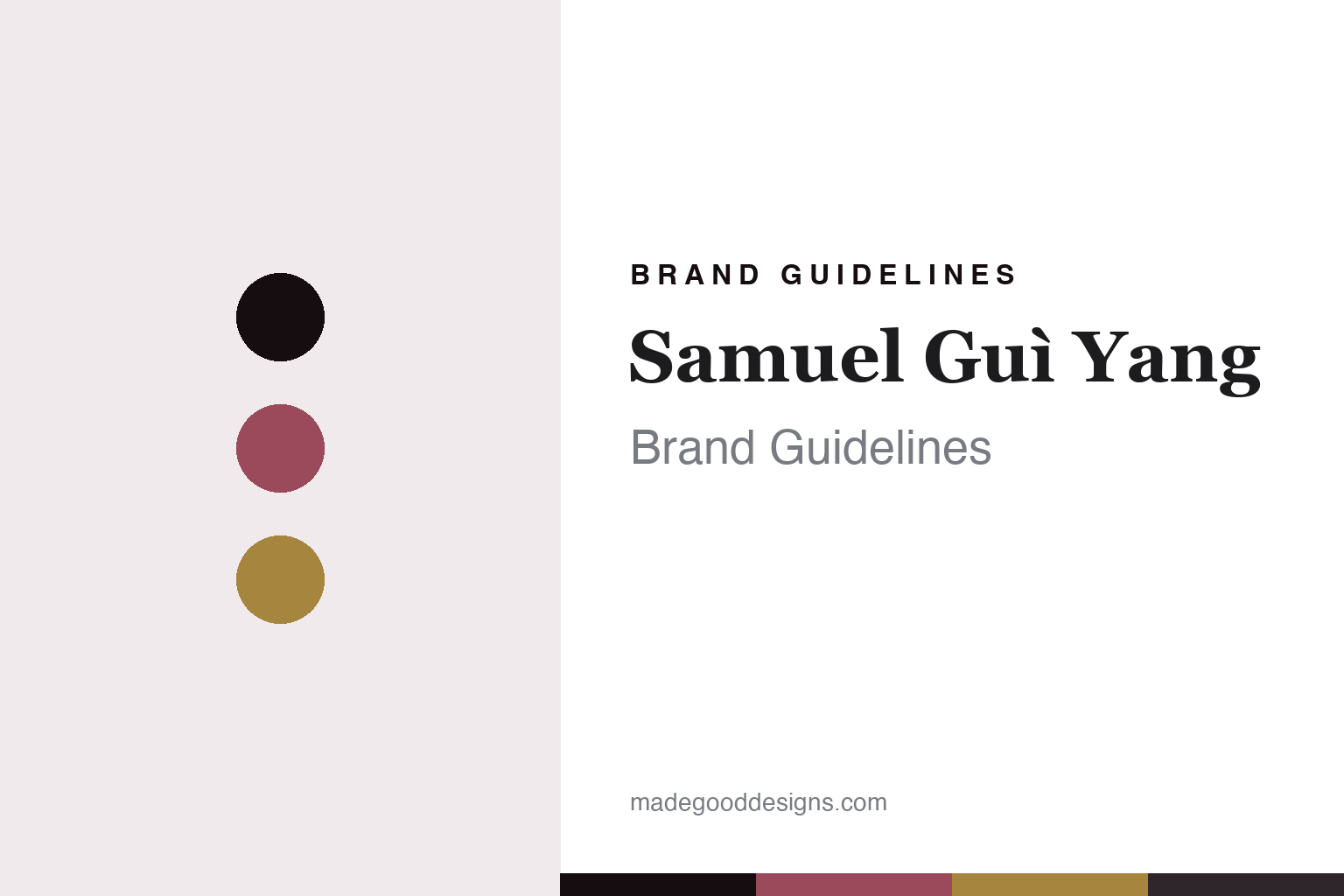
Samuel Guì Yang Brand Guidelines
The qipao, reimagined.
Aa
Two constants: a rose-and-gold palette and an elegant serif register. Abstract homage — not a Samuel Guì Yang piece, garment or wordmark.
The qipao, reimagined
Samuel Guì Yang reinterprets traditional Chinese dress through modern cutting.
Samuel Guì Yang is a lesson in a heritage garment as the identity. A Chinese label working between London and Shanghai, it built its name on reinterpreting traditional Chinese dress — chiefly the cheongsam, or qipao — through creative pattern-cutting and draping fused with Western tailoring.
Its identity is the qipao, reimagined. Samuel Guì Yang’s reworked Mandarin collars, wrap fronts and draped silhouettes, its restrained and quiet sensuality, are the work it is known for. Heritage dress, made modern. A brand that reclaims a Chinese garment on its own terms.
(Honest notes, so the story stays precise. Samuel Guì Yang is a Chinese brand, led by the Shenzhen-born designer of the same name, who earned an MA in womenswear at Central Saint Martins — not the London College of Fashion — graduating in 2015; the Stockholm-born designer Erik Litzén joined as co-designer in 2017, so when we speak of “the designers,” both are meant. It is based between London and Shanghai and, deliberately, shows at Shanghai Fashion Week rather than on the Paris runway; it is primarily womenswear, and we frame it honestly as design-led fashion. On ownership, it is independent — it grew slowly and refused early buyers — and its LVMH Prize recognition in 2020 was as a semi-finalist, not a winner, in a year whose final was cancelled. On production, the honest point: it is made across the UK and China, material by material, so we do not claim a single country. Its signature is a modern reinterpretation of the cheongsam and traditional Chinese dress; we describe the qipao lineage respectfully as a living cultural garment reimagined, never a costume or an exotic trope, and never reproduce the actual garments. We also do not attribute a signature dress name we cannot verify. Its wordmark is IP we describe but never reproduce, and there is no official brand hex — these tones are an unofficial interpretation. This is design commentary and does not promote any product.)
Colour
Samuel Guì Yang lives in a rose-and-gold palette. Click a swatch to copy the hex.
Samuel Guì Yang’s identity is refined, sensual and restrained — a rose, an ink, a gold, a graphite, and a silk off-white. The palette leans rose and gold: the register of quiet luxury and heritage silk rather than loud statement. It signals elegance and reinterpretation over spectacle. The honest caveat: with no published brand hex, these values are an original, unofficial interpretation, not first-party colours.
The lesson is a rose-and-gold palette signals a refined reinterpretation. Samuel Guì Yang’s world is a refined, sensual, considered object. For designers, it is a reminder that a soft, warm palette can carry a heritage-and-modernity idea — that a brand reworking a historic garment needs colour that feels both timeless and quietly contemporary. Because a mid rose can fail as small text, keep type dark and let the colour live in the accents, palette and band. The takeaways: reinterpret with respect; keep the palette refined; let the cut lead; and treat any single hex as unofficial.
Typography
The register is an elegant serif — refined, quiet, sensual.
Samuel Guì Yang’s identity carries a refined, quiet, sensual spirit — an elegant object, not a loud one. An elegant serif captures the mood: graceful and timeless, the register of considered, heritage-aware fashion. Set in a rose-and-gold palette, the elegant serif feels refined and sensual — exactly the personality the brand carries. It is graceful rather than plain, mirroring a draped silhouette. (Samuel Guì Yang’s real garments and wordmark are things we describe but do not reproduce, and the exact typeface is not ours to use.) Because it is not ours to use, the honest description is “an elegant-serif spirit,” shown here in a stand-in. The type behaves like the brand: refined, quiet and sensual.
Aa
An elegant-serif spirit — refined and sensual. (Specimen set in Playfair Display, an elegant-serif STAND-IN; NOT the Samuel Guì Yang wordmark.)
A heritage garment as identity
Samuel Guì Yang stands for the qipao, reimagined.
Samuel Guì Yang is a lesson in making a heritage garment the identity. A rose-and-gold palette, an elegant serif and a reworked qipao make one historic garment the whole brand — refined, sensual and modern. The reinterpretation is the differentiator. The differentiator is taking a single culturally-loaded garment and reworking it with real craft — pattern-cutting, draping, Western tailoring — so the heritage is honoured and made contemporary at once.
Put to work, the identity is a reinterpretation as design. A house building in this spirit would choose a garment or tradition that genuinely belongs to it, then reimagine it with skill and respect, so the customer buys into a story of heritage renewed rather than a costume. The lesson Samuel Guì Yang teaches is that a single, well-chosen heritage idea plus serious cutting craft can build a brand: the qipao gives it meaning, and the tailoring gives it modernity. The heritage is the personality, and the craft is the proof — handled as a living culture, not an exotic motif.
For designers and brand-builders, Samuel Guì Yang offers a clear takeaway: reimagine a heritage you can claim honestly. The lessons: choose a garment that means something; rework it with craft; keep the palette refined; and be honest about the story. It is also a reminder to stay accurate: the designer trained at Central Saint Martins (not the London College of Fashion), the label is co-designed with Erik Litzén from 2017, it shows in Shanghai rather than Paris, and it is made across the UK and China rather than one country — its LVMH recognition was a 2020 semi-final, not a win, and the palette here is an unofficial interpretation. Samuel Guì Yang made the reimagined qipao the brand — proof that a heritage garment can be the difference.
Explore & save
Keep Samuel Guì Yang’s identity on hand — save it to a board in the Made Good inspiration library.
Samuel Guì Yang identity set
Pin the rose-and-gold palette and the elegant-serif register to your own board.