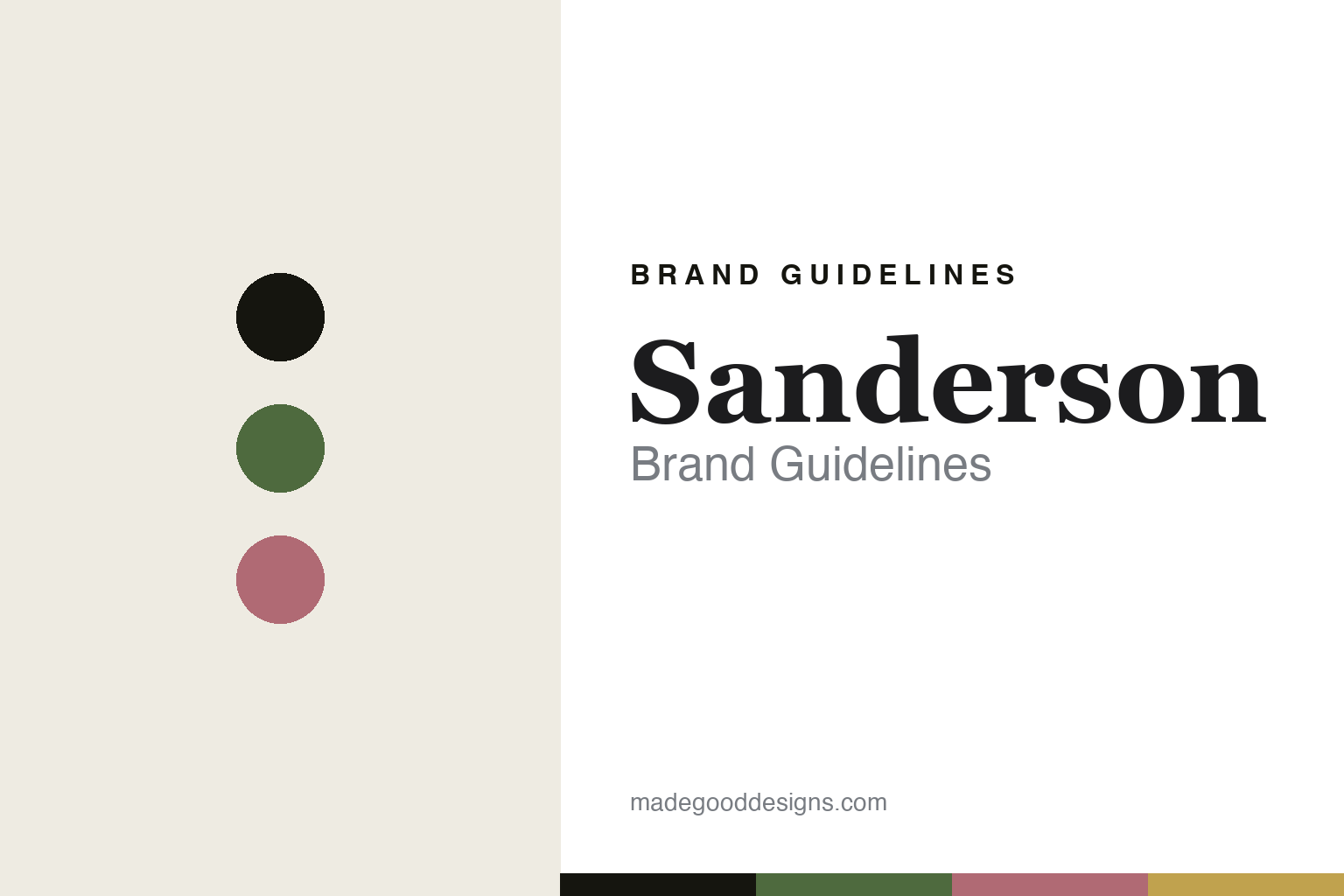
Sanderson Brand Guidelines
The English print.
Aa
Two constants: a leaf-and-rose palette and an English serif register. Abstract homage — not the Sanderson prints, wallpapers or packaging.
The English print
Sanderson is the English printed interior.
Sanderson is a lesson in an archive as English identity. Founded in 1860 by Arthur Sanderson in Islington, London — importing French wallpapers before making his own — it became one of Britain’s defining names in printed fabrics and wallpaper.
Its identity is the English print. Sanderson makes quintessentially English printed and woven fabrics and wallpapers — florals and chintzes — from a vast design archive, holds a royal warrant, and, crucially, holds the William Morris archive: when Morris & Co dissolved in 1940, Sanderson bought its wallpaper business, the rights to the Morris name and the original printing blocks. English decoration, drawn from the archive.
(Honest notes: Sanderson was founded in 1860 by Arthur Sanderson in Islington; the “& Sons” name came later. It’s now a brand of Sanderson Design Group (formerly Walker Greenbank, which acquired it in 2003; the rename is reported as 2020), whose other brands include Morris & Co, Zoffany and Harlequin — Morris & Co is a sibling brand, so we don’t merge it with Sanderson even though the group holds the Morris archive. It holds a royal warrant (since 1924); its wallpaper is made in Loughborough and fabric in Lancaster. There’s no official brand hex, and we reproduce no actual print — these tones are an unofficial interpretation. This is design commentary and does not promote any product.)
Colour
Sanderson lives in a leaf-and-rose palette. Click a swatch to copy the hex.
Sanderson’s identity is floral, heritage and English — a leaf green, an ink, a rose, a gold, and a cream. The palette pairs a leaf with a rose — the register of English chintz and floral prints. It signals garden and heritage rather than novelty. The honest caveat: with no published brand hex, these tones are an original, unofficial interpretation, not first-party values.
The lesson is a leaf with a rose signals an English print house. Sanderson’s world is a floral, printed interior. For designers, it is a reminder that a deep archive — 160 years of English design, plus the Morris legacy — can be a whole identity. Because a mid green can fail as small text, keep type dark and let the colour live in the accents, palette and band. The takeaways: build an archive; hold the warrant; steward a heritage (Morris); and treat any single hex as unofficial.
Typography
The register is an English serif — floral, heritage, British.
Sanderson’s identity carries a floral, heritage, British spirit — an English printed interior. A traditional book serif captures the mood: it is dignified and classic, the register of English decoration. Set in a leaf-and-rose palette, the English serif feels floral and heritage — exactly the personality Sanderson carries. It is established rather than trendy, mirroring chintz. (Sanderson’s real prints, wallpapers and wordmark are works we describe but do not reproduce, and the exact typeface is not ours to use.) Because it is not ours to use, the honest description is “an English serif spirit,” shown here in a stand-in. The type behaves like the brand: floral, heritage and British.
Aa
An English serif spirit — floral and heritage. (Specimen set in Libre Baskerville, a traditional book serif STAND-IN; NOT the Sanderson packaging.)
An archive as English identity
Sanderson stands for the English print.
Sanderson is a lesson in making an archive the identity. A leaf-and-rose palette, an English serif and a floral interior make the English print the whole brand — floral, heritage, British. The archive is the differentiator. The differentiator is 160 years of English design and the Morris legacy.
For designers and brand-builders, Sanderson offers a clear takeaway: build and steward an archive. The lessons: build an archive; hold the warrant; steward a heritage; and be honest about the story. It is also a reminder to stay accurate: it was founded in 1860 by Arthur Sanderson, is now part of Sanderson Design Group, and holds the William Morris archive (Morris & Co being a sibling brand) — the palette here is an unofficial interpretation. Sanderson made the English print the brand — proof that an archive can be the difference.
Explore & save
Keep Sanderson’s identity on hand — save it to a board in the Made Good inspiration library.
Sanderson identity set
Pin the leaf-and-rose palette and the English-serif register to your own board.