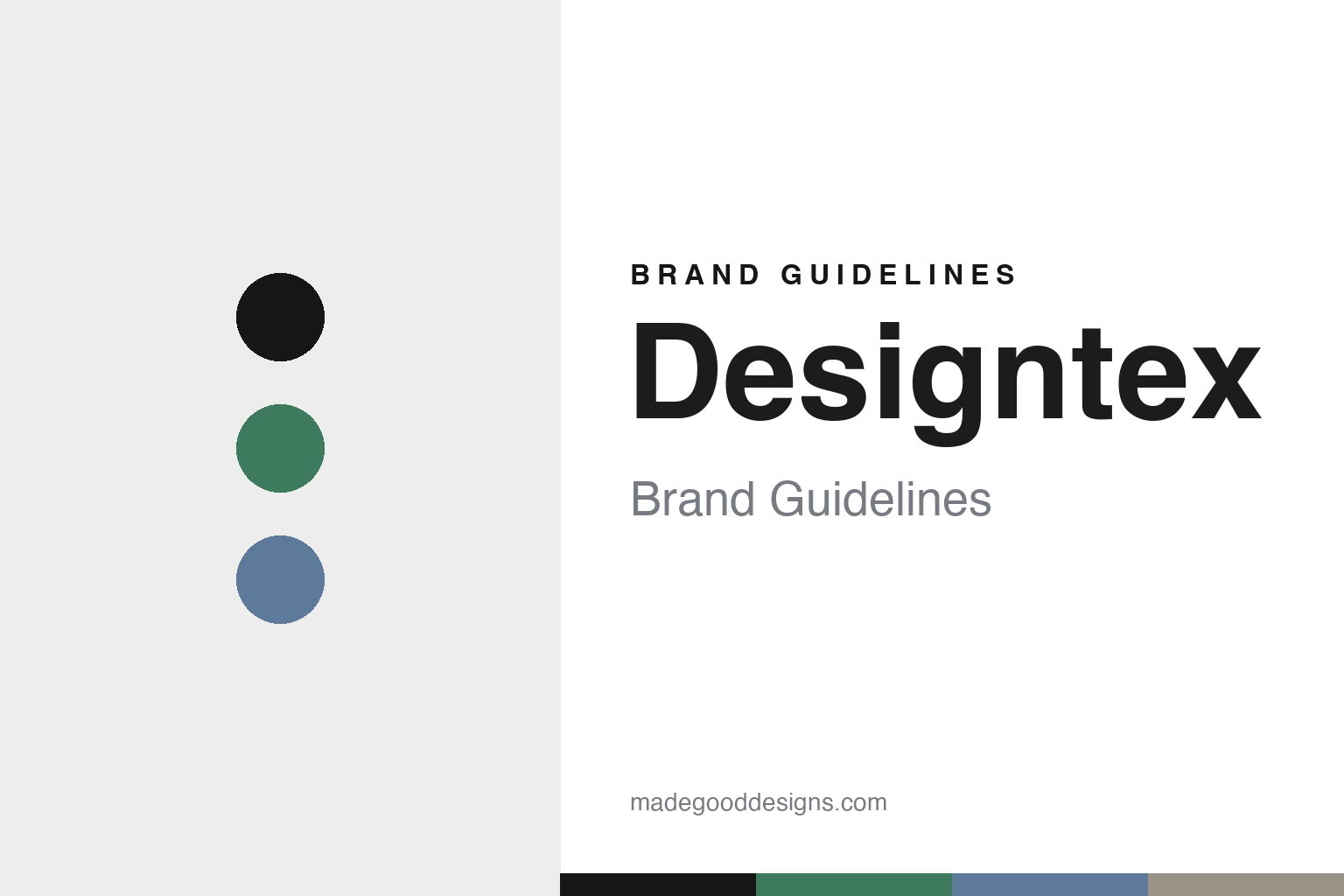
Designtex Brand Guidelines
The applied textile.
Aa
Two constants: a green-and-steel palette and an applied sans register. Abstract homage — not the Designtex textiles or packaging.
The applied textile
Designtex makes materials for the built environment.
Designtex is a lesson in the textile as applied material. Founded in 1962, it began with a flame-retardant drapery developed for Mies van der Rohe and Philip Johnson’s Seagram Building — and grew into a leading American contract-textile house.
Its identity is applied materials for the built environment. Designtex designs upholstery, panel textiles, wallcoverings and custom digitally printed materials for workplace, healthcare and commercial interiors — and it is a sustainability pioneer: its Climatex Lifecycle (1993), developed with William McDonough and Michael Braungart, was a landmark compostable, Cradle to Cradle upholstery. It works with the Bauhaus archives (Anni Albers, Gunta Stölzl), Charley Harper and Wallace Sewell. Textiles, engineered for the wall and the chair.
(Honest notes: Designtex was founded in 1962 (not 1961), and we don’t name a founder we couldn’t verify. It is owned by Steelcase, the office-furniture company — the acquisition year is unclear (reported as 1988, some sources 1998), so we hedge it. Its Climatex Lifecycle / Cradle to Cradle work is a genuine, verified design-history milestone. It’s a separate house from Knoll Textiles and Maharam. We couldn’t verify where products are made, so we don’t claim “made in USA.” There’s no official brand hex, and we reproduce no actual textile — these tones are an unofficial interpretation. This is design commentary and does not promote any product.)
Colour
Designtex lives in a green-and-steel palette. Click a swatch to copy the hex.
Designtex’s identity is applied, sustainable and American — an eco green, an ink, a steel blue, a grey, and a chalk. The palette pairs a green with a steel — the register of contract textiles and sustainability. It signals performance and responsibility rather than novelty. The honest caveat: with no published brand hex, these tones are an original, unofficial interpretation, not first-party values.
The lesson is a green with a steel signals a contract-textile house. Designtex’s world is an engineered, responsible material. For designers, it is a reminder that treating textiles as “applied materials” — and leading on sustainability — can be a whole identity. Because a mid green can fail as small text, keep type dark and let the colour live in the accents, palette and band. The takeaways: treat cloth as applied material; lead on sustainability; span workplace and healthcare; and treat any single hex as unofficial.
Typography
The register is an applied sans — engineered, responsible, American.
Designtex’s identity carries an engineered, responsible, American spirit — an applied material. A clean modern grotesque captures the mood: it is exact and contemporary, the register of a technical design house. Set in a green-and-steel palette, the applied sans feels engineered and responsible — exactly the personality Designtex carries. It is functional rather than decorative, mirroring applied textiles. (Designtex’s real textiles and wordmark are works we describe but do not reproduce, and the exact typeface is not ours to use.) Because it is not ours to use, the honest description is “an applied sans spirit,” shown here in a stand-in. The type behaves like the brand: engineered, responsible and American.
Aa
An applied sans spirit — engineered and responsible. (Specimen set in Space Grotesk, a clean modern grotesque STAND-IN; NOT the Designtex packaging.)
The textile as applied material
Designtex stands for applied materials for the built environment.
Designtex is a lesson in making applied material the identity. A green-and-steel palette, an applied sans and an engineered textile make contract materials the whole brand — engineered, responsible, American. The application is the differentiator. The differentiator is treating textiles as materials for the built environment, with sustainability leadership.
For designers and brand-builders, Designtex offers a clear takeaway: reframe the product as applied material. The lessons: treat cloth as material; lead on sustainability; span sectors; and be honest about the story. It is also a reminder to stay accurate: it was founded in 1962, is owned by Steelcase, and pioneered Cradle to Cradle textiles with McDonough and Braungart — the palette here is an unofficial interpretation. Designtex made applied material the brand — proof that reframing a product can be the difference.
Explore & save
Keep Designtex’s identity on hand — save it to a board in the Made Good inspiration library.
Designtex identity set
Pin the green-and-steel palette and the applied-sans register to your own board.