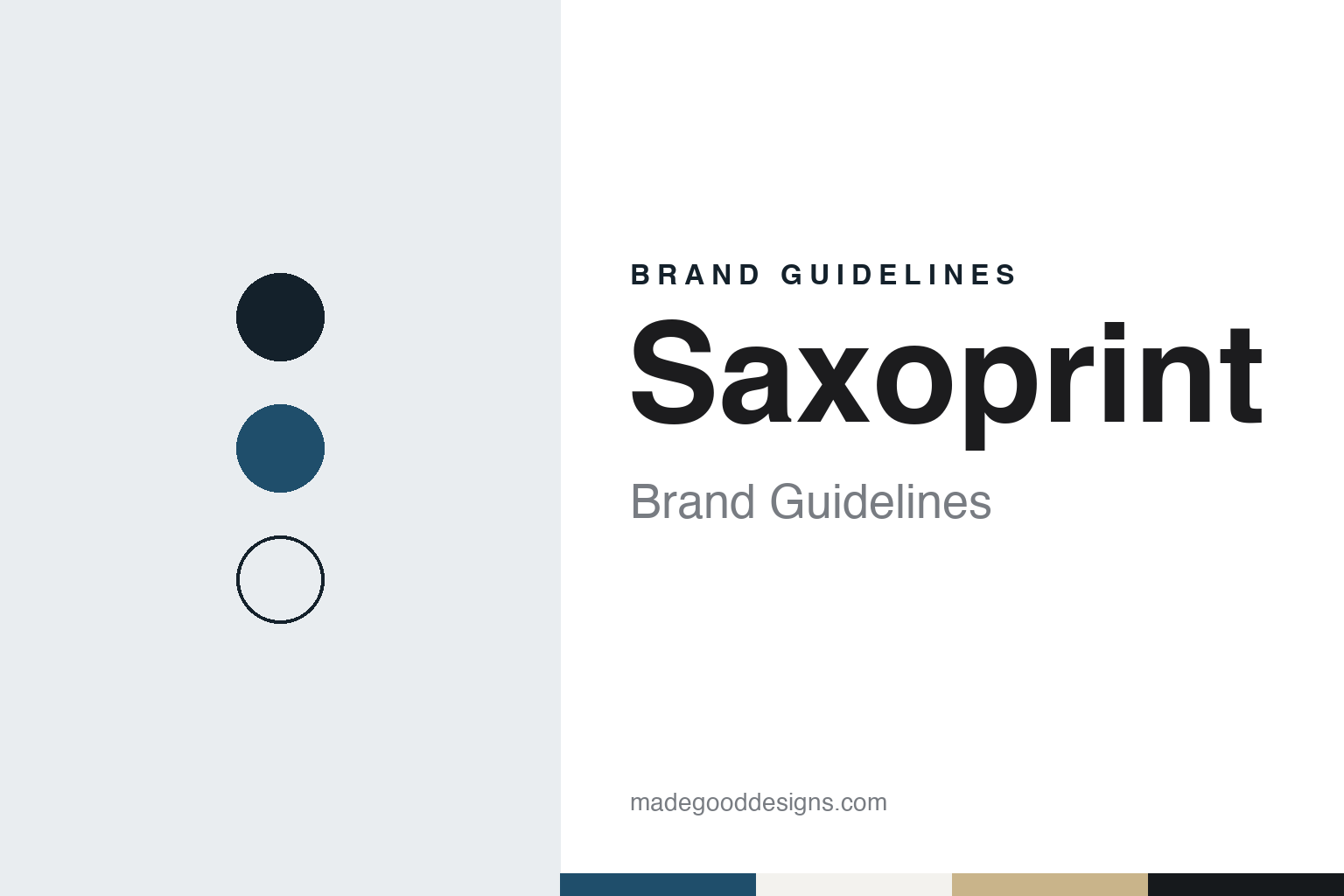
Saxoprint Brand Guidelines
A 1999 Dresden print shop that became an industrial online printer.
Aa
Two constants: an Elbe blue, press black and sheet white palette and a technical sans register. Abstract homage — not a Saxoprint product or mark; no logo, print sample or wordmark is reproduced.
Dresden, 1999
A local digital and offset printer goes online.
Saxoprint says it was founded in 1999 in Dresden as SAXOPRINT GmbH, a small local digital and offset printer with 22 employees. Its founder and managing director was Thomas Bohn, the trade site beyond-print.de reported in 2012. The company’s own timeline says that an online shop for Germany opened in its early years, followed a year later by one for Britain, and that production space grew to 10,000 square metres. beyond-print.de wrote in February 2012 that the shop saxoprint.de had by then been trading for six years, and that more than 350 people worked for the Saxon company in production, customer service, sales and development.
In February 2012 CEWE, the Oldenburg photo-book company then trading as CEWE Color, bought all the shares in Saxoprint, beyond-print.de reported on 2 and 3 February 2012, citing CEWE’s own announcement. CEWE already served business customers with digitally printed flyers, business cards and brochures through viaprinto.de; Saxoprint added offset capacity for longer runs and, in the trade site’s words, a strong position in print finishing. Bohn stayed on as managing director. Saxoprint’s timeline describes the result as becoming an independent subsidiary of the CEWE group.
Shops in France, Austria, Spain and Switzerland followed between 2008 and 2012, Saxoprint says, then Italy in 2013–14 and Belgium and the Netherlands between 2015 and 2017. By its account, staff numbers passed 500 in 2013–14, after a relaunch of the shops, when production space grew to more than 18,000 square metres. Between 2015 and 2017 it added its own named services, including SAXOPRINT pro design, the SAXOPRINT easy box and the SAXOPRINT Promoline range. Its website today lists shops in nine countries, Germany and Britain among them.
Colour
Offset sheets, folders and calendars.
Saxoprint’s range is aimed at business customers: business stationery such as cards and letterheads, brochures, flyers and folders with finishing, and display items such as roll-ups, banners and trade-fair counters, according to its website. It describes a production mix of sheetfed offset, web offset and digital printing, and lists named machines rather than general claims: a Heidelberg Speedmaster XL 106 offset press, an HP Indigo 100K digital press, Heidelberg Stitchmaster saddle stitchers a Heidelberg Stahlfolder folding machine, a Horizon perfect-binding line for brochures and a Renz line for wire-o calendar binding, with a laminator and a UV coater for finishes. It says it has been a reference customer of Heidelberger Druckmaschinen since 2014.
Much of the company’s published timeline is a list of equipment. It records a Speedmaster XL 162 with a reel sheeter in 2019, a switch to process-free printing plates in 2020, automated plate changing linked to Heidelberg’s Prinect planning software in 2021–22, and in 2025 an inline line pairing a Horizon stitchliner with a Canon varioPRINT iX3200 for brochures. In 2018, it says, it bought its site and took in Laserline as a wholly owned subsidiary; beyond-print.de dates CEWE’s purchase of Laserline, of Berlin, to 2017. In 2024 Saxoprint took over the large-format production of EAST|print GmbH, adding roll-ups, beach flags and exhibition stands to what it makes itself.
Saxoprint names its certifications on its own pages: a Fogra certificate for the ProzessStandard Digitaldruck, FSC certification for selected products and the French Imprim’Vert label. It also says it received the Dresden chamber of commerce’s seal as an exemplary training company in 2018, It reports more than 50,000 customer reviews on the Trusted Shops service since 2012, and its site sums up the business as about 500 staff and production space the size of 3.3 football pitches.
Typography
Online printers and their pages.
Online printers and print-on-demand platforms sell something the customer designs and the company makes. Their websites are therefore built around two things: the range of printed products on offer, and the steps for turning a file or an idea into an order. Product pages are organised by category — business cards, flyers and postcards, stickers and labels, signs and banners, packaging, apparel, and fabric or home goods — and each is shown through the company’s own photographs of finished pieces.
The ordering side is described in plain, practical terms. Customers either upload a finished print file or build a design in an editor that runs in the web browser, then choose size, quantity, paper and finish from a configurator. Cimpress, for example, describes its services as running from upload-and-print to logo design, with file checks before production. Papers and finishes are named rather than pictured in the abstract: weights in grams per square metre, coated or uncoated stock, matt or gloss lamination, and options such as rounded corners or spot varnish.
Behind the storefront, the companies differ in how they make things. Some run their own print plants; CEWE described SAXOPRINT’s Dresden site as a production facility when it agreed to sell it to Cimpress in May 2026. Others, such as HelloPrint in Rotterdam, describe themselves as platforms that pass orders to a network of partner printers and carriers. Several of the brands in this guide belong to larger groups, and their corporate pages set out owners, sites and the dates of takeovers.
This guide sets out what can be checked about each brand — who founded it, who owns it, where its products are made and how it presents itself — and attributes to the company anything that rests only on its own word.
Aa
A plain technical sans, in the spirit of a capital-letter company name. (Specimen set in IBM Plex Sans, a sans STAND-IN; NOT the Saxoprint logo.)
Saxoprint
From CEWE to Cimpress.
In May 2026 CEWE agreed to sell its whole commercial online-print business — the Saxoprint production plant in Dresden and the sales units viaprinto and Laserline — to Cimpress, the Ireland-based group known for VistaPrint and WIRmachenDRUCK, CEWE announced on 11 May 2026. CEWE said all 544 employees of the business would move to the new owner and that the price would stay confidential; completion depended on regulatory and competition approvals. Writing the same day, Bernd Zipper of beyond-print.de reported that the three brands were to join Cimpress’s PrintBrothers segment, and described the Dresden plant as highly automated. In CEWE’s announcement, Cimpress founder and chief executive Robert Keane called the business a strong industrial asset with modern production capacity, which Cimpress would use as part of its European network; Zipper added that several Cimpress companies were to use Saxoprint’s capacity for core products, while Saxoprint could draw on products from other specialised Cimpress plants in Europe.
Saxoprint’s own website now states that it has belonged to Cimpress since July 2026. CEWE said it would concentrate on its photofinishing business. The sale ended a period of about fourteen years in which Saxoprint served as the production plant of CEWE’s commercial online-print business.
The company writes its name in capitals, SAXOPRINT, across its shops and its own pages, and uses the same name in every country it serves.
For a design guide, Saxoprint shows how a printer can tell its brand story through its press hall and its machines. Compare Cimpress, which Saxoprint says has owned it since July 2026, and Vistaprint, the Cimpress brand it now sits beside. For this guide we use an Elbe blue, press black and sheet white with a sans, an unofficial interpretation; no product or logo is reproduced.
Explore & save
Keep Saxoprint’s identity on hand — save it to a board in the Made Good inspiration library.
Saxoprint identity set
Pin the Saxoprint Elbe blue, press black and sheet white palette and the technical sans register to your own board.