Setouchi Triennale Brand Guidelines
Islands, ferries and a three-yearly festival on the Seto Inland Sea.
Aa
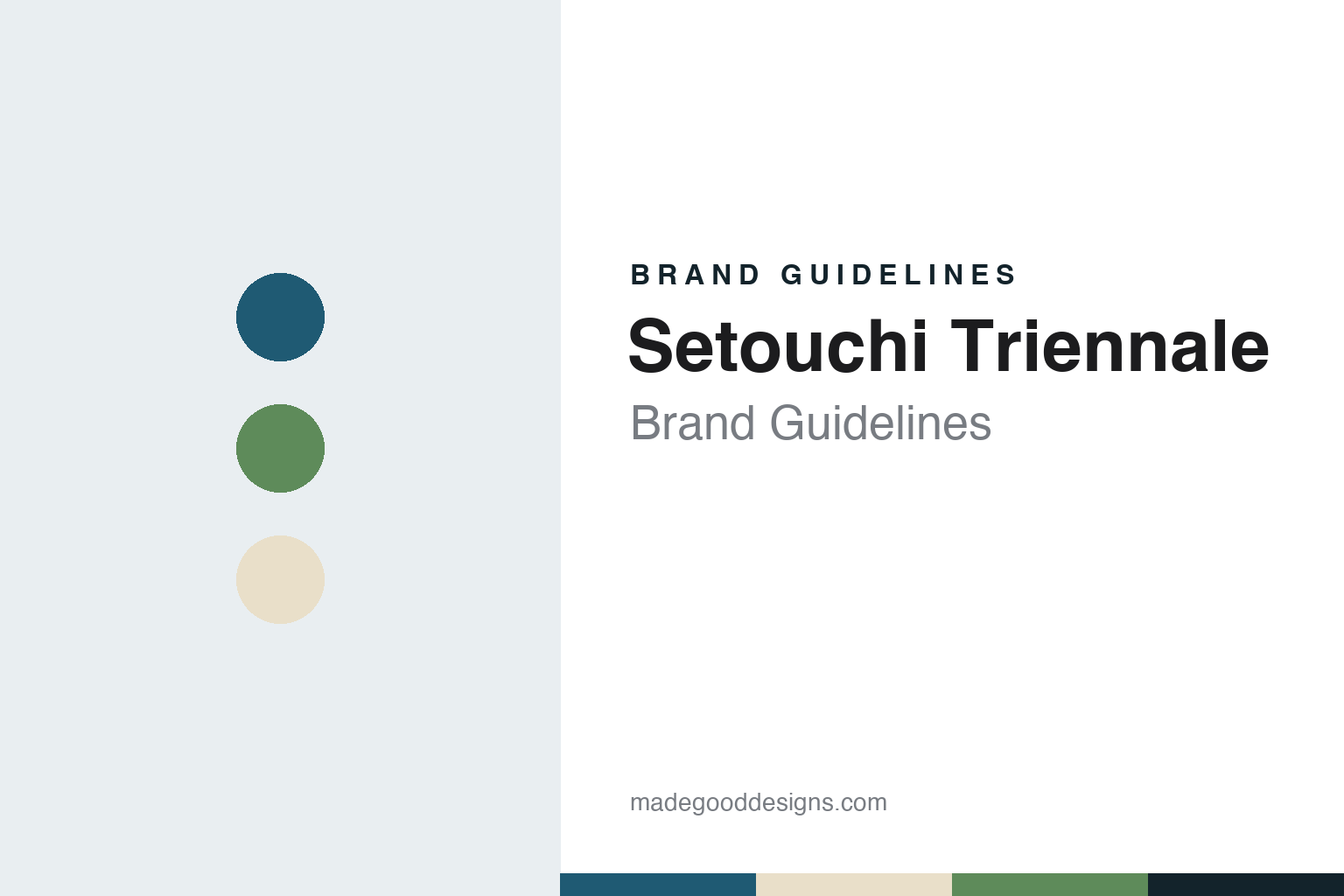
Two constants: a sea blue, island green and sand palette and a calm gothic sans register. Abstract homage — not a Setouchi Triennale asset or mark; no logo, poster or main visual is reproduced.
A festival across a sea
Islands, two ports and an executive committee.
The Setouchi Triennale — in Japanese the Setouchi International Art Festival, shortened locally to “Setogei” — is a contemporary art festival held every three years on islands of the Seto Inland Sea and along its coast. Japanese Wikipedia says the opening edition took place in 2010 and the sixth in 2025, and names the organiser as the Setouchi Triennale Executive Committee, chaired by the governor of Kagawa Prefecture. English Wikipedia describes the festival as a partnership between prefectural and municipal governments and the education publisher Benesse, with the coastal cities of Takamatsu and Tamano among its hosts.
The festival runs under one theme, “Restoration of the Sea.” In an article published by the Government of Japan’s KIZUNA on 1 August 2025, the general director, Fram Kitagawa, said the festival is rooted in a wish to revive, through art, the ways of life people once led on the islands alongside the sea. English Wikipedia says Kitagawa also founded the Echigo-Tsumari Art Triennial in Niigata, and that the local governments and Benesse asked him to produce a festival in the Setouchi region drawing on that experience. Japanese Wikipedia lists Soichiro Fukutake as general producer and Kitagawa as general director for every edition from 2010 to 2025.
The islands already held a body of art before the festival began. English Wikipedia traces the Benesse Art Site on Naoshima, Teshima and Inujima to the late 1980s: the Naoshima International Camp opened in 1989, Benesse House followed in 1992 and the Chichu Museum in 2004. The 2010 festival coincided with the opening of the Lee Ufan Museum on Naoshima, the Teshima Art Museum, whose only work is “Matrix” by the artist Rei Naito, and the Inujima Art House Project. The travel site japan-guide.com notes that the Benesse sites on Naoshima, Inujima and Teshima all serve as festival venues.
Colour
From one summer run to three seasons.
The calendar grew after the opening edition. Japanese Wikipedia gives the 2010 festival as a single run from 19 July to 31 October 2010, 105 days, on seven islands and the area around Takamatsu port, with 75 artists and projects from 18 countries and regions. From 2013 the festival was split into spring, summer and autumn sessions, and new venues were added, among them the islands of Honjima, Takamijima and Awashima and the area around Uno port, across the water in Okayama Prefecture. In 2016, 2019 and 2022 several of the western islands opened in the autumn session only.
The 2025 edition kept that pattern. Japanese Wikipedia dates its sessions to 18 April–25 May, 1–31 August and 3 October–9 November 2025, 107 days in all, across 17 areas. Naoshima, Teshima, Shodoshima, Inujima and the two port areas, with other islands, were open in every session; the area around the Seto Ohashi bridge opened in spring, two Kagawa coastal areas in summer, and four western islands with the town of Utazu in autumn. Three coastal areas of Kagawa were added that year. KIZUNA reported that the 2025 edition involved 222 artists and groups from 37 countries and 255 works.
Visitor figures are published edition by edition. Japanese Wikipedia, citing the committee’s reports, gives about 940,000 visits in 2010, 1.07 million in 2013, 1.04 million in 2016, 1.18 million in 2019, 723,000 in 2022 and about 1.084 million in 2025. KIZUNA said roughly a quarter of the 2019 visitors came from outside Japan.
Many works outlast their session. japan-guide.com says much of the art stays in place after each festival, set outdoors in fields, along the coast and in villages, or inside old houses that had stood empty, and that the Inujima Seirensho project is built into the ruins of an old copper refinery. KIZUNA described the Ogijima Pavilion, made with the artist Oscar Oiwa and known for the world painted on its windows, as a fixture since 2022, and said that keeping past works in place lets the region act as a kind of archive of the festival. A volunteer group, the Koebi-tai or “Little Shrimp Squad,” helps with reception desks, building work and sometimes the artworks themselves; KIZUNA counted about 50,000 sign-ups between 2010 and 31 May 2025, around a fifth of them from people who are not Japanese citizens.
Typography
Recurring exhibitions and their identities.
A biennial or triennial is an exhibition that is rebuilt from scratch each time it opens. The curator changes, the artists change and the theme changes, yet the event keeps one public name. What holds it together is the part that never moves: the name and the city or region attached to it. Around that fixed core sit the parts that change, usually an edition number and an edition title, so that each show is announced as, say, the 15th edition with a title of its own.
The title is normally set by the curator or artistic director invited for that edition. Some events keep a standing artistic director and invite a different curator each time; others hand the whole edition to one person or a team. Either way, the title reads less like a slogan than like the premise of an essay, and it shapes how the posters, catalogue and press material for that edition are written and designed.
The venues add a second layer. Many of these events are spread across a city or a region rather than held in one hall: a museum at the centre, then former factories, warehouses, power plants, harbour buildings, islands or open sites that may be used for one edition only. Some leave permanent works behind in the streets or landscape; others clear out completely when they close. The graphic identity is often commissioned afresh for each edition, while the name, and sometimes a simple wordmark, carries on unchanged.
For visitors, the practical design matters as much as the art. A spread-out show depends on maps, passes that cover several sites, signs that lead from one venue to the next, shuttles or ferries, and a guide or catalogue that explains each work. Each guide in this series sets out what dated sources record about one event: who founded it, who organises it, where it takes place and how each edition has been framed.
Aa
A calm gothic sans — island names, ferry times and a festival title. (Specimen set in Zen Kaku Gothic New, a sans STAND-IN; NOT the Setouchi Triennale logo.)
Setouchi Triennale
One designer, six editions of posters.
The festival’s graphic voice has had one author. Bijutsu Techo listed a special exhibition at the Takamatsu Art Museum, from 29 March to 25 May 2025, that traced fifteen years of the festival through its official design: the posters and flyers of all six editions from 2010 to 2025, every one of them by the designer Kenya Hara. The listing presented the series as a record of how each edition took a different approach to showing the islands and the art.
The name works on two levels. The Japanese title is descriptive — an international art festival of Setouchi, the Inland Sea region — while the English title uses “Triennale” for the three-year cycle. Japanese Wikipedia gives subtitles for the opening editions only: “A 100-day adventure around art and the sea” in 2010 and “The four seasons of the Seto Inland Sea, around art and islands” in 2013. Later editions are named by year.
A visit is organised around boats. Japanese Wikipedia says visitors use Takamatsu port and Uno port as the main gateways, travelling by ferry to each island and by island transport once ashore, and that the official website publishes the routes and timetables. japan-guide.com says Naoshima alone has more than twenty artworks and museums and takes at least a full day, while Shodoshima has about forty works spread across several locations. Many works stand outdoors, so the islands’ villages, beaches and hillsides form the frame around them. KIZUNA quoted Kitagawa saying that the festival chose to place works in natural settings rather than seal them inside museums, so that visitors meet the region itself as they travel from island to island.
For a design guide, the Setouchi Triennale shows how a festival spread across a sea can keep one identity: a fixed theme, the same general director for six editions and one designer’s hand on every poster, while the map shifts with each season. Compare the Yokohama Triennale, another recurring exhibition in Japan, and the Folkestone Triennial, a three-yearly exhibition in a coastal town. For this guide we use a sea blue, an island green and a pale sand with a sans, an unofficial interpretation; no product or logo is reproduced.
Explore & save
Keep Setouchi Triennale’s identity on hand — save it to a board in the Made Good inspiration library.
Setouchi Triennale identity set
Pin the sea blue, island green and sand palette and the calm gothic sans register to your own board.
Source & notes
Frequently Asked Questions
What font can I use to match the Setouchi Triennale look?
This guide describes Setouchi Triennale’s type as “A calm gothic sans — island names, ferry times and a festival title”. Its type specimen is set in Zen Kaku Gothic New from Google Fonts as a stand-in; Zen Kaku Gothic New is not Setouchi Triennale’s own lettering.
What colours are in the Setouchi Triennale palette?
This guide’s Setouchi Triennale palette is Inland Sea Blue #1F5A73, Ferry Ink #13232B, Island Green #5E8B5A, Beach Sand #E9DFC9 and Harbour White #F6F4EF. The tones are the guide’s own unofficial interpretation, not official Setouchi Triennale hex codes.
When was Setouchi Triennale founded?
Setouchi Triennale was founded in 2010, in Seto Inland Sea islands, Japan.