Prospect New Orleans Brand Guidelines
A numbered citywide art exhibition spread across New Orleans.
Aa
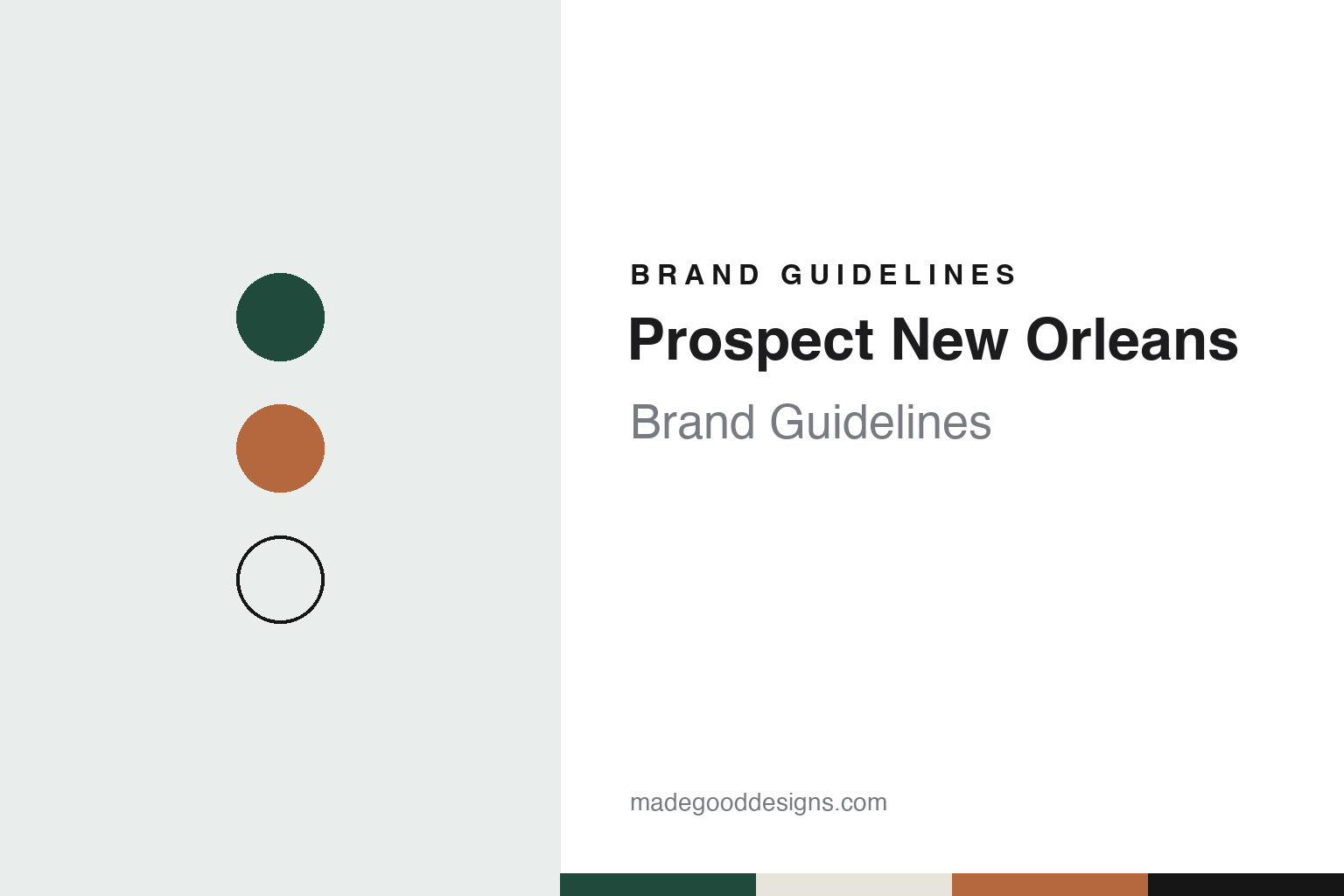
Two constants: a bayou green, levee clay and river mist palette and a numbered grotesque register. Abstract homage — not a Prospect New Orleans mark; no logo, poster or artwork is reproduced.
Prospect.1
A curator, a nonprofit and a city of venues.
Prospect New Orleans is a citywide contemporary-art exhibition held in New Orleans, Louisiana, every few years. English Wikipedia says the curator Dan Cameron conceived it during a visit to the city in early 2006, months after Hurricane Katrina, and that in January 2007 he founded a nonprofit, U.S. Biennial, Inc., to realise it, with a volunteer board of directors, rented office space and a small staff. The exhibition was conceived, the same article says, in the tradition of the large international biennials, naming the Venice Biennale, the São Paulo Biennial and the Istanbul Biennial.
The first edition, Prospect.1 New Orleans, ran from November 2008 to January 2009. Wikipedia counts 81 international artists at more than 24 venues across the city, with cultural and educational programmes for local audiences running alongside. Prospect.2 followed from October 2011 to January 2012, again curated by Cameron, with 62 artists; slightly more than half were based in the United States, ten of them in New Orleans, according to the edition’s press release as quoted by Wikipedia.
The name carries the format. Each edition is numbered — Prospect.1, Prospect.2 and onward, shortened in the organisation’s own announcements to P.4 or P.5 — and each takes its own title, while the umbrella name stays the same. In a 2019 announcement reprinted by the Biennial Foundation, Prospect’s executive director described the event as having “originated in 2008 as an experiment” to welcome the contemporary art world to New Orleans, and said the organisation was marking its tenth anniversary during the Prospect.5 cycle.
Colour
Six editions, each with its own title.
After the second edition the gap between shows widened to about three years, and The Art Newspaper now calls Prospect the city’s triennial. Wikipedia dates Prospect.3, titled Notes for Now, from October 2014 to January 2015. Prospect.4, The Lotus in Spite of the Swamp, ran from 16 November 2017 to 25 February 2018 with more than seventy artists, the organisers said in 2019; Wikipedia counts 73 artists in 17 venues.
Prospect.5 took its title, Yesterday we said tomorrow, from Yesterday You Said Tomorrow, a 2010 album by a New Orleans–born jazz musician, according to the 2019 announcement. It was first planned for October 2020 to January 2021. In April 2020 The Art Newspaper reported that it had been postponed by a full year, to open on 23 October 2021 and run until 23 January 2022. The same announcement introduced Programming Partners, a group of cultural producers staging events with venues across the city, from museums and cultural centres to theatres and bars.
The sixth edition, Prospect.6: The Future Is Present, The Harbinger Is Home, ran from 2 November 2024 to 2 February 2025. It was led by two co-artistic directors, the curator Miranda Lash and the artist Ebony G. Patterson. The Art Newspaper described Lash in November 2024 as senior curator at the Museum of Contemporary Art Denver; ArtReview noted that she had earlier been a curator at the New Orleans Museum of Art and that Patterson had shown work in Prospect.3. ArtReview counted 51 artists across more than 20 venues. Writing in the Louisiana humanities magazine 64 Parishes in September 2024, Prospect said the edition drew on living artists based in or tied to Louisiana, and on artists from regions linked to the state by migration, including the Caribbean, Central and South America, Southeast Asia and Africa.
The venues show how the format works. Prospect.6 used museums — the Newcomb Art Museum, the Ogden Museum of Southern Art, The Historic New Orleans Collection and the Contemporary Arts Center — alongside Harmony Circle, a traffic roundabout, and The Batture, a waterfront park on the levees. Its new hub was the century-old former Ford Motor Plant in Arabi, just east of the city, where twelve artists showed large projects, The Art Newspaper reported; they included Maia Ruth Lee, with a full-size airport luggage conveyor filled with sculptures. Raúl de Nieves made a large installation for Harmony Circle, and Tuấn Andrew Nguyễn showed a new film. ArtReview added music venues, parks and railroad yards to the map, and wrote that the edition was not easy to navigate — and nor, it added, is New Orleans.
Typography
Art across a region.
Many recurring exhibitions are held far from the cities that host the large art fairs and museum seasons. Instead of a single hall, they use a landscape, a farming region, a valley or the streets and buildings of a whole city. Works sit in fields, on hillsides, in disused schools, warehouses and shopfronts, and visitors move between them over hours or days rather than walking through one set of rooms.
Much of the art is made for the place. Artists are commissioned to respond to a particular site, its history or its people, and some of those works stay behind once an edition closes. In Niigata, the Echigo-Tsumari Art Triennale says about 200 works now remain on view between editions; in California, Desert X installs new temporary works across the Coachella Valley every two years. In both cases the region serves as the venue.
The identity therefore rests on a name that recurs. A biennial or triennale keeps its title, often joined to a place and a year, while each edition brings a new artistic director or curatorial team, a new title and a new list of artists. The graphic work changes with the edition; the name, the place and the rhythm of the calendar stay constant.
Distance makes the visit itself a design problem. Organisers publish maps, suggested routes, passes and opening hours, set up an information hub where a printed guide can be collected, add signage at sites spread over many kilometres and in some cases offer an app with directions and audio. The guides that follow look at how each of these events presents itself, from its founding and organisers to its venues and the way it is named.
Aa
A numbered grotesque — “Prospect.” plus an edition number. (Specimen set in Archivo, a sans STAND-IN; NOT the Prospect New Orleans logo.)
Prospect.
A name, a full stop and a number.
Prospect’s identity rests on a name and a number. The nonprofit that Cameron set up in 2007 presents each show as “Prospect” followed by a full stop and the edition number, and its 2019 announcement used the shorthand “P.4” in brackets after the fourth edition’s full title. Edition titles change with each artistic team — Notes for Now, The Lotus in Spite of the Swamp, Yesterday we said tomorrow, The Future Is Present, The Harbinger Is Home — while the numbered name stays constant from one edition to the next.
The leadership model has changed too. The first two editions were curated by the founder; the fifth was led by a pair of artistic directors; and the sixth was again shared, between a museum curator and an artist. The scale has stayed broadly similar across that time: from 81 artists at more than 24 venues in 2008–09 to 51 artists at about twenty venues in 2024–25, by the counts of Wikipedia and ArtReview.
Place is part of the brand. The Art Newspaper quoted Lash in 2024 saying the sixth edition set out to recast the city not as a place behind the times but as one already living with questions other places would face later, and the edition’s title carries that idea of the harbinger. ArtReview tied the show to a particular stretch of the city in its review, pointing to a sculpture sited in a small neighbourhood park as an example of site-specific work.
For a design guide, Prospect New Orleans shows how a short series name with a running number can hold steady while titles, curators and venues change around it, and how an exhibition spread across a whole city leans on its name to tie very different sites together. Compare it with Desert X and the Venice Biennale. For this guide we use a deep bayou green, a warm levee clay and a pale river-mist grey with a sans-serif, an unofficial interpretation; no product or logo is reproduced.
Explore & save
Keep Prospect New Orleans’s identity on hand — save it to a board in the Made Good inspiration library.
Prospect New Orleans identity set
Pin the Prospect New Orleans bayou green, levee clay and river mist palette and the numbered grotesque register to your own board.
Source & notes
Frequently Asked Questions
What font can I use to match the Prospect New Orleans look?
This guide describes Prospect New Orleans’ type as “A numbered grotesque — “Prospect.” plus an edition number”. Its type specimen is set in Archivo from Google Fonts as a stand-in; Archivo is not Prospect New Orleans’ own lettering.
What colours are in the Prospect New Orleans palette?
This guide’s Prospect New Orleans palette is Bayou green #1F4A3C, Ink #161616, Levee clay #B5683E, River mist #E7E4DC and Paper #F8F6F1. The tones are the guide’s own unofficial interpretation, not official Prospect New Orleans hex codes.
When was Prospect New Orleans founded?
Prospect New Orleans was founded in 2007 (organiser); 2008 (Prospect.1), in New Orleans, Louisiana, USA.
Who founded Prospect New Orleans?
Prospect New Orleans was founded in 2007 (organiser); 2008 (Prospect.1) by Dan Cameron, curator.