Toronto Biennial of Art Brand Guidelines
A free biennial that maps contemporary art onto Toronto’s shoreline, creeks and streets every two years.
Aa
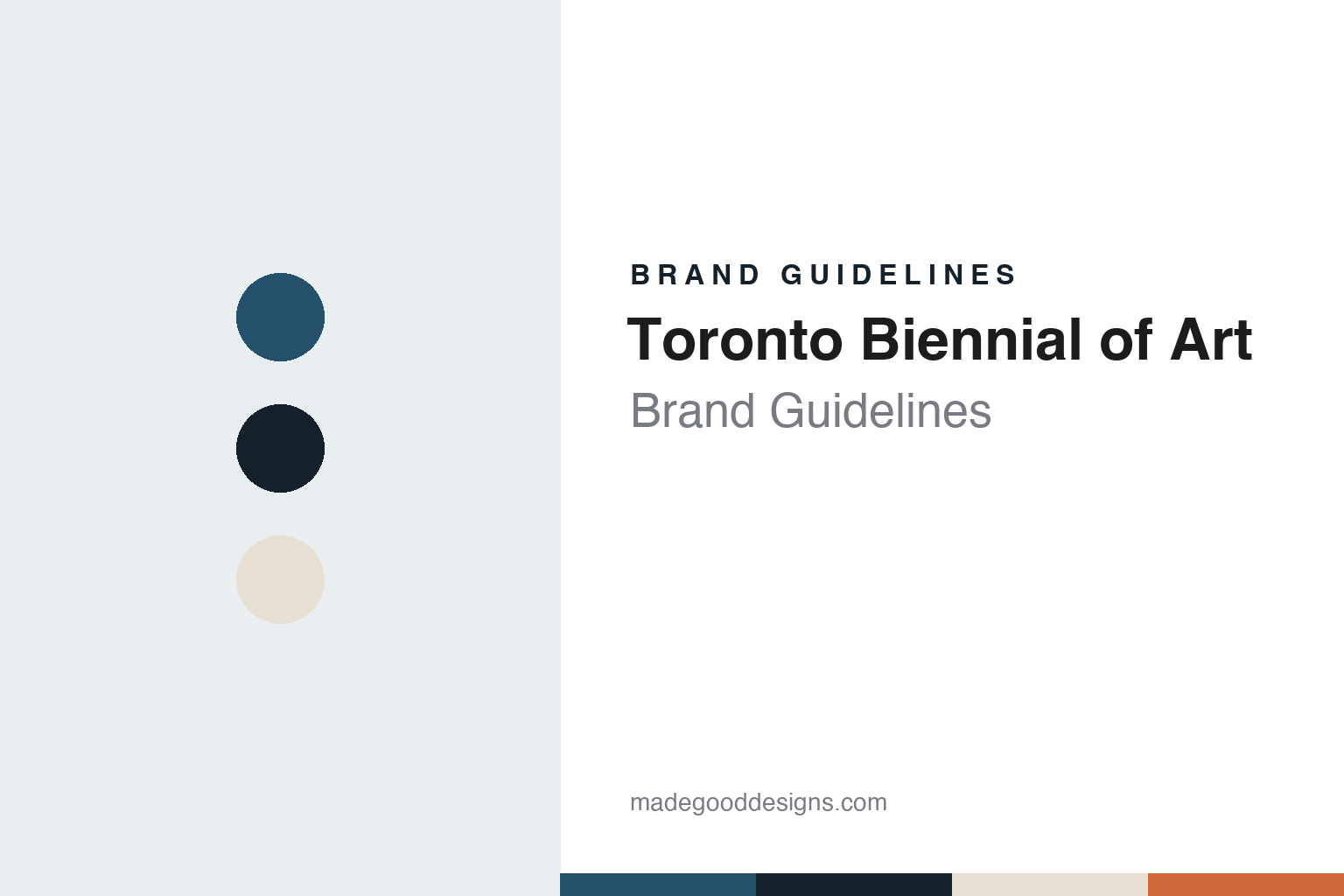
Two constants: a lake blue, shoreline sand and signal orange palette and an open grotesque sans register. Abstract homage — not a Toronto Biennial of Art asset; no logo, poster or artwork is reproduced.
The Shoreline Dilemma
A biennial that began on the waterfront.
The Toronto Biennial of Art is a free, city-wide exhibition of contemporary art held in Toronto every two years. Its website says it launched in 2019 and describes each edition as a twelve-week event that commissions artists to make new works in dialogue with the city’s local contexts, with public and learning programmes running in the years between editions. The Art Newspaper, reporting on the fourth edition in September 2026, named Patrizia Libralato as the biennial’s founding executive director.
The first curatorial appointment was made public in spring 2018. CBC News reported on 22 May that year that Candice Hopkins, a citizen of the Carcross/Tagish First Nation who had co-curated the biennial in Santa Fe, had been named senior curator of Toronto’s first art biennial, and that she and her team were exploring buildings along Toronto’s waterfront as possible exhibition spaces. She told CBC it mattered not to treat those buildings as empty vessels but to take their own histories into account. The opening edition was scheduled for September to December 2019, and Hopkins was already slated to curate the second.
That first edition, titled The Shoreline Dilemma, ran until 1 December 2019. The Art Newspaper, writing on 26 September 2019, described it as scattered over more than 15 sites, most within a short hop of Lake Ontario, on a waterfront that the paper noted was once the domain of Indigenous peoples and is now lined with condominiums. The sites ranged from the Small Arms Inspection Building, a former factory building, to public spaces such as the Toronto Sculpture Garden and Union Station, and to established venues including the Art Gallery of Ontario, the Museum of Contemporary Art and The Power Plant, with further projects hosted by York University, Ryerson University and the University of Toronto.
Colour
Creeks, hubs and the Great Lakes.
The second edition followed in spring 2022. Postponed from autumn 2021, What Water Knows, the Land Remembers ran from 26 March to 5 June 2022 and was billed as “72 days of free art,” The Art Newspaper reported on 25 March 2022. The paper counted nine sites, some 100 works and around 70 artists from five continents, again under a curatorial team that included Hopkins. Where the first edition had followed the lakefront, the second “moved inland from the shoreline,” in the words of its exhibition text, tracing creeks and ravines including Etobicoke Creek, Garrison Creek and Taddle Creek, as well as the Laurentian Channel. Some venues returned, notably the Small Arms Inspection Building in Mississauga, just west of the city, and the Museum of Contemporary Art in the Junction; others joined, among them Fort York National Historic Site, Colborne Lodge in High Park and the Textile Museum of Canada.
The third edition, Precarious Joys, ran from 21 September to 1 December 2024 under two co-curators. The Art Newspaper reported on 17 September 2024 that it spanned 11 primary locations and a handful of partner sites, with some 36 artists. Its central exhibition and programming hub was at 32 Lisgar Street in the Queen Street West neighbourhood, with two further hubs at the Auto Bldg on Sterling Road and at Collision Gallery. Other locations included the Art Gallery of Ontario, the Image Centre at Toronto Metropolitan University, Union Station, The Power Plant, Gallery TPW, a billboard at Abell Street and Queen Street West, and Terminal 1 at Toronto Pearson International Airport. The biennial’s website gives a figure of more than 850,000 visitors for that edition and says that two of its 20 new commissions were later acquired by the National Gallery of Canada.
The fourth edition, Things Fall Apart, opened in September 2026 and runs until 20 December 2026. It was curated by the New York-based curator Allison Glenn, The Art Newspaper reported on 27 September 2026, and takes its title from W. B. Yeats’s 1919 poem “The Second Coming” and Chinua Achebe’s 1958 novel. The paper described a 12-week exhibition of more than 30 artists and collectives, with 16 new commissions, that uses the Great Lakes region as a point of departure for more than 20 trade routes, waterways and journeys across five continents. Glenn told the paper she had expanded on an inquiry into waterways begun by the 2019 edition. The biennial’s website says the Art Museum at the University of Toronto, across its Art Centre and the Justina M. Barnicke Gallery, serves as the edition’s main exhibition hub, and that a three-day convening, An Arrival, A Grounding, A Departure, took place from 16 to 18 October 2026.
Typography
How biennials outside the big art capitals build an identity.
Many recurring exhibitions are held far from the cities that host the large art fairs and museum seasons. Instead of a single hall, they use a landscape, a farming region, a valley or the streets and buildings of a whole city. Works sit in fields, on hillsides, in disused schools, warehouses and shopfronts, and visitors move between them over hours or days rather than walking through one set of rooms.
Much of the art is made for the place. Artists are commissioned to respond to a particular site, its history or its people, and some of those works stay behind once an edition closes. In Niigata, the Echigo-Tsumari Art Triennale says about 200 works now remain on view between editions; in California, Desert X installs new temporary works across the Coachella Valley every two years. In both cases the region serves as the venue.
The identity therefore rests on a name that recurs. A biennial or triennale keeps its title, often joined to a place and a year, while each edition brings a new artistic director or curatorial team, a new title and a new list of artists. The graphic work changes with the edition; the name, the place and the rhythm of the calendar stay constant.
Distance makes the visit itself a design problem. Organisers publish maps, suggested routes, passes and opening hours, set up an information hub where a printed guide can be collected, add signage at sites spread over many kilometres and in some cases offer an app with directions and audio. The guides that follow look at how each of these events presents itself, from its founding and organisers to its venues and the way it is named.
Aa
An open grotesque sans — the register of maps, site lists and wayfinding. (Specimen set in Archivo, a sans STAND-IN; NOT the Toronto Biennial of Art logo.)
TBA
A name, a free door and a moving map.
The biennial has no single fixed home. Its identity is carried by a recurring name, which the organisation shortens to TBA, by free admission, and by a map of sites that changes with each edition, from the lakefront in 2019 to the creeks of 2022 and the downtown hubs of 2024. Its website lists a TBA Digital Guide and visitor information alongside downloadable guidebooks. For the 2024 edition, the biennial’s deputy director told The Art Newspaper that the audio guide asked each artist to record a short description of their own work.
The 2026 edition stretched that map beyond the city. Under a programme called the Extended Footprint, The Art Newspaper reported, partner organisations across North America presented portions of artists’ biennial commissions at the same time, among them the Anchorage Museum in Alaska, the Counterpublic Triennial in St Louis, the Medina Triennial in upstate New York and Times Square Arts in Manhattan. The website also describes TBA Parallel Projects, which draws attention to local exhibitions by artists taking part in the 2026 edition, and a National Curatorial Advisory committee whose members include the head of the Art Museum at the University of Toronto.
Learning runs through the programme. The website describes a free School Program that brings students to exhibition sites for tours led by local artist Storytellers, and an artist-led Mobile Arts Curriculum that teachers can use in class. It says works commissioned by the biennial have entered collections including those of the National Gallery of Canada, the Art Gallery of Ontario and Tate Modern, and puts total attendance since 2019 at more than 1.3 million visitors.
For a design guide, the Toronto Biennial of Art shows how a young biennial can build recognition through a recurring name, a short acronym and a water-led thread that runs from the 2019 shoreline to the Great Lakes framing of 2026, while venues and curators change. Compare Art Toronto, the city’s contemporary art fair, and Prospect New Orleans, another North American city-wide biennial. For this guide we use lake blue, shoreline sand and a deep navy with a sans, an unofficial interpretation; no product or logo is reproduced.
Explore & save
Keep Toronto Biennial of Art’s identity on hand — save it to a board in the Made Good inspiration library.
Toronto Biennial of Art identity set
Pin the lake blue, shoreline sand and signal orange palette and the open grotesque sans register to your own board.
Source & notes
Frequently Asked Questions
What font can I use to match the Toronto Biennial of Art look?
This guide describes Toronto Biennial of Art’s type as “An open grotesque sans — the register of maps, site lists and wayfinding”. Its type specimen is set in Archivo from Google Fonts as a stand-in; Archivo is not Toronto Biennial of Art’s own lettering.
What colours are in the Toronto Biennial of Art palette?
This guide’s Toronto Biennial of Art palette is Lake blue #24506B, Deep navy #14212B, Shoreline sand #E6DFD2, Signal orange #D2693C and Paper #F6F5F1. The tones are the guide’s own unofficial interpretation, not official Toronto Biennial of Art hex codes.
When was Toronto Biennial of Art founded?
Toronto Biennial of Art was founded in 2019 (first edition), in Toronto, Canada.