Desert X Brand Guidelines
A recurring exhibition that spreads site-specific art across the Coachella Valley.
Aa
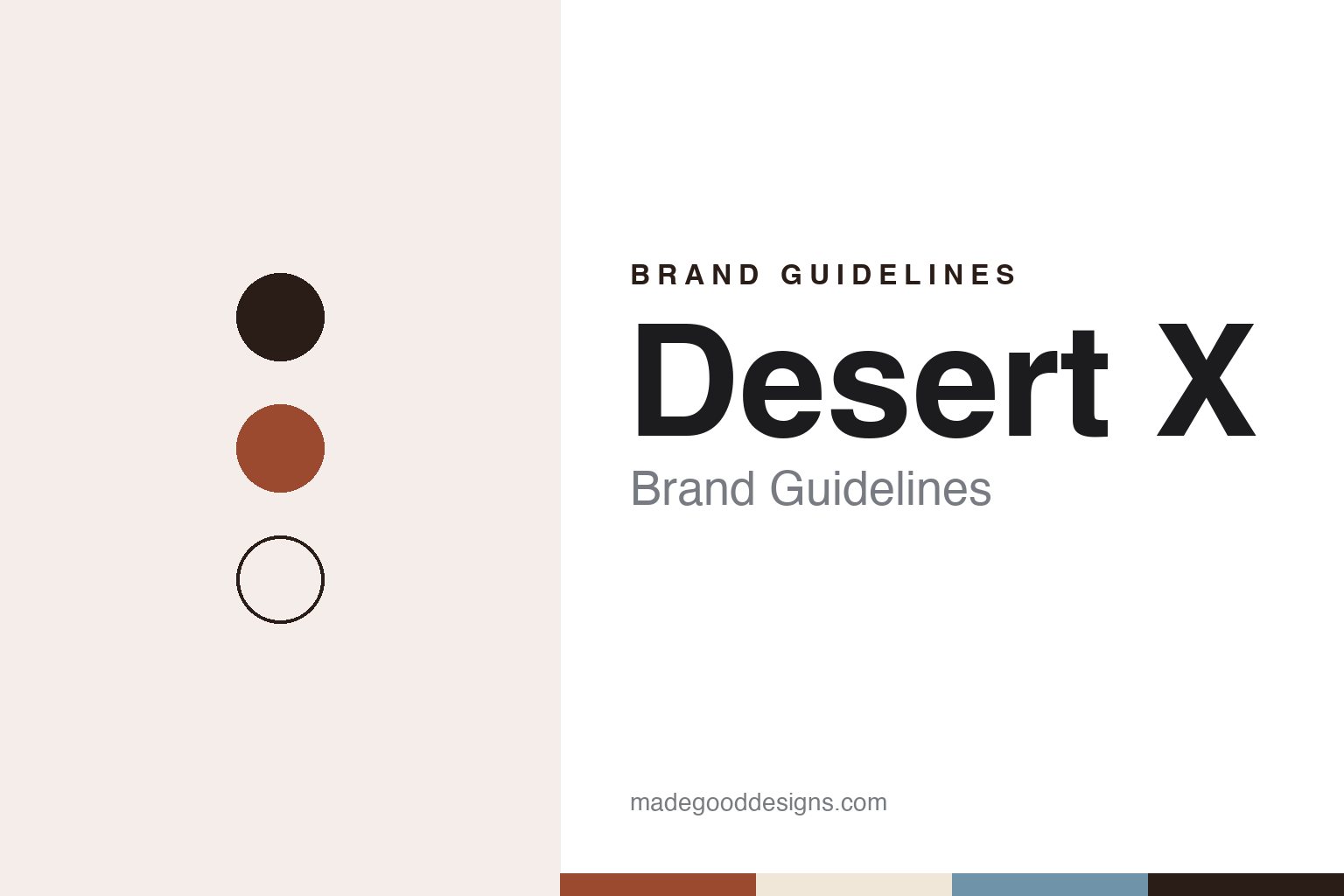
Two constants: a canyon terracotta, dune sand and desert sky palette and an open grotesque sans register. Abstract homage — not a Desert X asset; no logo, poster or artwork is reproduced.
Desert Exhibition of Art
A recurring exhibition in the valley around Palm Springs.
Desert X is a recurring exhibition of site-specific contemporary art held across the Coachella Valley in Southern California, the desert valley that includes Palm Springs. It was announced well ahead of its opening. The Art Newspaper, reporting on 6 January 2016, described a planned “recurring exhibition” for the valley and its desert cities, including Palm Springs and Rancho Mirage, due to open in February 2017, with venues to include the Palm Springs Art Museum and Sunnylands Center & Gardens. It named the founder of the non-profit event as Susan Davis, then editorial director at Sunnylands, and said Neville Wakefield, the former curator of Frieze Projects, had been appointed artistic director of the first edition.
When the first edition neared, The Art Newspaper spelled out the name on 1 February 2017 as Desert Exhibition of Art and called it a new biennial. It ran from 25 February to 30 April 2017. English Wikipedia describes the exhibition as the work of Desert Biennial, a charitable organisation founded in 2015, and the organisation’s own website gives the same founding year and carries a copyright line in Desert Biennial’s name.
Davis has stayed at the head of the organisation. The Art Newspaper described her in March 2023 as founder and board president and quoted her account of the original idea: to bring contemporary artists to the valley and have them create works so that people could see it “through a different lens, a contemporary art lens.” The organisation’s website lists her as founder and president of its board, and Wakefield as artistic director, alongside an executive director and a small curatorial and education team. It describes Desert X as an international contemporary art organisation that commissions site-responsive work in desert landscapes.
Colour
Every two years, a new set of sites.
The first edition brought 16 artists to sites around the valley, Wallpaper* reported on 3 March 2017. Among them, Doug Aitken built Mirage, a house covered in mirrors inside and out, and Tavares Strachan laid out 290 patches of light across an empty stretch of desert that spelled the words “I Am” when seen from above, the magazine said. Wakefield told Wallpaper* that the desert seems free and open but is in fact closely regulated, so the team had to deal with many cities over zoning; other works were placed at the Palm Springs Art Museum and at Sunnylands, according to The Art Newspaper.
Since then the exhibition has returned every two years. The organisation’s website gives the dates of the California editions as 9 February to 21 April 2019, 12 March to 16 May 2021, 4 March to 7 May 2023 and 8 March to 11 May 2025. Wakefield has worked with a co-curator on every edition since the second, in 2019, The Art Newspaper reported in March 2023; that year’s fourth edition had 12 artists, most of them making sculptures and installations, several of them participatory. For 2025 the co-curator was Kaitlin Garcia-Maestas, curator and director of exhibitions at Socrates Sculpture Park in New York, The Art Newspaper reported in September 2023. The organisation’s list of 2025 works includes Agnes Denes’s The Living Pyramid.
The works are temporary and the sites change from edition to edition. The organisation has also worked outside the United States. Its website says that since 2020 it has staged exhibitions in the desert of AlUla in Saudi Arabia as Desert X AlUla, and The Art Newspaper reported in 2023 that Wakefield is artistic director there as well.
Typography
Art beyond the capitals.
Many recurring exhibitions are held far from the cities that host the large art fairs and museum seasons. Instead of a single hall, they use a landscape, a farming region, a valley or the streets and buildings of a whole city. Works sit in fields, on hillsides, in disused schools, warehouses and shopfronts, and visitors move between them over hours or days rather than walking through one set of rooms.
Much of the art is made for the place. Artists are commissioned to respond to a particular site, its history or its people, and some of those works stay behind once an edition closes. In Niigata, the Echigo-Tsumari Art Triennale says about 200 works now remain on view between editions; in California, Desert X installs new temporary works across the Coachella Valley every two years. In both cases the region serves as the venue.
The identity therefore rests on a name that recurs. A biennial or triennale keeps its title, often joined to a place and a year, while each edition brings a new artistic director or curatorial team, a new title and a new list of artists. The graphic work changes with the edition; the name, the place and the rhythm of the calendar stay constant.
Distance makes the visit itself a design problem. Organisers publish maps, suggested routes, passes and opening hours, set up an information hub where a printed guide can be collected, add signage at sites spread over many kilometres and in some cases offer an app with directions and audio. The guides that follow look at how each of these events presents itself, from its founding and organisers to its venues and the way it is named.
Aa
An open grotesque sans for a name the organisation sets in capitals. (Specimen set in Space Grotesk, a sans STAND-IN; NOT the Desert X logo.)
Desert X
A map, an app and a long drive.
Desert X is designed as a drive. The organisation’s visitor page describes the exhibition as a self-guided outdoor experience in which visitors choose their own start and end points. It says the artworks are spread across the valley and are most easily reached by car, that most locations can be seen in a single day or over several, and that visiting hours usually run from sunrise to sunset. The exhibitions are open to all, it says.
Its wayfinding sits largely on a phone. The organisation offers a free DESERT X app with the artwork map, audio guides and directions to each site, and lists a mobile app developer on its staff. It also runs a DESERT X Hub during each exhibition, where visitors can pick up maps and a printed programme and talk to volunteers, and says trained docents stand at most sites on Saturday mornings. Visitors are asked to follow signs and park only in designated areas on desert roads.
The name itself is the constant. The organisation sets it in capitals, DESERT X, on its website and in its app and hub names, and notes there that DESERT X is a registered trademark; editions are named by place and year, as in Desert X 2025 or Desert X AlUla. Its website credits its design to the studio Studio Lin and its development to Cold Rice LLC. The organisation describes each exhibition as beginning with the place it temporarily inhabits, with artists responding to the land, its histories and its environmental conditions.
For a design guide, Desert X shows how an exhibition with no single venue can rely on one short name, a map and a route. Compare Frieze, where Wakefield curated Frieze Projects before Desert X, and Prospect New Orleans, another American recurring exhibition spread across many sites. For this guide we use a canyon terracotta, a dune sand and a desert-sky blue with a sans, an unofficial interpretation; no product or logo is reproduced.
Explore & save
Keep Desert X’s identity on hand — save it to a board in the Made Good inspiration library.
Desert X identity set
Pin the Desert X canyon terracotta, dune sand and desert sky palette and the open grotesque sans register to your own board.
Source & notes
Frequently Asked Questions
What font can I use to match the Desert X look?
This guide describes Desert X’s type as “An open grotesque sans for a name the organisation sets in capitals”. Its type specimen is set in Space Grotesk from Google Fonts as a stand-in; Space Grotesk is not Desert X’s own lettering.
What colours are in the Desert X palette?
This guide’s Desert X palette is Canyon terracotta #9C4A2F, Creosote ink #2A1C16, Dune sand #F1E7D8, Desert sky #6F93A8 and Paper #FAF6F0. The tones are the guide’s own unofficial interpretation, not official Desert X hex codes.
Who founded Desert X?
Desert X was founded by Susan Davis.