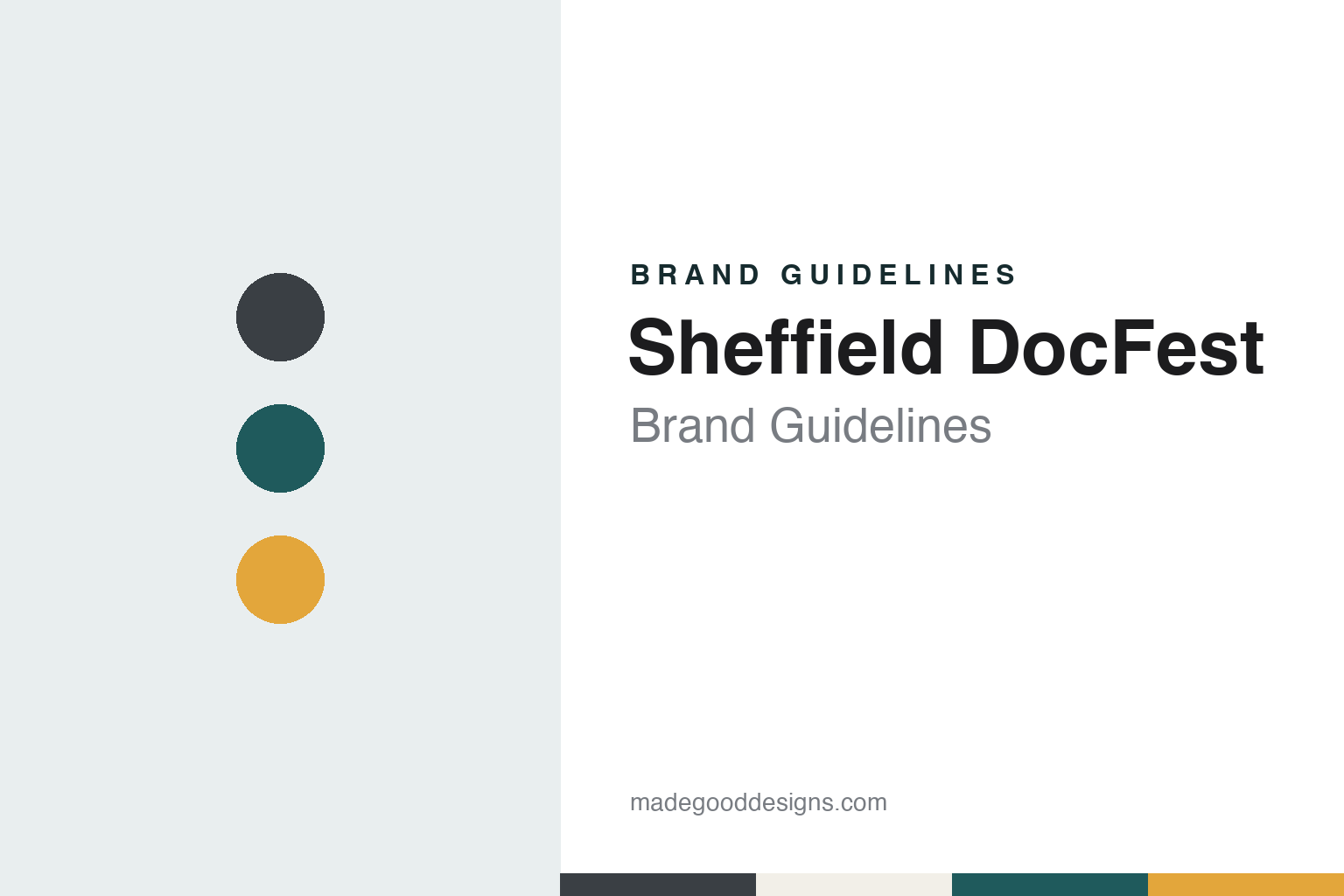
Sheffield DocFest Brand Guidelines
A documentary festival that takes over a city each June.
Aa
Two constants: a steel grey, deep teal and warm amber palette and a documentary sans register. Abstract homage — not a Sheffield DocFest asset or mark; no poster, logo or ident is reproduced.
From a BBC idea to Sheffield
A forum for documentary makers, held in a northern city.
Sheffield DocFest is an international documentary festival and industry marketplace held each year in Sheffield, in South Yorkshire. BBC News, writing in 2014, said the festival was launched in 1994. English Wikipedia gives the same year and traces the idea to 1990, when Peter Symes of BBC Television’s features department in Bristol proposed a forum where British documentary makers could debate their craft. In 1993, the article says, he set up a festival board with representatives of broadcasters including Channel 4 and Discovery, and the board chose Sheffield as the host city.
The opening edition, according to Wikipedia, was a two-day event that combined a film programme with a conference for documentary professionals, under the name Sheffield International Documentary Festival. For years the short name was written with a slash, Sheffield Doc/Fest: that is how The Guardian styled it in June 2013 and BBC News in 2014. By 2023, trade coverage such as Deadline was using Sheffield DocFest, the one-word form the festival uses on its own website today.
The calendar changed as well. English Wikipedia says the festival moved from November to June in 2011, and it has been held in June since. In 2019, the same article says, the organisation became an independent registered charity after 26 years as a subsidiary of the Sheffield Media & Exhibition Centre; the festival’s website now describes it as a registered charity.
By its 20th year the festival was tying its programme closely to the city. The Guardian reported on 10 June 2013 that Sheffield had hosted the festival for two decades, and that the 2013 edition opened with The Big Melt, a documentary that set archive footage of the city’s steelworkers to a live soundtrack played by Sheffield musicians, in the year the city marked a century of stainless steel.
Colour
Screenings, a market and a city as venue.
DocFest pairs public screenings with an industry programme. English Wikipedia describes a “Marketplace & Talent” side that includes the MeetMarket, a pitching forum where filmmakers meet funders and distributors one to one, which was brought to Sheffield in 2006, and Alternate Realities, a strand for interactive, immersive and virtual reality work. The festival also runs screenings and events outside the June dates, its website says.
The 2023 edition, the 30th, ran from 14 to 19 June. Deadline reported in May 2023 that the programme had 122 films, 86 features and 36 shorts, chosen from almost 2,500 entries, screening in three competitions — the International Competition, the International First Feature Competition and the International Short Film Competition — and in six strands: Rhythms, Debates, People & Community, Memories, Rebellions and Journeys. Its main award is the Grand Jury Award, given in the International Competition, Deadline said. The world premiere of Wham!, a documentary about the pop duo, was among the highlights it listed.
The 33rd edition ran from 10 to 15 June 2026 under the title “Realities in Motion,” Deadline reported in April 2026. That year the festival added GEN DocFest, a strand for children and families, and Deadline quoted its creative director, Raul Niño Zambrano, and its managing director, Mimi Poskitt. The festival’s own announcement said the programme was drawn from around 3,000 entries and spanned film, television, podcasts, immersive work and art.
The city itself is the venue. English Wikipedia names Sheffield City Hall, where the 2022 edition opened with Moonage Daydream; the Crucible Theatre; the Showroom Cinema; the Abbeydale Picture House, a 1920s cinema used in 2021; and the DocFest Exchange on Tudor Square. Screenings have also gone beyond cinemas: BBC News reported in 2014 that one premiere would screen at Chatsworth House and another in a cave in the Peak District, and The Guardian noted a cave screening in 2013. Since 2012, Wikipedia adds, selected highlights have often played at the BFI Southbank in London.
Typography
How single-form festivals build an identity.
A festival devoted to one form of cinema, or tied closely to one city, usually builds its identity from the name outward. The form or the place goes into the title — documentary, short film, fantastic film, or the name of the host city — and the title is then shortened until it works on a lanyard or a ticket. Amsterdam’s documentary festival is known by four letters, IDFA, and Copenhagen’s by a compound with a colon in the middle, CPH:DOX. Once a short name exists, it tends to spread to everything the festival runs: markets, funds, labs, online platforms and touring programmes.
The second layer changes every year. Festivals often commission a new poster, trailer or campaign for each edition, sometimes from an outside artist and sometimes from a studio that develops the look over several years. Each edition is often counted by number as well as by year, so the artwork, the edition number and the dates together mark one festival off from the next, while the name and the shortened form stay fixed.
Sections and strands give the programme a structure that visitors can learn. Competitions, non-competitive sections, thematic pathways, retrospectives and industry forums each carry a name of their own, and those names often follow a pattern — a shared prefix, a shared word, or shared punctuation — so that a schedule reads as one family rather than a list.
Then there are the places. A festival takes over cinemas, theatres, museums and halls for a week or two, and some set up a festival centre or keep a building of their own through the year. The practical design of a visit follows from that: programme books and printed schedules, online timetables, passes and accreditation, signage between venues, and a hub where audiences and professionals meet between screenings. This guide looks at how each festival handles those layers, using dated sources for each fact.
Aa
A plain, strong sans for a festival of factual film. (Specimen set in Archivo, a sans STAND-IN; NOT the Sheffield DocFest logo.)
Sheffield DocFest
One short name, a new title each June.
The festival’s identity rests on a short name and a fixed place in the calendar. The name has been written two ways — as Doc/Fest, with a slash, in press coverage of the early 2010s, and as one word, DocFest, today — and the full form, Sheffield International Documentary Festival, still appears on the festival’s website. Each edition also carries its own programme title: “Sparking Curiosity” for the 30th edition in 2023, according to English Wikipedia, and “Realities in Motion” in 2026, according to the festival and Deadline.
The programme structure gives a designer clear units to work with. In 2023 the films sat in three named competitions and six one-word or two-word strands, from Rhythms to Journeys; alongside them run the MeetMarket and Alternate Realities on the industry side, and, from 2026, GEN DocFest for families. Each of those names needs to work in a printed schedule, on a venue sign and in a pass, which suggests a type system with a strong sans for names and a quieter text face for listings.
The places matter too. A festival that moves between a city hall, a theatre, an independent cinema, a 1920s picture house, a country house and, at times, a cave asks its wayfinding to carry the brand rather than relying on any one building. The city’s steel history, which the 2013 opening event set to music, gives an obvious material reference for an interpretation, without borrowing any of the festival’s own graphics.
For a design guide, Sheffield DocFest shows how a festival can keep one short name while each edition gets its own title and its programme spreads across a city. Compare IDFA, the Amsterdam documentary festival where Raul Niño Zambrano was previously a senior film programmer, according to English Wikipedia, and BFI, whose Southbank cinema has screened DocFest highlights. For this guide we use steel grey, a deep teal and a warm amber with a sans, an unofficial interpretation; no product or logo is reproduced.
Explore & save
Keep Sheffield DocFest’s identity on hand — save it to a board in the Made Good inspiration library.
Sheffield DocFest identity set
Pin the steel grey, deep teal and warm amber palette and the documentary sans register to your own board.
Source & notes
Frequently Asked Questions
What font can I use to match the Sheffield DocFest look?
This guide describes Sheffield DocFest’s type as “A plain, strong sans for a festival of factual film”. Its type specimen is set in Archivo from Google Fonts as a stand-in; Archivo is not Sheffield DocFest’s own lettering.
What colours are in the Sheffield DocFest palette?
This guide’s Sheffield DocFest palette is Steel grey #3A3F44, Deep teal #1F5A5C, Warm amber #E3A63B, Ink #162B2E and Paper #F2EFE8. The tones are the guide’s own unofficial interpretation, not official Sheffield DocFest hex codes.
When was Sheffield DocFest founded?
Sheffield DocFest was founded in 1994, in Sheffield, England. Sheffield DocFest is known for MeetMarket, Alternate Realities.