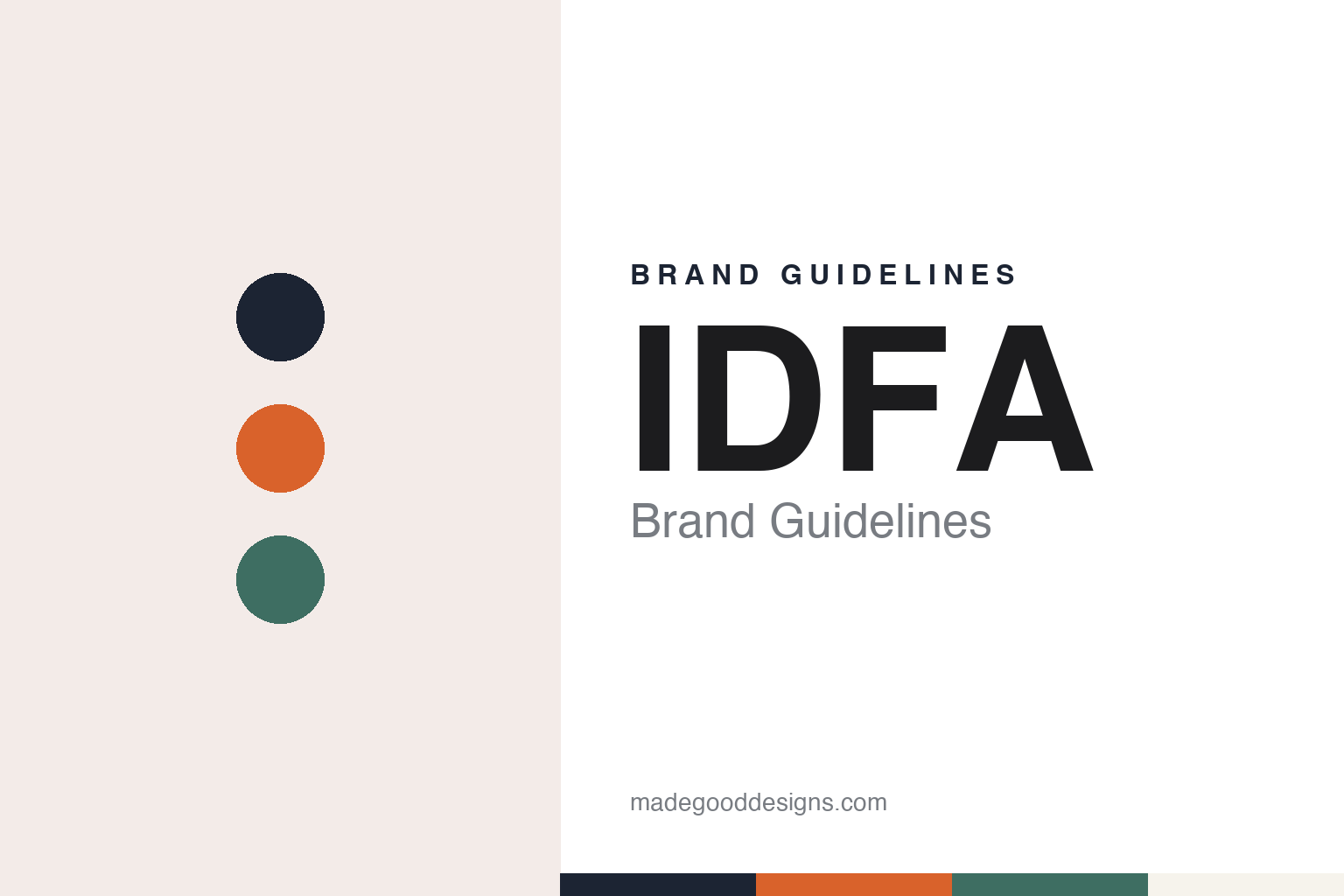
IDFA Brand Guidelines
Four letters, an Amsterdam November and a pavilion in the park.
Aa
Two constants: a screening ink, lamp orange and park green palette and a Plain festival sans register. Abstract homage — not an IDFA asset or mark; no logo, poster, photograph or wordmark is reproduced.
Amsterdam, 1988
A documentary festival that grew out of an educational one.
The International Documentary Film Festival Amsterdam, known by its acronym IDFA, has been held in Amsterdam every year since 1988. Dutch Wikipedia says its inaugural edition took place in November 1988 in the former cinema rooms of De Balie, and that the festival was set up to stimulate documentary culture in the Netherlands and abroad. English Wikipedia describes IDFA as the successor to Festikon, a festival of educational film that the Dutch Film Institute founded in 1961 and that closed in 1987; Festikon’s director proposed a new festival given over entirely to documentary.
Ally Derks, who had joined the Festikon team in 1985, headed IDFA from 1988 until 2017, English Wikipedia says, and her programming shaped the event’s profile for almost three decades. An interim artistic director led the 2017 edition, and a new artistic director took over in January 2018.
The programme has been reorganised several times. English Wikipedia says that in 2019 IDFA introduced the non-competitive sections Luminous and Frontlight, together with thematic Pathways meant to help audiences find their way through the programme, and that in 2021 it added the Envision Competition, for films that experiment with form, beside its International Competition. On the industry side, a new structure took shape between 2019 and 2022, including the Producers Connection, where producers present projects to each other.
The festival also grew in length. Dutch Wikipedia says it had become an eleven-day event by 2004, marked its 30th anniversary in 2017, and held its 33rd edition in 2020 largely online, with some screenings at Tuschinski and Eye. English Wikipedia gives an audience of 295,000 for 2019, spread over more than 40 venues around the city.
Deadline reported on 13 November 2026 that the 39th edition was underway, with Isabel Arrate Fernandez in her second year as artistic director and more than 250 films across the sections. The festival’s own site gives the 2026 dates as 12 to 22 November.
Colour
Markets, a fund, a lab and a building of its own.
IDFA is more than a run of screenings. English Wikipedia describes the professional activities that sit beside the festival: IDFA Forum, a co-financing and co-production market where filmmakers and producers pitch their projects to financiers; Docs for Sale, where new documentaries are offered to programmers and distributors; the IDFA Bertha Fund, which supports filmmakers and documentary projects in developing countries; and IDFAcademy, a training programme for emerging documentary makers. Dutch Wikipedia dates IDFA Forum, a three-day event held during the festival, to 1993, Docs for Sale to 1996 and the fund’s support for projects to 1998, and says the fund was previously named after one of the festival’s founders.
Since 2007, English Wikipedia says, IDFA DocLab has presented interactive and new-media non-fiction and looked at how digital technology is changing documentary. Among the festival’s regular non-competitive programmes it lists Masters, for new work by established documentary makers; Panorama; and Paradocs, for work on the borders between film and art, truth and fiction, and narrative and design. Special programmes have included focus strands on craft, such as sound design, editing and cinematography.
The festival began around the Leidseplein, in central Amsterdam, and has since spread to other locations, English Wikipedia says, including the Tuschinski Theatre and Eye Filmmuseum. In the summer of 2023 IDFA moved into the Vondelpark pavilion, which it has since named Het Documentaire Paviljoen, according to its annual report for that year. The building holds IDFA’s office as well as three spaces for audiences — a cinema, a studio and a salon — and a café open to the public. The report says the building was renovated before the move, that weekly screenings ran there from October 2023 under the name IDFA Vondelpark Under Construction, and that the pavilion served as an official festival location during the 36th edition that November.
IDFA announced on 16 March 2024 that it had officially opened Het Documentaire Paviljoen the previous evening, followed by an opening week of events.
Typography
Festivals of one form or one city.
A festival devoted to one form of cinema, or tied closely to one city, usually builds its identity from the name outward. The form or the place goes into the title — documentary, short film, fantastic film, or the name of the host city — and the title is then shortened until it works on a lanyard or a ticket. Amsterdam’s documentary festival is known by four letters, IDFA, and Copenhagen’s by a compound with a colon in the middle, CPH:DOX. Once a short name exists, it tends to spread to everything the festival runs: markets, funds, labs, online platforms and touring programmes.
The second layer changes every year. Festivals often commission a new poster, trailer or campaign for each edition, sometimes from an outside artist and sometimes from a studio that develops the look over several years. Each edition is often counted by number as well as by year, so the artwork, the edition number and the dates together mark one festival off from the next, while the name and the shortened form stay fixed.
Sections and strands give the programme a structure that visitors can learn. Competitions, non-competitive sections, thematic pathways, retrospectives and industry forums each carry a name of their own, and those names often follow a pattern — a shared prefix, a shared word, or shared punctuation — so that a schedule reads as one family rather than a list.
Then there are the places. A festival takes over cinemas, theatres, museums and halls for a week or two, and some set up a festival centre or keep a building of their own through the year. The practical design of a visit follows from that: programme books and printed schedules, online timetables, passes and accreditation, signage between venues, and a hub where audiences and professionals meet between screenings. This guide looks at how each festival handles those layers, using dated sources for each fact.
Aa
A plain festival sans for an acronym that carries a whole institution. (Specimen set in Work Sans, a sans STAND-IN; NOT the IDFA logo or any IDFA typeface.)
IDFA
A festival acronym and a pavilion with its own look.
The name does much of the identity work. Four letters stand for the festival, and the same prefix runs through its markets, lab, fund and training programme: IDFA Forum, IDFA DocLab, the IDFA Bertha Fund and IDFAcademy. Each edition is counted by number, so the 2026 festival is the 39th.
The pavilion was given a look of its own. In its announcement of 16 March 2024, IDFA says Het Documentaire Paviljoen relates to Amsterdam differently from the festival, following the rhythm and calendar of the city through the year, and that this difference is made visible in a new visual style by the graphic designer Sherida Kuffour. IDFA says her design celebrates the range of programmes and subjects shown in the pavilion, through a recurring motif with a refraction or “shutter” effect inspired by light passing through a camera lens, and that this cinematic style runs through its communications.
The rooms were renamed at the same time. IDFA says the cinema, which seats seventy people and is equipped for screenings and post-screening talks, became De Spiegel (the mirror); Het Podium (the stage) can be turned into a debate room, television studio or performance space; The Salon, formerly the French Room, is used for workshops and meetings; and The Foyer, entered from the terrace, serves receptions.
The festival itself refreshes its artwork every year. Deadline reported in November 2026 that the 2026 poster was designed by an artist who also contributed artwork used in that year’s festival trailer.
For a design guide, IDFA shows how one acronym can hold together a festival, its markets, a fund and a year-round building, while the building keeps a separate visual style tied to the city’s calendar. Compare IFFR, the festival in Rotterdam, and CPH:DOX, the documentary festival in Copenhagen. For this guide we use screening ink, lamp orange and park green on programme paper with a plain sans, an unofficial interpretation; no product or logo is reproduced.
Explore & save
Keep IDFA’s identity on hand — save it to a board in the Made Good inspiration library.
IDFA identity set
Pin the IDFA screening ink, lamp orange and park green palette and the Plain festival sans register to your own board.
Source & notes
Frequently Asked Questions
What font can I use to match the IDFA look?
This guide describes IDFA’s type as “A plain festival sans for an acronym that carries a whole institution”. Its type specimen is set in Work Sans from Google Fonts as a stand-in; Work Sans is not IDFA’s own lettering.
What colours are in the IDFA palette?
This guide’s IDFA palette is Screening ink #1C2433, Lamp orange #D9622B, Park green #3E6E62, Brick shadow #8A3A14 and Programme paper #F6F3EC. The tones are the guide’s own unofficial interpretation, not official IDFA hex codes.
When was IDFA founded?
IDFA was founded in 1988, in Amsterdam, Netherlands. This guide gives Het Documentaire Paviljoen, Vondelpark (since 2023) as where IDFA is based.
Where is IDFA based?
IDFA is based in Het Documentaire Paviljoen, Vondelpark (since 2023).