CPH:DOX Brand Guidelines
A colon in the name, a March in Copenhagen and a hall at Charlottenborg.
Aa
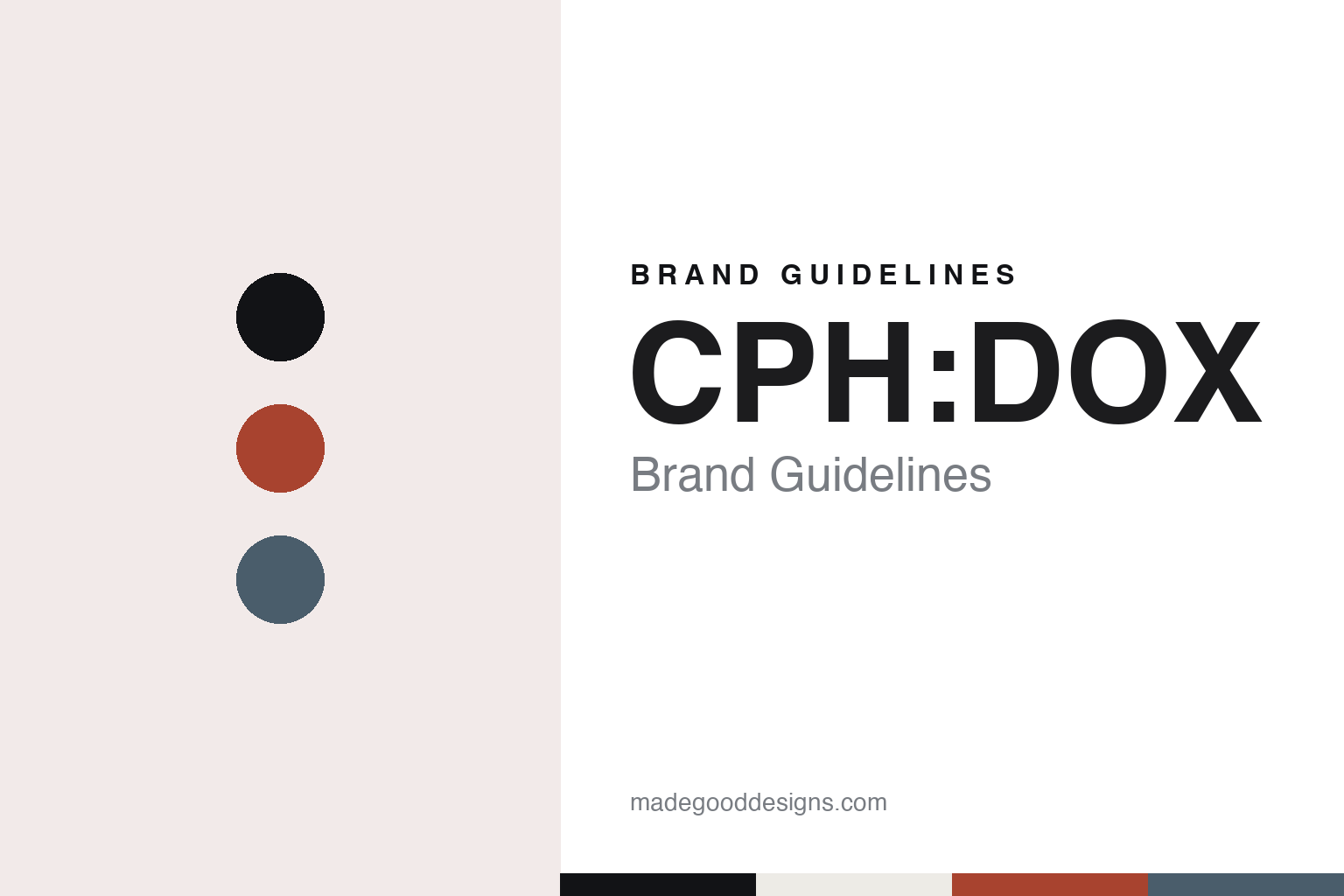
Two constants: a night black, kunsthal brick and harbour slate palette and a Condensed festival sans register. Abstract homage — not a CPH:DOX asset or mark; no logo, poster, photograph or wordmark is reproduced.
Copenhagen, 2002
A documentary festival born beside NatFilm.
CPH:DOX — the Copenhagen International Documentary Film Festival — was founded in 2002 and held its inaugural edition the following year, in 2003, Danish Wikipedia says. It was set up on behalf of Natsværmerfonden, the foundation behind the NatFilm Festival, which ran from 1990 to 2008. The team responsible for the 2003 festival came from Cinemateket, from NatFilm Festival and from the European Documentary Network, according to the same article. The colon is part of the name: English Wikipedia says CPH:DOX is the festival’s official name.
Until 2008 the festival was run under Natsværmerfonden and produced by NatFilm Festival, Danish Wikipedia says, with Tine Fischer as head of programme, artistic lead and public face; she later became festival director. In 2008 CPH:DOX, the children’s film festival BUSTER and the newly created fiction festival CPH PIX were brought together under one foundation, Copenhagen Film Festivals (Fonden De Københavnske Filmfestivaler), which still runs BUSTER and CPH:DOX. English Wikipedia says Niklas Engstrøm, a member of the festival team since 2003 and its head of programme, was appointed artistic director in May 2021, and that a managing director was appointed soon afterwards.
The festival changed season in the 2010s. Following the 2015 edition it announced a move from November to March, English Wikipedia says, and the inaugural spring edition ran from 16 to 26 March 2017, with Kunsthal Charlottenborg, in the centre of Copenhagen, as the new festival centre. The 2020 edition moved online. The 2025 festival ran from 19 to 30 March, and English Wikipedia gives more than 150,000 admissions and more than 2,000 international industry guests for that year.
The 23rd edition ran from 11 to 22 March 2026. Nordisk Film & TV Fond reported on 9 March 2026 that it would bring more than 200 new films to Copenhagen, including 86 world premieres.
Colour
Competitions, a forum, a lab and a whole country.
CPH:DOX screens in cinemas across Copenhagen, with Kunsthal Charlottenborg as its centre, English Wikipedia says. Its programme is built around international competitions and curated sections. The festival’s main competition is the DOX:AWARD, according to Nordisk Film & TV Fond, and the other competition names follow the same pattern: NEW:VISION for experimental and artists’ film, F:ACT for work between investigative journalism and documentary, NORDIC:DOX for Nordic documentaries and NEXT:WAVE for emerging filmmakers. CPH:DOX is part of the Doc Alliance, a partnership of European documentary festivals.
The 2026 programme was organised around thematic strands, Nordisk Film & TV Fond reported, including the newly launched Brain Waves, on neuroscience and technology. The festival centre hosted exhibitions and immersive works, among them the INTER:ACTIVE showcase, whose 2026 theme was “Hypervigilance,” and a curated online selection followed on the festival’s PARA:DOX platform after the physical event.
The festival also reaches beyond the capital. Since 2021 it has run local editions in other Danish towns under the name DOX:DANMARK. Danish Wikipedia says the pilot reached nine municipalities outside Copenhagen in 2021, rising to 21 in 2022, 29 in 2023, 42 in 2024, 54 in 2025 and 61 in 2026; Nordisk Film & TV Fond reported more than 400 screenings across the country for 2026.
Beside the screenings sits an industry programme. English Wikipedia describes CPH:FORUM, a three-day financing and co-production forum with an attached CPH:MARKET for buyers and programmers; CPH:WIP, where Nordic works in progress are presented; and the CPH:Conference. The talent and production workshop CPH:LAB, formerly DOX:LAB, was launched in 2009 and each year brings together about twenty filmmakers who make films in pairs; the ART:FILM strand, launched in 2011, supports feature-length films by visual artists. The festival also runs a concert series, Audio:Visuals, in which bands perform to new work by visual artists.
Typography
Festivals of one form or one city.
A festival devoted to one form of cinema, or tied closely to one city, usually builds its identity from the name outward. The form or the place goes into the title — documentary, short film, fantastic film, or the name of the host city — and the title is then shortened until it works on a lanyard or a ticket. Amsterdam’s documentary festival is known by four letters, IDFA, and Copenhagen’s by a compound with a colon in the middle, CPH:DOX. Once a short name exists, it tends to spread to everything the festival runs: markets, funds, labs, online platforms and touring programmes.
The second layer changes every year. Festivals often commission a new poster, trailer or campaign for each edition, sometimes from an outside artist and sometimes from a studio that develops the look over several years. Each edition is often counted by number as well as by year, so the artwork, the edition number and the dates together mark one festival off from the next, while the name and the shortened form stay fixed.
Sections and strands give the programme a structure that visitors can learn. Competitions, non-competitive sections, thematic pathways, retrospectives and industry forums each carry a name of their own, and those names often follow a pattern — a shared prefix, a shared word, or shared punctuation — so that a schedule reads as one family rather than a list.
Then there are the places. A festival takes over cinemas, theatres, museums and halls for a week or two, and some set up a festival centre or keep a building of their own through the year. The practical design of a visit follows from that: programme books and printed schedules, online timetables, passes and accreditation, signage between venues, and a hub where audiences and professionals meet between screenings. This guide looks at how each festival handles those layers, using dated sources for each fact.
Aa
A condensed festival sans for a name built on a colon. (Specimen set in Barlow Condensed, a sans STAND-IN; NOT the CPH:DOX logo or any CPH:DOX typeface.)
CPH:DOX
A naming system, a yearly identity and a temporary hall.
The colon is the festival’s most consistent device. It sits in the name itself and in the names of almost everything around it, from CPH:FORUM and CPH:LAB to INTER:ACTIVE, PARA:DOX and DOX:DANMARK, so that a section, a platform and a country-wide programme all read as parts of one system.
The visual identity is renewed for each edition. The Brand Identity reported on 22 April 2022 that the Copenhagen and Stockholm branding studio Barkas was continuing its yearly development of the CPH:DOX identity, taking the festival’s interplay of society, science and art as its starting point. For 2022 the studio combined stark type with fluid three-dimensional shapes, made by a Danish 3D artist and laid over photography so that they appear to distort the image beneath, and introduced the typeface Baikal, by the foundry newglyph, in a monochrome application, the magazine said.
The festival centre is designed afresh as well. In a news item of 17 March 2026, CPH:DOX says its headquarters at Kunsthal Charlottenborg, a temporary cinema, lounge and bar, was designed by the architect Sarah Falk Fredslund and the studio Terroir, and that the architects designed its parts so that they can be stored and set up again in new ways. The festival says that year it began a three-year partnership with the Danish furniture maker Montana and the textile maker Gabriel, which supplied furniture and textiles; most textiles were used at full length, with the rolls serving as the structure, so that they can be rolled up and reused.
For a design guide, CPH:DOX shows how one piece of punctuation can turn a festival, its competitions and its industry events into a single family of names, while the posters and the festival centre change from year to year. Compare IDFA in Amsterdam and Sheffield DocFest, two other documentary festivals. For this guide we use night black, kunsthal brick and harbour slate on stone white with a condensed sans, an unofficial interpretation; no product or logo is reproduced.
Explore & save
Keep CPH:DOX’s identity on hand — save it to a board in the Made Good inspiration library.
CPH:DOX identity set
Pin the CPH:DOX night black, kunsthal brick and harbour slate palette and the Condensed festival sans register to your own board.
Source & notes
Frequently Asked Questions
What font can I use to match the CPH:DOX look?
This guide describes CPH:DOX’s type as “A condensed festival sans for a name built on a colon”. Its type specimen is set in Barlow Condensed from Google Fonts as a stand-in; Barlow Condensed is not CPH:DOX’s own lettering.
What colours are in the CPH:DOX palette?
This guide’s CPH:DOX palette is Night black #121316, Kunsthal brick #A8432F, Harbour slate #4A5D6B, Deep brick #7C2E20 and Stone white #EDEBE6. The tones are the guide’s own unofficial interpretation, not official CPH:DOX hex codes.
When was CPH:DOX founded?
CPH:DOX was founded in 2002; inaugural edition 2003, in Copenhagen, Denmark.