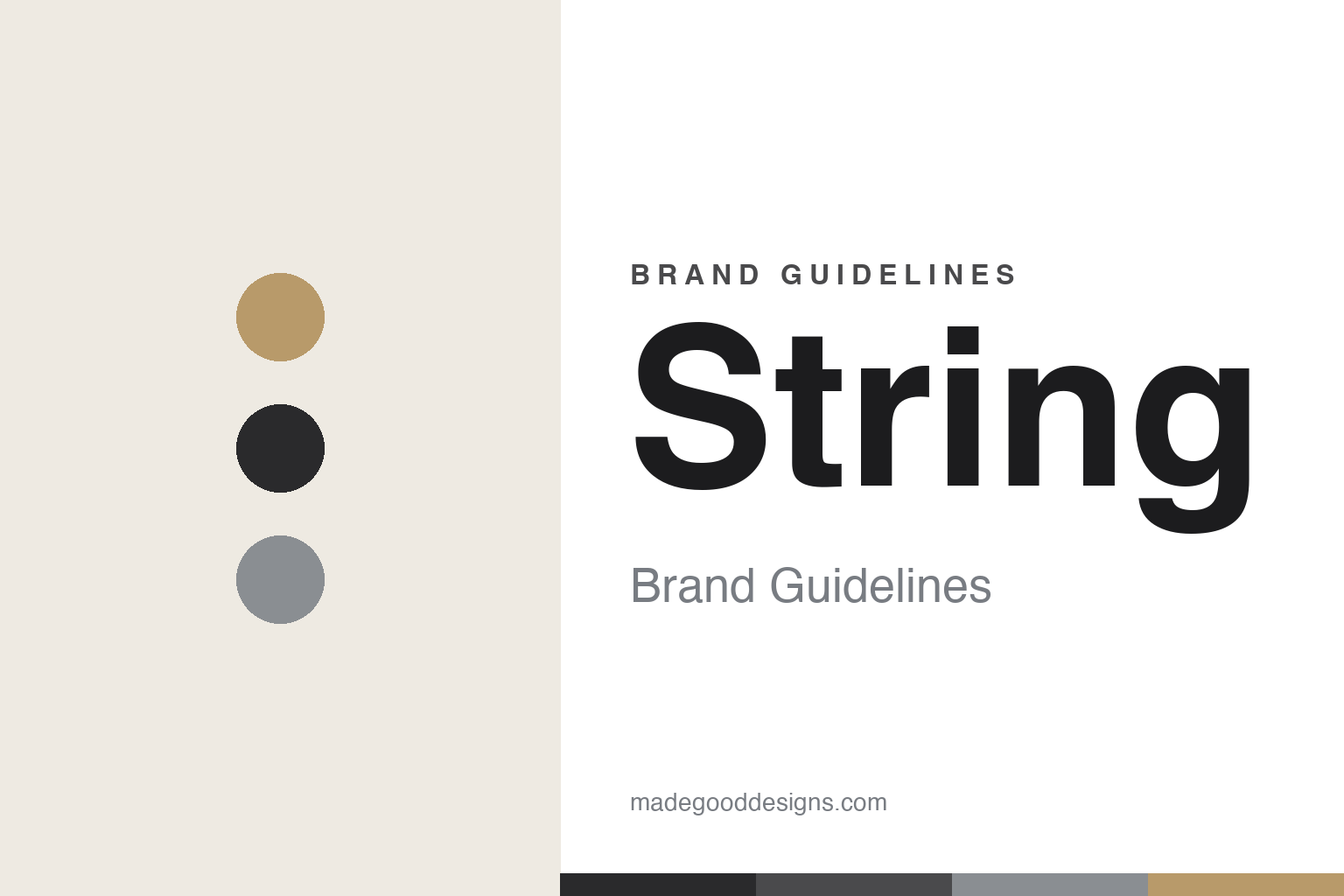
String Brand Guidelines
A shelf that won a contest — light, modular wall shelving on bent-wire ladders, a Swedish classic since 1949.
Aa
Two constants: a light wood-black-and-grey palette and a clean, Nordic sans. Abstract homage — not the String wordmark.
A shelf that won a contest
String reinvented the bookshelf.
String is a lesson in a single, perfect modular system. The String shelving system was designed in 1949 by the married architects Nisse (Nils) Strinning and Kajsa Strinning (an honest note: Kajsa was a genuine co-designer, not merely “the wife”). Its origin is charming: the Swedish publisher Bonnier (its Bonniers Folkbibliotek imprint) ran a 1949 competition for “an affordable, wall-mounted, expandable bookshelf with at least two metres of shelf space” — and the Strinnings won first prize with the design that became String. (Two honest notes: no official brand hex is published, and the wordmark typeface is undocumented.)
The design is unmistakable and endlessly useful: light, plastic-coated bent-steel-wire, ladder-like side panels onto which modular, wall-mounted shelves clip — a flexible, expandable, endlessly reconfigurable wall-shelving system that can grow and change with a home. (An honest note: the name is generally understood to refer to the thin wire supports, though that isn’t officially confirmed.) It’s a genuine 20th-century Scandinavian Modern classic — 40,000 units sold in the first year, installed in the UN headquarters in 1952, and awarded a Gold Medal at the 1954 Milan Triennale.
A precise note on history: the shelf is 1949, while the original company, String Design AB, was established by Nisse Strinning a few years later, in 1952. The modern company, String Furniture, is a genuine revival: entrepreneurs Peter Erlandsson and Pär Josefsson tracked down the original creators and brought the system back into production (relaunched in 2004, publicly reintroduced in 2005). It remains a Swedish-owned, independent company (HQ in Limhamn), making the system largely in Sweden. A shelf that won a contest.
Colour
String lives in a light wood-black-and-grey palette. Click a swatch to copy the hex.
String’s identity is light, airy and Scandinavian — the natural tones of ash, oak and walnut shelves, the black (or white) bent-wire side panels, and clean greys and whites. The palette reads as functional, modern and unfussy — the look of a light, flexible, wall-mounted system rather than heavy furniture — and the interplay of warm wood and thin metal wire is central to the system’s (and the brand’s) identity. It’s a restrained, modernist palette that lets the elegant structure show. The honest caveat: String publishes no official brand hex, so the wood, black-wire and grey here are an original, unofficial interpretation, not first-party values.
The lesson is a light wood-and-wire palette signals functional Scandinavian modernism. String’s wood-and-black world reads as airy and modular. For designers, it’s a reminder that warm wood plus thin metal can convey lightness and flexibility. The takeaways: use warm wood with black/white metal for functional modernism; let the structure show; and treat specific hexes as unofficial when there’s no published spec.
Typography
The wordmark is a clean Nordic sans — light and functional.
String’s identity carries a light, functional, Scandinavian spirit — the lowercase “string®” wordmark whose even, understated letterforms read as modern, unfussy and Nordic. A clean Nordic sans captures the mood: it’s restrained and functional, matching a system built on lightness, flexibility and modularity. Set against a light wood-and-wire palette, the type feels light and functional — exactly the airy, modular personality String cultivates. It’s clean and modern rather than decorative, mirroring the elegant, minimal shelving. Because the exact wordmark face isn’t publicly documented, the honest description is “a clean Nordic sans spirit,” not a named font. The type behaves like the brand: light, functional and Nordic.
Aa
A clean Nordic sans spirit — light and functional. (Specimen set in Hanken Grotesk, a clean Nordic-style sans in the spirit of the String identity; the real face is undocumented.)
System as the difference
String grows with you.
String is a lesson in one perfect, adaptable system as a lasting design. Like the best modular systems, String’s genius is that it’s not really a product but a kit of parts: bent-wire side panels and clip-on shelves that can be arranged, expanded and reconfigured into almost any wall-storage configuration, and changed as a home changes. That adaptability is the whole differentiator — a String shelf bought today can grow with you for decades, which is why a 1949 design is still in continuous production and endlessly relevant. It also democratises good design: light, affordable, easy to add to. The competition brief that birthed it — cheap, wall-mounted, expandable — reads like a design manifesto, and the Strinnings answered it so completely that the system has never needed replacing. The lesson is that designing a genuinely modular, adaptable system — rather than a fixed object — can create a design that lasts generations, because it flexes to the user instead of expiring. Build a system that grows, and it never goes out of date. Adaptable by design.
For designers and brand-builders, String offers a clear takeaway: a genuinely modular, adaptable system can outlast any fixed product. The lessons: design a kit of parts, not a single object (wire panels + clip-on shelves); make it expandable and reconfigurable for life; and keep it light and democratic. It’s also a reminder to keep the facts precise — the String shelf was designed in 1949 by Nisse and Kajsa Strinning, won a Bonnier competition, and the modern String Furniture revived it in 2004. String grows with you — proof that a system can be the difference.
Explore & save
Keep String’s identity on hand — save it to a board in the Made Good inspiration library.
String identity set
Pin the Scandinavian palette and the Nordic-sans spirit to your own board.