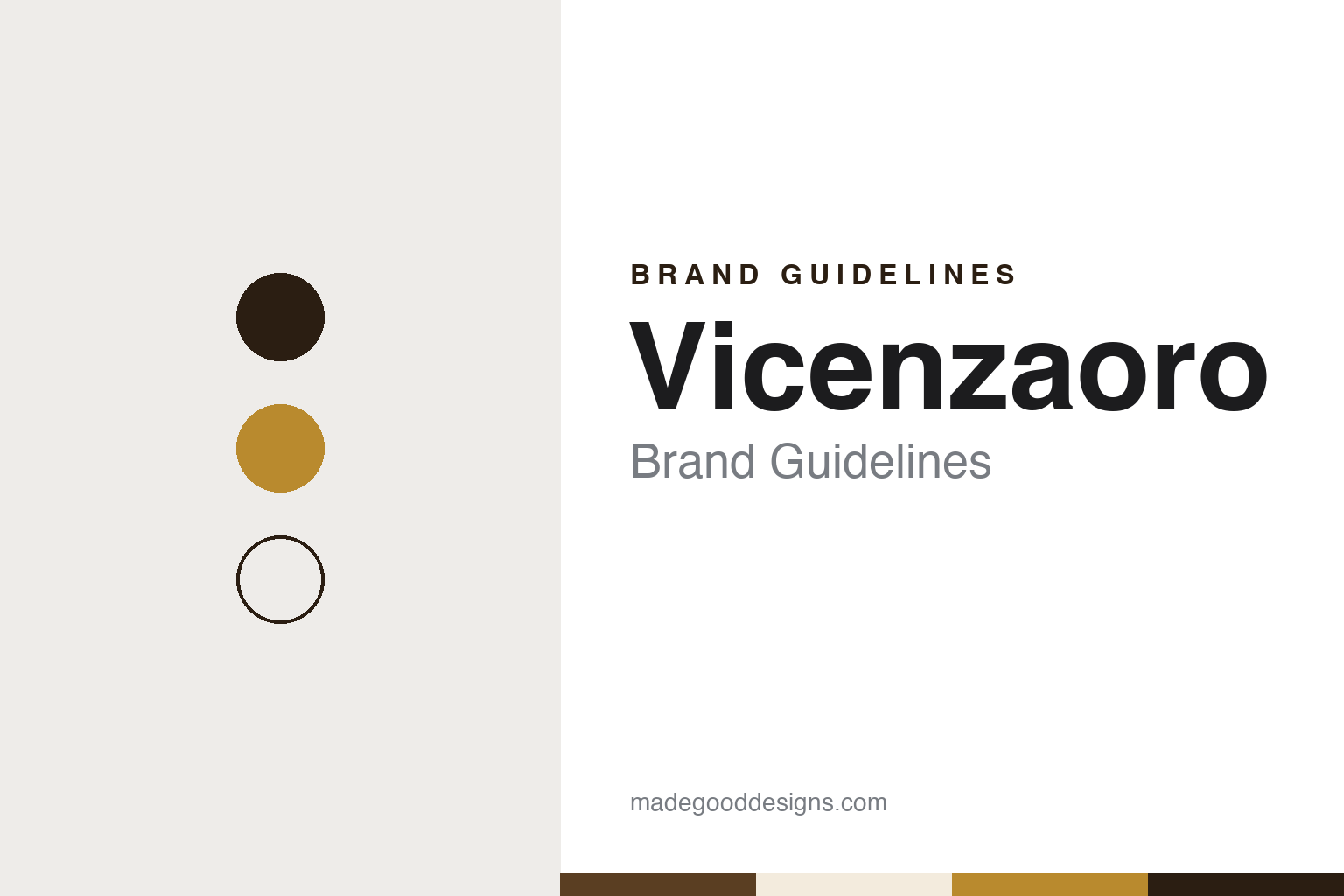
Vicenzaoro Brand Guidelines
Vicenza’s gold and jewellery fair, held every January and September.
Aa
Two constants: a walnut, gold and ivory palette and a classical serif register. Abstract homage — not a Vicenzaoro product or mark; no logo, key visual or exhibit is reproduced.
Giardino Salvi, 1954
A national goldsmithing show in a city garden.
Vicenzaoro is the gold and jewellery trade fair of Vicenza, in the Veneto; its name joins the city to oro, the Italian word for gold. Its roots go back to 1954, when the Giardino Salvi in the centre of the city hosted the first national exhibition of goldsmithing and silverware, the Mostra nazionale dell’oreficeria e dell’argenteria, Il Giornale di Vicenza recalled in January 2024, when the fair marked its seventieth anniversary. Il Post also gave 1954 as the fair’s founding year in an explainer published on 22 January 2024.
The city’s exhibition body is a few years older. Italian Wikipedia says the Fiera di Vicenza was set up in 1948 on the initiative of the industrialist Gaetano Marzotto, its founder and first president, as a national sample fair involving the city, the province and the provincial tourism board. Its first home was the Giardini Salvi in the city centre. In 1971 the Fiera di Vicenza moved to a larger site at Vicenza Ovest, in the west of the city, near the motorway, according to the same article. Italian Wikipedia describes an exhibition district of about 70,500 square metres in 13 halls around a central pyramid-shaped pavilion, and says a 15,000-square-metre hall without columns, known as “il Magnete”, opened during the January 2014 gold fair.
The names and the calendar have changed several times. Italian Wikipedia records that the single early show grew into three gold fairs a year: VicenzaOro1 in January, VicenzaOro2 in June and Orogemma in September, with a separate hall, Oromacchine, for goldsmithing machinery. In 2007, when the Fiera di Vicenza became a joint-stock company, the shows were renamed VicenzaOro Winter, Spring and Autumn. In 2008 they became three distinct events named First, Charm and Choice, and the machinery hall took the name T-Gold. By 2024 the fair had settled into two editions a year, one in January and one in September, Il Post reported. The organiser now writes the name as Vicenzaoro, with a lower-case o, and that is the spelling used in this guide. Vicenzaoro is held every January and September.
Colour
Communities, not just halls.
Since 2016 the fair has been organised by Italian Exhibition Group (IEG). Italian Wikipedia, citing IEG’s announcement, says the group was formed that year when Fiera di Vicenza, by then renamed Vicenza Holding, was combined with Rimini Fiera, and that IEG owns the Vicenza exhibition district. Il Post describes Vicenzaoro as a business-to-business fair: only professionals from the gold and jewellery trade attend, and its purpose is to put retailers and distributors serving international markets in touch with manufacturers, and the other way round.
The floor is divided into what the organiser calls communities, each with a capitalised name. On its website in 2026 these include ICON for high-end branded jewellery, CREATION for goldsmith production and for mountings and semi-finished parts, TIME for contemporary watches and ESSENCE for gems, diamonds, corals and pearls, with further areas for packaging and visual merchandising, for high-end jewellery designers and for trend jewellery. Il Post singled out this division into communities as a particular feature of the fair, naming the “community time” for watches and the areas for precious stones, mountings and machinery.
Two events run beside the main fair. T.Gold, the show for machinery and technologies used in gold and jewellery production, ran in hall 9 during the January 2024 edition, organised in partnership with Afemo, the machinery producers’ association, with more than 70 exhibitors from 18 countries, Il Giornale di Vicenza reported. VO Vintage, devoted to vintage watches and jewellery, is open to the public, unlike the main fair, the newspaper noted. Trend forecasting comes from Trendvision Jewellery + Forecasting, which Il Sole 24 Ore describes as Vicenzaoro’s independent jewellery trend observatory, and whose trendbook has forecast luxury trends for more than 20 years. Talks from trade bodies such as Federpreziosi Confcommercio and the Istituto Gemmologico Italiano are part of the programme, the paper reported in 2026.
Typography
Trade fairs and their names.
Jewellery, watch, beauty and textile trade fairs usually take their names from one of three places: the trade itself, the city that hosts them, or a coined word. Some names spell out the goods on show, some lead with a city such as Basel, Geneva, Munich, Vicenza, Bologna, Frankfurt or Paris, and some combine the two, so that the name tells a visitor both what is shown and where.
Most of these fairs are built first for the trade. Their halls are planned for retailers, buyers, designers, manufacturers and the press, who come to see new collections, materials and ingredients and to place orders. Some fairs set aside trade days and then open their doors to the public for a day or more, and some add a programme of talks, tours and events in the host city around the halls.
Behind each fair sits an organiser: a foundation set up by the exhibitors, a trade association, or an exhibition company that runs many shows in its own halls and abroad. The organiser often shapes the layout, grouping exhibitors by product, from brand booths and private appointment rooms to shared areas for suppliers, trend presentations and materials forums, and some run sister editions in other cities under a related name.
Visually, these fairs tend to keep a name and a wordmark from one edition to the next while the key visual, season theme or hall design changes each year. This guide describes those identities plainly, as dated sources describe them; the colours and type shown here are our own interpretation, and no logo, key visual or stand is reproduced.
Aa
A classical serif — for a city joined to the word for gold. (Specimen set in Cormorant Garamond, a serif STAND-IN; NOT the Vicenzaoro logo.)
Vicenzaoro
The Jewellery Boutique Show.
The January 2024 anniversary edition ran until 23 January with 1,300 exhibitors, 40 per cent of them from abroad and from 37 countries, Il Giornale di Vicenza reported. The organiser marked the seventieth year with the line “The Heritage for Tomorrow”, which its website still carried in November 2026 beside the words “Seventy golden years”. According to Il Sole 24 Ore, the January 2026 edition counted more than 1,300 exhibiting brands by the organiser’s figures, 40 per cent of them from abroad.
The September 2026 edition ran from 4 to 8 September. The organiser’s T.Gold page says that from September 2026 the machinery show sits inside the Vicenzaoro exhibition grounds, in Hall 4, and runs at both the January and September editions; Il Sole 24 Ore, previewing the edition, put the added exhibition area at 23,000 square metres and quoted Matteo Farsura, IEG’s global exhibition manager for jewellery and fashion. The same edition hosted the congress of CIBJO, the World Jewellery Confederation, marking the confederation’s first hundred years, the paper reported.
On its own website the organiser presents the fair as “The Jewellery Boutique Show” and describes it as the international show dedicated to goldsmithing, jewellery and watchmaking. The name works as a compact piece of type: a city and a metal in one word, with no hyphen and, in the organiser’s current spelling, only one capital.
For a design guide, Vicenzaoro shows how a fair can keep a plain place-and-material name through decades of renamed editions, from First, Charm and Choice to today’s January and September shows. Compare INHORGENTA MUNICH, the jewellery and watch fair held each February in Munich, and the Hong Kong International Jewellery Show. For this guide we use a walnut brown, a burnished gold and a warm ivory with a serif, an unofficial interpretation; no product or logo is reproduced.
Explore & save
Keep Vicenzaoro’s identity on hand — save it to a board in the Made Good inspiration library.
Vicenzaoro identity set
Pin the walnut, gold and ivory palette and the classical serif register to your own board.
Source & notes
Frequently Asked Questions
What font can I use to match the Vicenzaoro look?
This guide describes Vicenzaoro’s type as “A classical serif — for a city joined to the word for gold”. Its type specimen is set in Cormorant Garamond from Google Fonts as a stand-in; Cormorant Garamond is not Vicenzaoro’s own lettering.
What colours are in the Vicenzaoro palette?
This guide’s Vicenzaoro palette is Walnut #5A3E22, Espresso #2B1E12, Burnished gold #B98A2E, Ivory #F3EBDD and Paper #FAF6EE. The tones are the guide’s own unofficial interpretation, not official Vicenzaoro hex codes.