Wildfish Cannery Brand Guidelines
A cannery with a brand.
Aa
Two constants: a spruce-green palette and a cannery-sans register. Abstract homage — not a Wildfish Cannery product or mark.
A cannery with a brand
Wildfish Cannery is the independent Alaskan cannery that smokes and hand-packs its wild seafood in Klawock.
Wildfish Cannery closes the round as the real thing — the independent, family-run Alaskan cannery in Klawock that smokes and hand-packs its own wild-caught seafood, and describes itself, memorably, as a cannery with a brand rather than a brand with a cannery. Wildfish Cannery makes smoked, tinned wild seafood, and its answer to a round about the art of the tin is the opposite of outsourcing: every can done by hand, in Alaska. A brand, from the cannery.
Its identity is a cannery with a brand. Wildfish Cannery’s Alaskan making, its hand-packing and its family independence are the story here. A brand, Alaskan. A cannery with a brand.
(Honest notes, so the story stays precise. Wildfish Cannery — at wildfishcannery.com, a live store — makes premium small-batch smoked, hand-packed wild seafood, with its confirmed line including smoked king, coho and sockeye salmon, geoduck and rockfish, so we say smoked salmon and other wild Alaskan seafood rather than naming products we could not verify. By its own account, it was founded in 1987 by Phyllis Mueller as a smokehouse, began canning in 2003 under Greg Scaletta, and is now led by a grandson, Mathew Scaletta, a multi-generational family business, and we attribute the succession and dates to the company’s own telling. It is based in Klawock, on Prince of Wales Island, in Southeast Alaska. On where it is made — the theme of this round — this is a genuine made-in-Alaska story: wild-caught in Alaska, smoked and hand-packed in Klawock, with the company stressing no co-packers and no middlemen, and every can done by hand. On ownership, it states it is independently owned and family-run, with no venture capital. Klawock sits in Tlingit territory, with a long Indigenous fishing history and the site of Alaska’s first salmon cannery, which we reference respectfully as place history, without implying the brand is Indigenous-owned. Its name, logo and retro label are IP we describe but do not reproduce; there is no official brand hex; these tones are an unofficial interpretation. This is design commentary.)
Colour
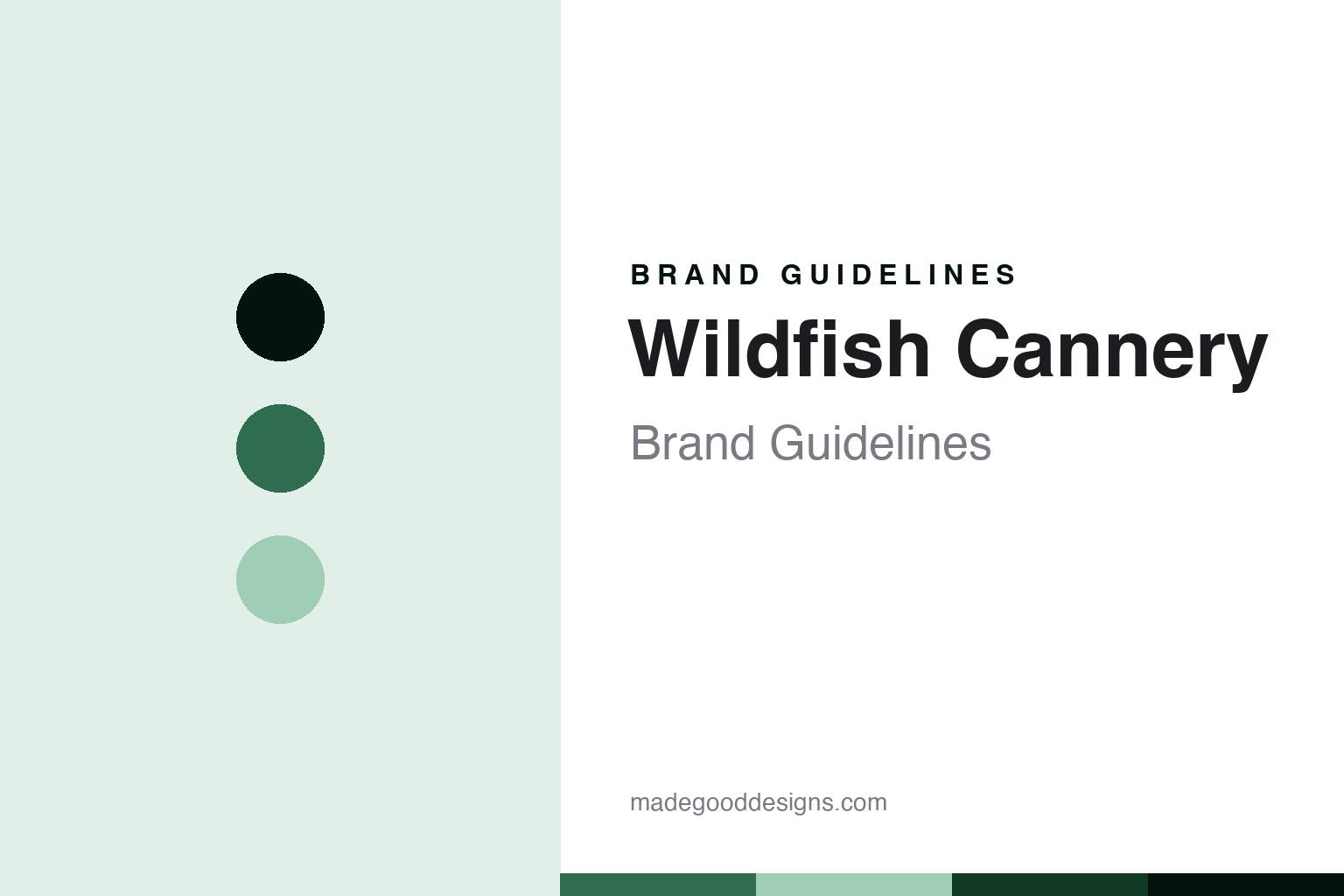
Wildfish Cannery lives in a spruce green. Click a swatch to copy the hex.
Wildfish Cannery’s identity is Alaskan, independent and smoke-toned — a spruce green, an ink, a sage, a deep spruce, and a paper. The palette leans spruce green and sage: a cool, northern register that nods to a Southeast Alaskan forest and a smokehouse rather than a loud palette. It signals a real, made-at-home cannery. The honest caveat: with no published brand hex, these values are an original, unofficial interpretation, not first-party colours.
The lesson is a spruce green signals an Alaskan, independent identity. Wildfish Cannery’s world is a made object. For designers, it is a reminder that a spruce green and a soft sage can carry a food brand — the tone of a northern forest. Because these tones can fail as small text, keep type dark and let the colour live in the accents, palette and band. The takeaways: make what you sell; own a place; stay independent; and treat any single hex as unofficial.
Typography
The register is a cannery sans — Alaskan, honest, plain.
Wildfish Cannery’s identity carries an Alaskan, honest, plain spirit — a working cannery, not a fashion. A cannery sans captures the mood: clean, sturdy and confident, the register of a place that packs by hand. Set in a spruce-green palette, the cannery sans feels Alaskan and honest — exactly the personality Wildfish Cannery carries. It is a made-at-home story rather than a logo, mirroring smoke and tinplate. (Wildfish Cannery’s real logo and retro label are things we describe but do not reproduce, and the exact typeface is not ours to use.) Because it is not ours to use, the honest description is “a cannery-sans spirit,” shown here in a stand-in. The type behaves like the brand: Alaskan, honest and plain.
Aa
A cannery-sans spirit — Alaskan and honest. (Specimen set in Mulish, a cannery-sans STAND-IN; NOT the Wildfish Cannery logo.)
The art of the tin
Wildfish Cannery stands for a cannery with a brand.
Wildfish Cannery closes the round as the real thing. A spruce-green palette, a cannery sans and hand-packing make one thing — a cannery with a brand — the whole identity: Alaskan, independent and smoke-toned. The made-in-Klawock hand-packing is the differentiator, and being a cannery first is the meaning. The point is an independent Alaskan family cannery that smokes and packs its own wild seafood, the opposite of a design-led brand that outsources its tins.
Put to work, the identity is a made-at-home story told straight, as design. A maker in this spirit would make what it sells, own a place, and stay independent. A reader in this spirit would keep the facts right: Wildfish Cannery was founded, by its own account, in 1987 by Phyllis Mueller as a smokehouse, began canning in 2003 under Greg Scaletta, and is now led by a grandson, Mathew Scaletta; it makes smoked salmon and other wild Alaskan seafood, with a confirmed line of salmon, geoduck and rockfish; it is wild-caught, smoked and hand-packed in Klawock, on Prince of Wales Island, with no co-packers; and it is independently owned and family-run, with no venture capital. Wildfish Cannery sits in the round’s where-made thread as its purest made-at-home case, alongside Nuri’s hand-wrapped Portuguese tins, and its independence contrasts with the round’s corporate owners. The honest editorial moves are to attribute the succession to the company, to say salmon and other wild seafood not unverified products, to state the made-in-Alaska fact confidently, and to treat the Tlingit history respectfully. The lesson Wildfish Cannery teaches is that making what you sell can be a whole identity, and honesty about the place keeps it credible.
For designers and brand-builders, Wildfish Cannery closes the art of the tin: make what you sell — and own a place. The lessons: be a cannery with a brand, not the reverse; hand-pack at home as the whole story; attribute a family history to its own account; treat Indigenous place-history as respectful context, not branding; and never reproduce a logo. It is also a reminder to stay precise: Wildfish Cannery is the independent Alaskan cannery that smokes and hand-packs its wild seafood in Klawock — with the palette here an unofficial interpretation. Read that way, Wildfish Cannery is less a tin than a cannery: an Alaskan family that packs its own, closing the round on the most made-at-home voice. The lesson for a brand is that making what you sell and owning a place reinforce each other, and being a cannery-first keeps the story earned. Wildfish Cannery made a-cannery-with-a-brand the identity — proof that a cannery can define a brand.
Explore & save
Keep Wildfish Cannery’s identity on hand — save it to a board in the Made Good inspiration library.
Wildfish Cannery identity set
Pin the spruce-green palette and the cannery-sans register to your own board.