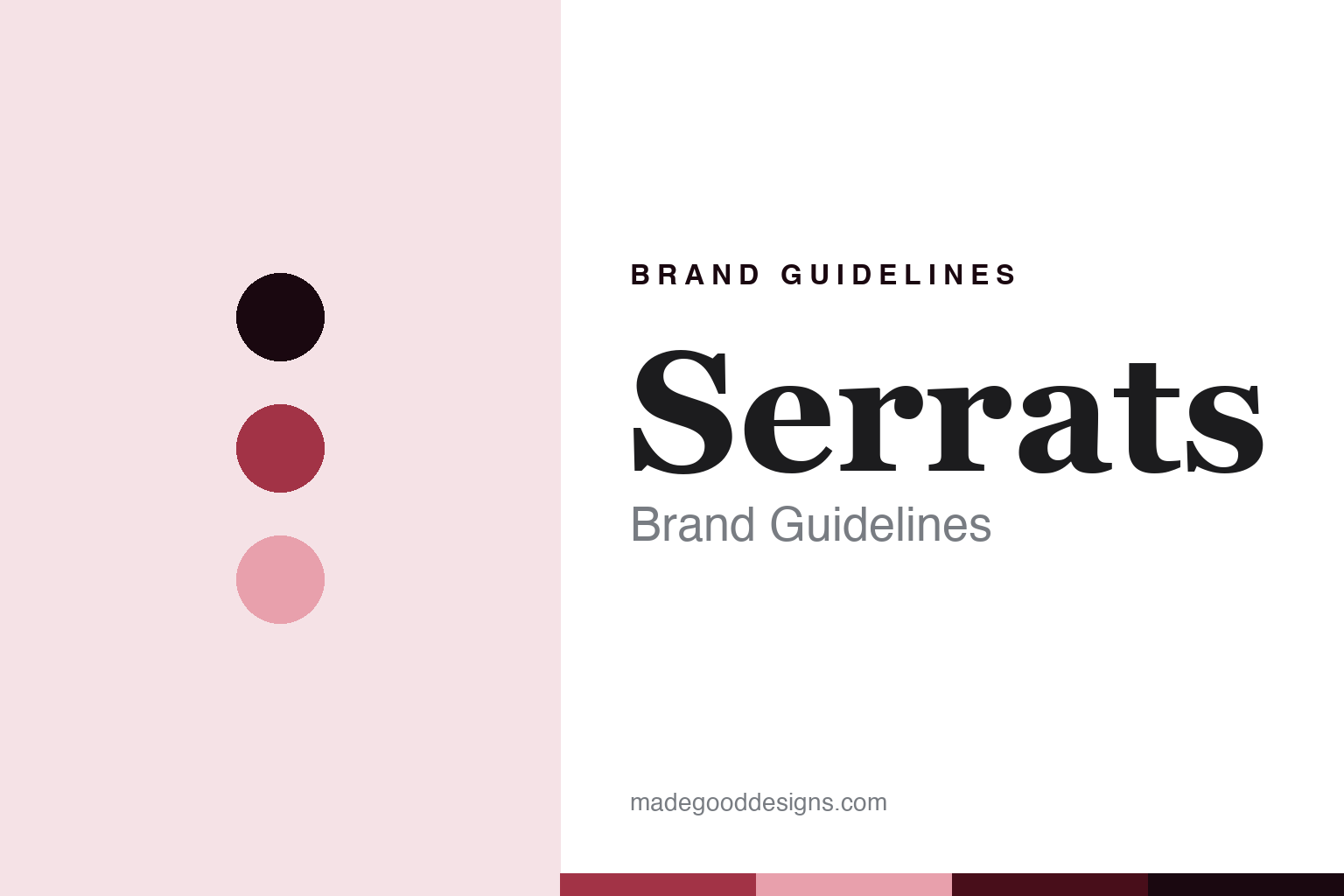
Serrats Brand Guidelines
The Basque house of bonito and anchovy.
Aa
Two constants: a Basque-red palette and a Basque-serif register. Abstract homage — not a Serrats product or mark.
The Basque house of bonito and anchovy
Serrats is the fifth-generation Basque conservas house of bonito del norte and Cantabrian anchovies — preserving since 1890.
Serrats opens the round as the Basque coast’s conservas house — the family maker from Bermeo, on the Bizkaian shore, preserving fish since 1890, best known for its bonito del norte white tuna and its Cantabrian anchovies. Serrats makes premium Basque conservas, and its answer to a round about the specialists is a regional signature: the bonito and the anchovy, hand-packed by a fifth-generation family. A brand, from Bermeo.
Its identity is the Basque house of bonito and anchovy. Serrats’ 1890 heritage, its Bermeo home and its family craft are the story here. A brand, Basque. The Basque house of bonito and anchovy.
(Honest notes, so the story stays precise. Serrats — Conservas Serrats, at serrats.com, with a live store — makes premium Basque conservas: bonito del norte and its ventresca belly, Cantabrian anchovies and white anchovies, plus small sardines, mussels, razor clams, scallops, cockles and sea-urchin caviar. It calls itself a preserver since 1890, founded in Bermeo, in Bizkaia, in the Basque Country, and describes itself as the fifth generation of a family, so we say fifth-generation and family-owned, without naming individuals we could not verify. On where it is made — a theme of this vein — it operates and produces in Bermeo, on the Basque coast, and sources its anchovies from the Bay of Biscay, the Cantabrian coast, while some shellfish come from the Galician rías, so we say Bay of Biscay and Cantabrian coast with some Galician shellfish, not a single-sea claim, and it holds MSC certification and keeps a hand-packed tradition. Its name and logo are IP we describe but do not reproduce; there is no official brand hex; these tones are an unofficial interpretation. This is design commentary, not promotion, and we treat Bermeo’s fishing and canning heritage respectfully.)
Colour
Serrats lives in a Basque red. Click a swatch to copy the hex.
Serrats’ identity is Basque, heritage and hand-packed — a Basque red, an ink, a blush, a deep red, and a paper. The palette leans Basque red and blush: a warm, coastal register that nods to a Bermeo canning house and a tinplate lid rather than a loud palette. It signals a heritage Basque specialist. The honest caveat: with no published brand hex, these values are an original, unofficial interpretation, not first-party colours.
The lesson is a Basque red signals a heritage, hand-packed identity. Serrats’ world is a heritage, made object. For designers, it is a reminder that a warm red and a soft blush can carry a food brand — the tone of a Basque port. Because these tones can fail as small text, keep type dark and let the colour live in the accents, palette and band. The takeaways: own a region; lead with a signature; source honestly; and treat any single hex as unofficial.
Typography
The register is a Basque serif — heritage, coastal, considered.
Serrats’ identity carries a heritage, coastal, considered spirit — a Basque conservas house, not a fashion. A Basque serif captures the mood: warm, classic and a little venerable, the register of a name preserving since 1890. Set in a Basque-red palette, the Basque serif feels heritage and coastal — exactly the personality Serrats carries. It is a regional heritage rather than a logo, mirroring tinplate and oil. (Serrats’ real name and logo are things we describe but do not reproduce, and the exact typeface is not ours to use.) Because it is not ours to use, the honest description is “a Basque-serif spirit,” shown here in a stand-in. The type behaves like the brand: heritage, coastal and considered.
Aa
A Basque-serif spirit — heritage and coastal. (Specimen set in Cormorant Garamond, a Basque-serif STAND-IN; NOT the Serrats logo.)
The specialists’ tins
Serrats stands for the Basque house of bonito and anchovy.
Serrats opens the round as the Basque coast’s conservas house. A Basque-red palette, a Basque serif and a family craft make one thing — the Basque house of bonito and anchovy — the whole identity: Basque, heritage and hand-packed. The bonito del norte and the Cantabrian anchovy are the signature, and 1890 in Bermeo is the meaning. The point is a fifth-generation Basque family that has preserved fish for over a century.
Put to work, the identity is a regional heritage told straight, as design. A maker in this spirit would own a region, lead with a signature, and source honestly. A reader in this spirit would keep the facts right: Serrats preserves since 1890 in Bermeo, Bizkaia; it makes bonito del norte and its ventresca, Cantabrian anchovies and a range of shellfish; it is a fifth-generation family company, MSC-certified and hand-packed; and it sources anchovies from the Bay of Biscay and some shellfish from the Galician rías, not a single sea. Serrats opens the round’s regional-Spain thread with Espinaler, Los Peperetes, Don Bocarte and Güeyu Mar, the five Spanish regions, and its heritage anchors the round’s nineteenth-century pair with Espinaler. The honest editorial moves are to date it to 1890, to say fifth-generation without naming individuals, to source honestly across two seas, and to keep the craft respectful. The lesson Serrats teaches is that a region and a signature can be a whole identity, and honesty about the sourcing keeps it credible.
For designers and brand-builders, Serrats opens the specialists’ tins: own a region — and lead with a signature. The lessons: anchor a brand to a place like Bermeo; build on a signature product like bonito; source honestly across the waters you use; state a family generation without inventing names; and never reproduce a logo. It is also a reminder to stay precise: Serrats is the fifth-generation Basque conservas house of bonito del norte and Cantabrian anchovies, since 1890 — with the palette here an unofficial interpretation. Read that way, Serrats is less a tin than a port: a Basque family preserving since 1890. The lesson for a brand is that a region and a signature reinforce each other, and dating it to 1890 keeps the heritage earned. Serrats made the-Basque-house-of-bonito-and-anchovy the identity — proof that a port can open a round.
Explore & save
Keep Serrats’s identity on hand — save it to a board in the Made Good inspiration library.
Serrats identity set
Pin the Basque-red palette and the Basque-serif register to your own board.