Yanghe Brand Guidelines
The Jiangsu baijiu that turned blue in 2003.
Aa
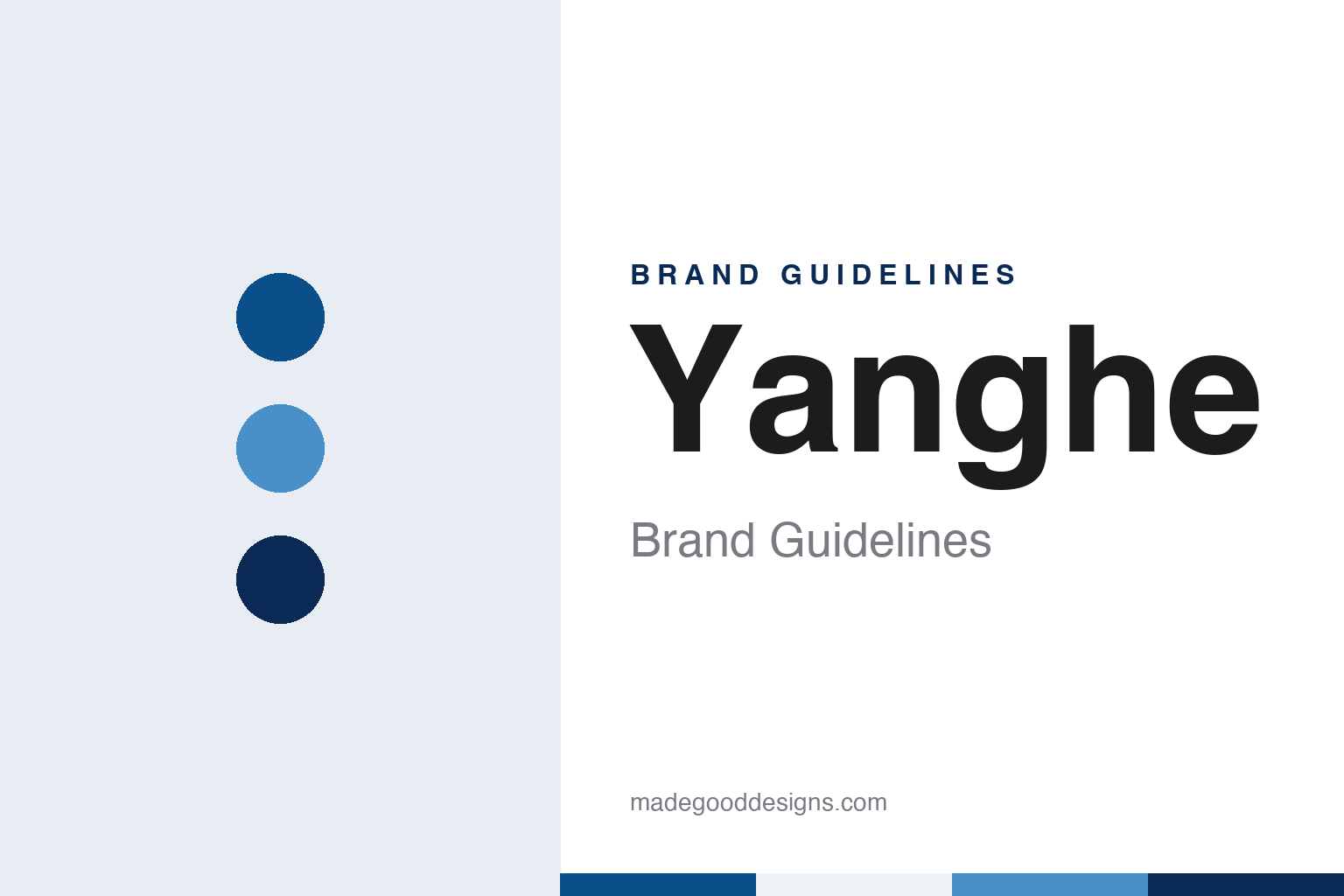
Two constants: an ocean blue, sky blue and dream navy palette and a soft geometric sans register. Abstract homage — not a Yanghe product or mark; no label, logo or bottle is reproduced.
A canal town in northern Jiangsu
Old workshops, a spring and a national title.
Yanghe is both a town and a spirit. Yanghe Daqu, Chinese Wikipedia says, comes from Yanghe town in Suqian, in the north of Jiangsu province; the town once sat in Siyang county and is now part of Suqian’s Sucheng district. The company behind it is Jiangsu Yanghe Distillery Co., Ltd., which Chinese Wikipedia also calls the Su Jiu Group and which is listed on the Shenzhen Stock Exchange.
The local story reaches back a long way. Chinese Wikipedia says Yanghe Daqu “rose in the Sui and Tang and flourished in the Ming and Qing,” and that in the Yongzheng reign of the Qing dynasty it sold across the Jiang-Huai region under the saying that its taste was “first in Jiang-Huai,” with tribute supplied to the imperial household.
The modern distillery has a clearer date. Chinese Wikipedia says the state-run Yanghe distillery was formed in 1949 from several private workshops, among them Yuyuan, Xiangtai, Fengtai and Guangquanju. Water is part of the local legend: the article names a spring called Meirenquan, the “beauty spring,” as the source of the brewing water.
National recognition followed three decades later. At China’s third national liquor appraisal in 1979, Yanghe Daqu was named one of the country’s eight famous spirits, Chinese Wikipedia says. The distillery was restructured as a joint-stock company in 2002, and its shares began trading in Shenzhen in November 2009.
Colour
A strong-aroma house that sold itself as soft.
By style, Yanghe belongs to nongxiang, the strong-aroma family of baijiu. Chinese Wikipedia describes Yanghe Daqu as made from sorghum fermented with a high-temperature daqu starter of wheat, barley and peas, and lists its character as sweet, mellow, soft, clean and fragrant. Chinese business coverage of the company’s newer range leans on another word, mianrou, roughly “soft and smooth.”
The turning point was a colour. In 2003 Yanghe launched the Blue Classic range in three tiers: Haizhilan (Ocean Blue), Tianzhilan (Sky Blue) and Mengzhilan (Dream Blue). China News Service reported the 2003 launch in a 2010 feature on the company, and a case study published by the China Europe International Business School (CEIBS) calls the Blue Classic range, with its smooth taste and modern feel, the product that turned a regional distillery into a national brand.
Blue mattered because baijiu packaging had long leaned on red and gold-yellow. China Securities Journal reported in June 2022, when Yanghe released what it called the 6.0 version of Ocean Blue, that the range’s blue had broken with that red-and-yellow convention. Yangtse Evening Post’s Ziniu News reported in March 2026 that Ocean Blue went on sale in 2003, when strong-aroma baijiu dominated the market, in blue packaging and at an everyday price point aimed at ordinary drinkers, and that it had been upgraded seven times since, with packaging and taste adjusted but its positioning unchanged.
The three names form a ladder of ocean, sky and dream, all in the same family of blues, with Ocean Blue as the everyday bottle that Ziniu News described.
Typography
Design and documentation.
The seven brands in this group are all mezcal, baijiu and grappa names: Del Maguey, Montelobos, 400 Conejos, Luzhou Laojiao, Fenjiu, Yanghe and Nardini. Spirits brands in general sit at many different points in the trade, from family houses that still carry a founder’s name to labels that now belong to much larger drinks groups, and a single brand can be sold everywhere from a corner shop to a bar list.
A spirits brand’s identity is usually carried less by a single bottle than by a label, a name and the place it promises, because the company behind the name may have changed hands, moved its production or grown far beyond the place where it started. That makes the questions behind each name worth asking plainly: who started it, who owns it now, and where its spirit is actually made and bottled.
Each guide separates what independent sources record from what the company says about itself — its founding story, its owners over time, where its spirit is made and how its labels have changed — and marks plainly what rests only on the company’s own word.
Aa
A soft geometric sans for a brand built on a colour and the idea of smoothness. (Specimen set in Manrope, a sans-serif STAND-IN; NOT the Yanghe logo.)
Yanghe
From one distillery to a provincial group.
The Blue Classic years turned Yanghe into a consolidator. Chinese Wikipedia says the company acquired Jiangsu Shuanggou Group, a neighbouring baijiu maker, in 2010, and that the combined business took the name Su Jiu Group, with the Yanghe and Shuanggou distilleries and a national sales arm, Su Jiu Industrial, beneath it. Further purchases followed: Hubei Lihuacun, Hunan Miluochun and the Binzhou distillery in Harbin in 2013, and Guizhou Guijiu in 2016, the same article says. Morningstar’s company profile lists Yanghe, Shuanggou and Sujiu among its brands.
Yanghe Daqu has not disappeared under the blue bottles. Chinese Wikipedia lists it alongside the three Blue Classic tiers as a main product, sold in a cellar-aged series and an “old famous spirit” series, with versions including a ten-year cellar bottling, a blue-porcelain bottle and an “elephant ear” bottle.
The national appraisals still frame how the category ranks itself. At the first, in 1952, four spirits were named and Fenjiu was among them, English Wikipedia says; Yanghe Daqu joined the list at the third, in 1979, when eight famous spirits were named, Chinese Wikipedia says. Chinese Wikipedia says Yanghe Daqu then held the famous-spirit title at three successive appraisals.
The name needs a little care in searches. English Wikipedia lists Yanghe as the name of several towns and townships across China, a former name of mountains in Hunan and a stadium in Chongqing, as well as the baijiu; only the Suqian town is home to the distillery.
For a design guide, Yanghe shows how a single colour, applied to a three-step ladder of names, can make a traditional spirit look new without changing its category, and how a provincial distillery can grow into a group behind one hue. Compare Fenjiu, the light-aroma baijiu of Shanxi, and Jinro, the Korean soju with its own blue bottle. For this guide we use ocean blue, sky blue and dream navy with a sans, an unofficial interpretation; no product or logo is reproduced.
Explore & save
Keep Yanghe’s identity on hand — save it to a board in the Made Good inspiration library.
Yanghe identity set
Pin the Yanghe ocean blue, sky blue and dream navy palette and the soft geometric sans register to your own board.