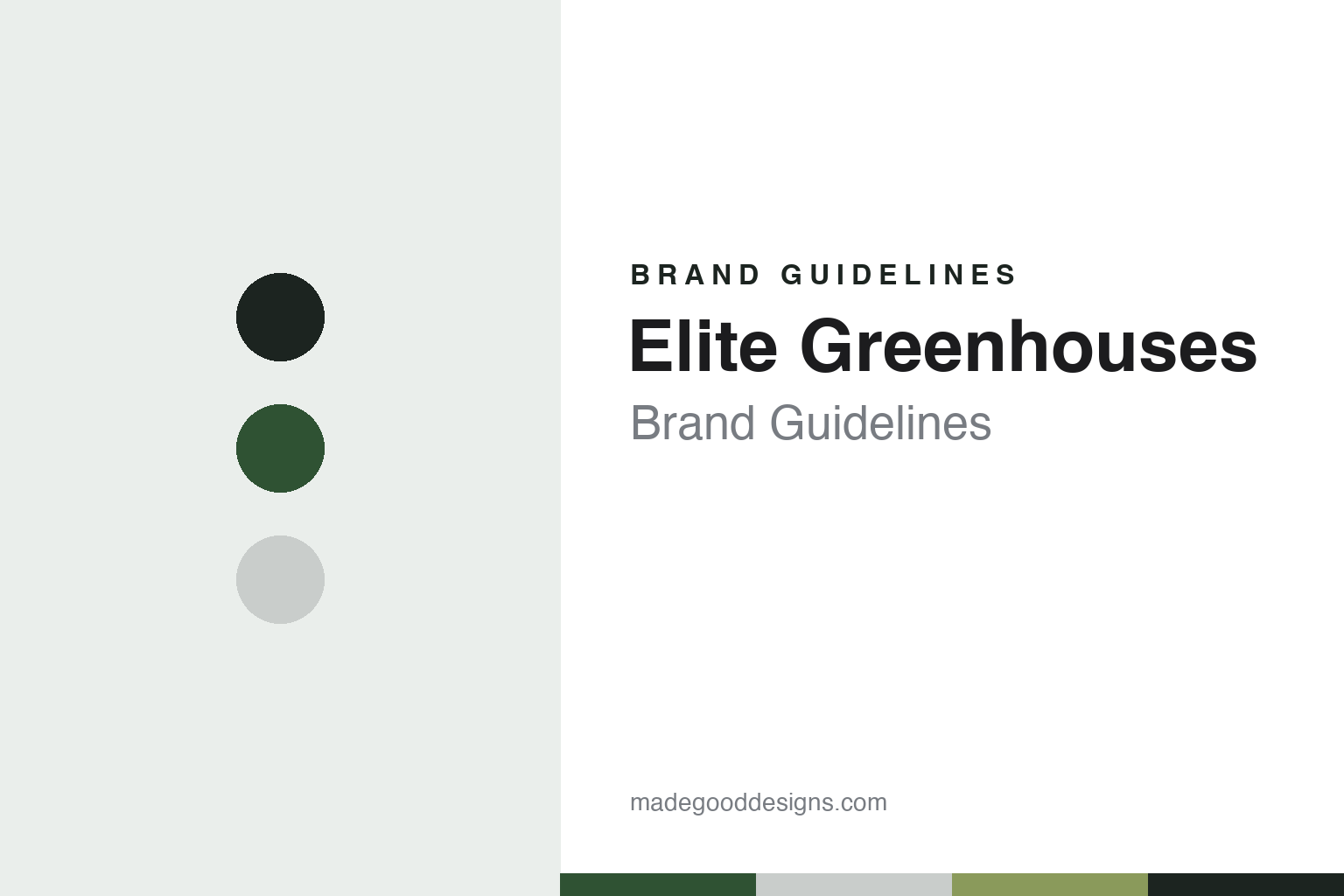
Elite Greenhouses Brand Guidelines
The Bolton family firm making aluminium greenhouses.
Aa
Two constants: an Elite green, aluminium and leaf palette and a plain British sans register. Abstract homage — not an Elite Greenhouses product or mark; no greenhouse, logo or nameplate is reproduced.
Bolton
A Lancashire greenhouse maker that dates itself to 1953.
Elite Greenhouses is a Lancashire business. The company’s website says it started “from humble beginnings in 1953” and describes it as a privately owned, third-generation UK family business that has recently celebrated its 70th year; the founders are not named on the site. The legal company is younger: the UK register Companies House records Elite Greenhouses Limited as an active private limited company incorporated in January 1977, with its registered office at Kearsley in Bolton and its business classed as manufacturing. Its most recent accounts on the register were made up to November 2025.
Bolton is central to the way the company presents itself. The website says Elite makes its greenhouses only at its own plant in Bolton, Lancashire, that they are “made right here in the UK,” and that it delivers them with its own fleet of vehicles. An archived copy of the company’s website from 2001, held by the Internet Archive, already gave the same Kearsley, Bolton base. Retailers that stock the brand repeat the company’s own history, describing the greenhouses as made in Lancashire since 1953.
The company also describes itself as a trade supplier rather than a shop. Elite says it does not sell direct to the public; instead it lists hundreds of authorised dealers around the UK — garden centres and garden-building outlets — where customers can see the buildings and place orders.
Colour
Aluminium, in two-foot steps.
Elite’s greenhouses are made of aluminium, and the range is built around widths. An archived 2008 version of the company’s website set out freestanding models from 4 feet to 12 feet wide — the Compact, Streamline, Craftsman, High Eave, Belmont, Supreme and Classique — alongside lean-tos from 2 feet to 8 feet wide, among them the Easygrow, Windsor and Kensington. It also listed GX 600 and GX 800 models, an R-Type freestanding greenhouse and lean-to, and two small buildings, a Window Garden and a Cold Frame. The same pages explained that Elite buildings are modular, growing in 2-foot steps, so that the length is unlimited and each greenhouse can be made to the buyer’s chosen size.
The modern website keeps that system. It describes freestanding greenhouses from 4 to 12 feet wide and lean-tos from 2 to 8 feet wide, both in “unlimited lengths,” and groups them into collections including the Titan Collection; The Edge, a range of pent-roof greenhouses; The Next Generation, a lean-to range; and The Sanctuary, presented as new for 2026. Titan 600 and Titan 800 models were already on the archived site in 2012, beside a group of models with names such as Delta, Strata and Vantage.
The website reads like a manual as much as a catalogue. Alongside the collections it carries pages on glazing material, bar capping, powder coating, base options, construction and delivery, plus technical information, installation videos, a brochure and a dealer finder — the practical questions a buyer brings to a garden centre.
Glazing and colour are the main choices. In 2008 the website offered three glazing types on every model — horticultural glass, toughened glass and polycarbonate. Today it offers its frames powder-coated in around ten colours — the homepage says ten and the About page eleven — and says its aluminium accessories, such as staging and shelving, can be coated to match. Those accessories have always been part of the offer: the 2008 site listed staging, shelves, automatic openers, heaters and rainwater kits.
Typography
Design and documentation.
Greenhouse makers sell a building, but they mostly sell a picture of a garden. The oldest visual language in the trade is Victorian: ridged roofs, finials, cast brackets and the steep pitch of a nineteenth-century glasshouse set against a brick wall. Some makers reproduce those proportions closely in aluminium; Alitex, for example, says it follows the width of Victorian glazing bars, a 45-degree roof pitch and traditional eaves heights. Others present slimmer, plainer frames as modern horticulture, and many sell polycarbonate kits that leave ornament out altogether.
Materials set the colour story. Timber greenhouses, often cedar, are shown in their warm natural tones, while aluminium frames are usually powder-coated in a short list of colours, from dark greens and blacks to softer creams and greys. The names attached to those structures borrow from gardens and estates: Alitex’s National Trust Greenhouse Collection is named after Trust gardens such as Hidcote, Scotney and Stourhead, and endorsements from bodies like the Royal Horticultural Society and the Royal Botanic Gardens, Kew are placed prominently.
The copy speaks the language of the kitchen garden & the potting shed: seed trays, tomatoes, pelargoniums, staging and benching, cold frames and walled gardens. Heritage is a common theme. Hartley Botanic, founded in Greenfield in 1938, has built its flower-show stands around vintage structures from each decade of its history, planted and propped to match.
Catalogue photography follows the same logic. Greenhouses are usually pictured planted up rather than empty, with terracotta pots, tools and sometimes a chair inside, so that the glass reads as a room as much as a structure. Flower shows such as RHS Chelsea, Hampton Court and Tatton Park act as live versions of those catalogues, and the makers’ stands are judged and reported on in their own right.
Aa
A plain British sans for a plain-spoken family manufacturer. (Specimen set in Libre Franklin, a sans STAND-IN; NOT the Elite Greenhouses logo.)
Elite Greenhouses
A family manufacturer that talks to gardeners.
Elite’s voice is that of a family manufacturer. Its About page talks of a “throw away” culture it sets itself against, of the founders’ vision, and of greenhouses “made with care, pride and attention to detail by our family” for customers’ families. It asks buyers to compare makers before they choose and lists the features it wants them to weigh, from British design and manufacture to stainless-steel clips and neoprene beading. It also promises “no automated service” — a real person on the telephone.
The company frames its age in round numbers. The homepage speaks of “more than 60 years” at the Bolton factory and of designs that have been favourites with growers for over 60 years, while the About page speaks of 70 years in business; both lead back to the 1953 date the company gives for its start, a date its website already carried in 2012 under the line “Quality Greenhouse Manufacturers, Established 1953.” The documented record is the 1977 incorporation of the present limited company and the Bolton base shown in archived copies of its website since 2001.
Online, the brand needs care. The Elite Greenhouses website uses a hyphen in its address, elite-greenhouses.co.uk; the unhyphenated web addresses lead to unrelated holding pages rather than the company.
For a design guide, Elite Greenhouses shows how a family maker can build a brand on a modular system, a home town and a dealer network. Compare Halls, another long-running British aluminium greenhouse name, and Robinsons Greenhouses. For this guide we use a deep green, aluminium grey and a leaf green with a sans, an unofficial interpretation; no product or logo is reproduced.
Explore & save
Keep Elite Greenhouses’s identity on hand — save it to a board in the Made Good inspiration library.
Elite Greenhouses identity set
Pin the Elite green, aluminium and leaf palette and the plain British sans register to your own board.