H. Samuel Brand Guidelines
A Victorian mail-order watch business that became a high-street chain.
Aa
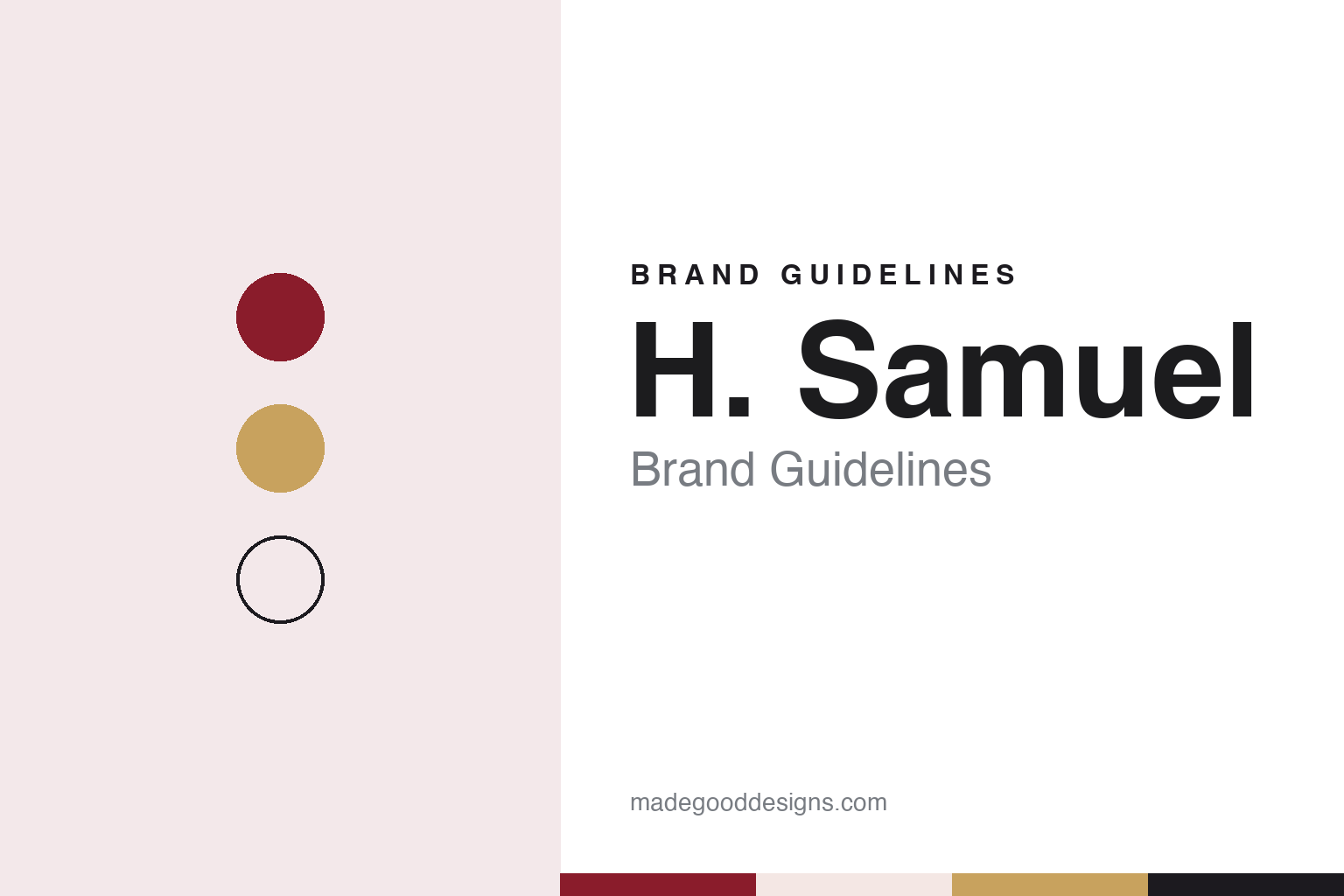
Two constants: a garnet, gold and blush palette and a rounded high-street sans register. Abstract homage — not an H. Samuel product or mark; no logo, fascia or packaging is reproduced.
Market Street
A clock-making business, a mail-order trade and a shop in Preston.
H. Samuel takes its name from Harriet Samuel (née Wolf). English Wikipedia says that in the mid-1800s her father-in-law Moses Samuel and his brother Lewis ran a clock-making and silversmith business in Liverpool; the company itself dates that business to 1821. Harriet Samuel took it over and moved it to Market Street, Manchester, where she ran the mail-order side while her son Edgar developed the retail side, English Wikipedia says. The company gives 1862 as the year she took charge and renamed the business H. Samuel, and City AM wrote in November 2025 that H Samuel “was founded in 1862 in Liverpool.”
Watches were part of the trade from the start. English Wikipedia, citing David Newton’s 2008 book Trademarked: A History of Well-known Brands, says the business had registered trademarks for its Acme and Climax watches by 1884. The first H. Samuel shop opened in Preston, Lancashire, in 1890; the company says shops opened in Preston and Rochdale that year. Citing James B. Jefferys’ study of trends in British retailing, English Wikipedia counts more than ten branches by the turn of the century and about 50 by 1914.
In 1912 the business moved to larger premises in Birmingham, a site the company says it still occupies. After the Second World War, Harriet Samuel’s grandsons Gilbert and Robert Edgar became chairman and vice chairman, and in 1948 the company was listed on the London Stock Exchange, English Wikipedia says, again citing Newton; the chain grew to more than 200 stores. In 1984 H. Samuel bought the James Walker group.
Colour
Ratners, a speech and a new group name.
The family era ended in 1986, when Ratners took over H. Samuel. The International Directory of Company Histories, published by Gale, says Ratners had begun with a single shop opened by Leslie Ratner in Richmond, Surrey, in 1949, and that his son Gerald Ratner took over the business in 1985. With fewer than 200 shops of its own, the group bought H. Samuel plc, which then had some 350 stores. Ratners went on to open new branches of both chains, the directory says, bought Ernest Jones in 1987, and in 1988 converted shops it had acquired under the Collingwood and Weir names to its H. Samuel and Ratners formats.
H. Samuel was also at the centre of the episode that changed the group. In April 1991, speaking to the Institute of Directors at the Royal Albert Hall, Gerald Ratner joked about a cut-glass sherry decanter set sold by the H. Samuel chain. The Irish Times, recalling the speech in August 2006, said the remark drew an instant public backlash and that he left the company in November 1992. The group then renamed itself Signet Group in 1993, converted its Ratners shops to the H. Samuel and Ernest Jones formats and closed nearly 300 UK stores by the end of 1994, according to Gale. The same history says that in 1996 Signet considered selling its UK holdings, H. Samuel among them, and then dropped the idea; by the early 2000s it listed H. Samuel Ltd and Ernest Jones Ltd among the group’s principal subsidiaries, with Leslie Davis as a third UK chain.
Signet moved its primary listing from London to the New York Stock Exchange on 11 September 2008, changing its name to Signet Jewelers and its domicile to Bermuda, with headquarters in Akron, Ohio, English Wikipedia says. In March 2025 National Jeweler listed H. Samuel and Ernest Jones as the group’s international, UK-based chains, alongside North American names such as Kay, Zales and Jared. In November 2025 City AM described the UK company behind both chains as headquartered in Birmingham and reported that it had restructured its store estate during its latest financial year. The same City AM survey of the UK’s high-street jewellers set the two Signet chains beside the family-owned Beaverbrooks, the Watches of Switzerland group, owner of Goldsmiths and Mappin & Webb, and the chains F Hinds, Fraser Hart and TH Baker.
Typography
How high-street jewellers present themselves.
High-street jewellery chains sell from small, bright shops in town centres and shopping centres, and much of their identity work happens at close range. The fascia over the door, the window display, the ring tray on the counter, the gift box and the carrier bag carry the name more often than any advertisement does, and several chains are run side by side by one parent group, each with its own sign, colours and tone of voice.
The windows do much of the talking. Rings, watches and gifts are usually grouped in themed displays that change with the retail calendar, from engagement season to Christmas, while counter trays, pouches and boxes repeat the same colours and lettering at hand scale. Catalogues, once printed and now mostly online, follow a similar structure: collections set out in grids, with plain product descriptions of metal, stone and size.
Naming tends to be literal. Collections are often named for a material, a cut, an occasion or a designer, and stores for the town or shopping centre they stand in, so the house name does most of the brand work. Where a chain stocks other makers’ watches and jewellery, its own mark sits beside theirs, and the shop has to frame those names without competing with them.
Corporate pages tell a second story. Many chains publish heritage timelines naming founders and first shops, then explain which parent group owns them today, from family companies to listed groups. Reading a chain’s identity therefore means reading two layers: the shopfront a customer walks past, and the ownership history that decides how many names a group keeps, merges or retires.
Aa
A rounded, friendly sans for a high-street name. (Specimen set in DM Sans, a sans STAND-IN; NOT the H. Samuel logo.)
H. Samuel
One name in a portfolio of shop signs.
H. Samuel’s presentation has been reworked several times under Signet. In March 2011 Marketing Week reported that the group was preparing new store concepts for both H. Samuel and Ernest Jones, designed to bring the shops up to date, and that it would communicate H. Samuel’s broad appeal under the line “Helps you say it better” while giving Ernest Jones a separate, prestige-led proposition. The same report said Signet had reorganised its marketing department into brand-specific teams earlier that year.
The distinction between names has since become explicit group policy. Announcing a plan called “Grow Brand Love” in March 2025, Signet’s chief executive J.K. Symancyk said brands “build loyalty with customers through emotional and engaging connections, while banners are transactional, literally a static nameplate on the door,” National Jeweler reported.
For a design guide, H. Samuel shows how a Victorian mail-order watch business became a mass-market chain whose identity is now managed as one name within a group portfolio. Compare Ernest Jones, its sister chain within Signet, and Goldsmiths, another UK high-street jeweller. For this guide we use a garnet red, ink and a warm gold with a rounded sans, an unofficial interpretation; no product or logo is reproduced.
Explore & save
Keep H. Samuel’s identity on hand — save it to a board in the Made Good inspiration library.
H. Samuel identity set
Pin the garnet, gold and blush palette and the rounded high-street sans register to your own board.