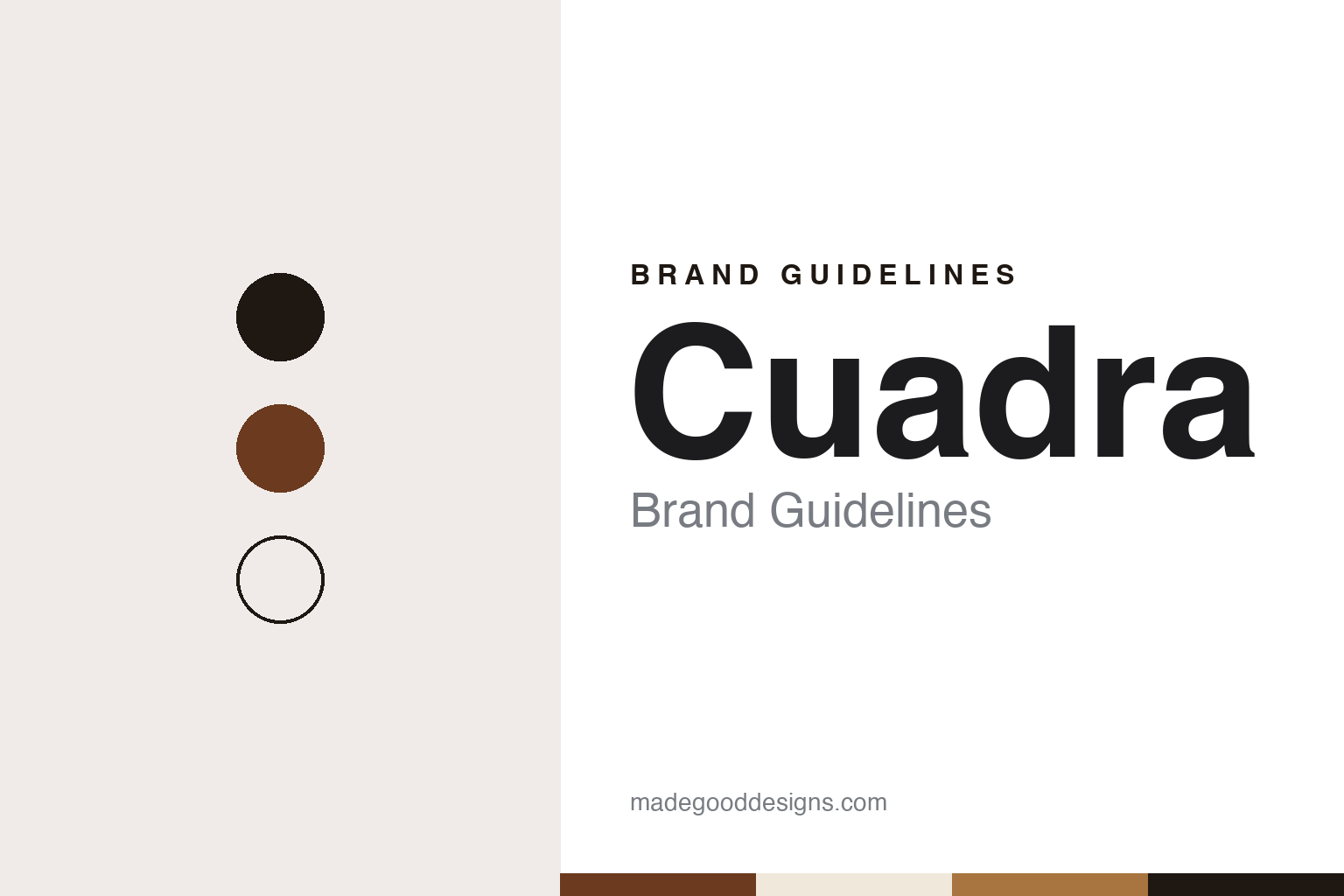
Cuadra Brand Guidelines
The León exotic-leather boot maker founded by brothers in 1991.
Aa
Two constants: a saddle brown, cognac and bone palette and a western serif register. Abstract homage — not a Cuadra asset or mark; no logo, boot or product is reproduced.
A León family
A father’s shop, an exotic-skins trade and a 1991 factory.
Cuadra is a maker of boots and leather goods from León, in the state of Guanajuato, a city the company’s blog calls footwear city. The León newspaper AM reported in May 2022 that the brand was formally launched on 28 June 1991, with boots, belts and wallets; the company’s own blog gives the same date and says it was founded by “the brothers Cuadra.” In a long history of the firm published in June 2026, AM named the founders as Héctor, Fernando and Francisco Cuadra. A 2016 Forbes México article instead called their father, Agustín Cuadra, the founder, and said his sons began making belts; El CEO, writing in June 2023, described the brothers as the founders and their father as the inspiration.
The family trade began a generation earlier. According to AM, Agustín Cuadra Suárez came to León from San Luis Potosí in 1936 and opened a shop in the city centre, La Potosina, which sold clothes, shirts and shoes until 1976; nine children grew up around the business. In the early 1980s an older brother, Jorge, imported exotic skins for León’s bootmakers, and Héctor and Fernando distributed them, then used the offcuts to make belts and wallets in a small workshop with six workers. Francisco, meanwhile, had exotic-leather boots made by contract workshops and sold them around the country; he launched his own label, Pancho Botas, in 1985, and built up capital selling from a stand at the Feria de León.
The brothers joined forces at the end of the decade. AM reported that when an export boom to France and Germany took up the capacity of León’s workshops, it became hard to get boots made for the Mexican market, so Héctor, Fernando and Francisco set up their own factory, bringing together boot making, tanning and experienced staff from firms that had closed. That factory became Cuadra in 1991.
Colour
Boots, then everything leather.
Exotic skins have defined the brand from the start. AM reported in July 2019 that Cuadra made boots, ankle boots, dress shoes and sandals as well as jackets, vests, bags and belts, in skins including stingray, ostrich, deer and python. Fernando Cuadra, then chair of the skins supplier Reptilius, told the paper that the 27 species used were covered by CITES, the international convention on trade in wild species; some skins, such as crocodile and shark, came from Mexico, and others were imported from countries including Indonesia, South Africa, Colombia and Argentina. The company then had about 2,000 workers, AM said.
Exports came early. Forbes México reported in 2016 that Cuadra began exporting to the United States in 1993; AM linked its move into the American market, aimed mainly at Hispanic customers, to the peso devaluation of 1994, and said the company also created a separate brand, Corral, for the United States. In 1995 Cuadra opened its own shops: one in León’s Plaza del Zapato and three in Mexico City, AM reported in 2026. As of July 2019, the company had 60 stores of its own in Mexico and exported about 40 percent of its shoe production, mainly to the United States and Canada, according to AM.
The range widened in stages. In 2001 Francisco Cuadra created Franco Cuadra, a line of men’s dress shoes that he described to AM as Italian in inspiration and Mexican in comfort, and which took the company into the department-store chains Liverpool and El Palacio de Hierro. In 2010, AM reported, the company set up a factory for jackets and bags, and around the same time made components for a French luxury house. In 2012 Grupo Cuadra opened three stores in Las Vegas, at Fashion Show, The Palazzo and Caesars Palace. In June 2026 AM reported that the company had 80 stores in Mexico.
Typography
Design and documentation.
Mexican supermarket, pharmacy, discount and footwear chains tend to show their identity less through one logo than through a family of names. A grocer may run a hypermarket, a supermarket, a warehouse store and a neighbourhood shop side by side, and the format names do the sorting: a prefix or suffix such as Híper, Súper, Mercado or Express, or a diminutive for the smallest stores, tells shoppers what size of shop to expect before they walk in.
Promotions and own programmes carry weight too. Seasonal campaigns with their own names, loyalty cards and printed or online flyers appear on the companies’ own pages as part of how the stores present themselves, and some promotion names have outlived the chains that created them, moving with the stores when they changed hands. Mascots, catalogues and house ranges play a similar role for pharmacy and footwear sellers, and a guide can describe them only as the companies publish them.
Ownership is usually stated plainly. Several of these groups began as family shops in a single city and still describe their founders, holding companies and stock-exchange listings on corporate pages; takeovers between rivals recur, and a store can carry several names over its life. Regulators have a part in that story: competition reviews can decide which stores a buyer may keep.
For a designer, the useful lesson is the system rather than any single mark: how a palette, a sans and a set of format names can scale from a large hypermarket to a corner store without losing the parent name. In this guide the palette and type are an unofficial interpretation; no logo, fascia or product is reproduced.
Aa
A western serif for a León leather house. (Specimen set in Fraunces, a serif STAND-IN; NOT the Cuadra logo.)
Cuadra
Stands, skins and a family name.
Cuadra has long used trade fairs as a showcase. AM wrote in 2026 that its stands at the Salón de la Piel y el Calzado, León’s leather and footwear fair, were known for their creativity and used carved wooden figures, and that Francisco Cuadra regarded design as central to attracting customers.
The company remains a family business. El CEO described it in June 2023 as owned by the brothers Héctor, Fernando and Francisco Cuadra, and in June 2026 AM reported that a new generation was joining under a more formal system of corporate governance, with Paolo Bortolan as director of Grupo Cuadra. The brand’s own website, at cuadra.com.mx, sells men’s and women’s boots, shoes, bags, jackets and accessories, and in 2026 marked the company’s 35th anniversary. The similar address cuadra.com belongs to an unrelated software company.
For a design guide, Cuadra shows how a material can become a brand: the exotic skin is the product, the pattern and the selling point. Compare Price Shoes, a Mexican footwear seller built on catalogues rather than workshops, and OXXO, another Mexican brand with its own guide. For this guide we use a saddle brown, a cognac and a bone white with a serif, an unofficial interpretation; no product or logo is reproduced.
Explore & save
Keep Cuadra’s identity on hand — save it to a board in the Made Good inspiration library.
Cuadra identity set
Pin the Cuadra saddle brown, cognac and bone palette and the western serif register to your own board.
Source & notes
Frequently Asked Questions
What font can I use to match the Cuadra look?
This guide describes Cuadra’s type as “A western serif for a León leather house”. Its type specimen is set in Fraunces from Google Fonts as a stand-in; Fraunces is not Cuadra’s own lettering.
What colours are in the Cuadra palette?
This guide’s Cuadra palette is Saddle brown #6B3A1F, Espresso #1E1712, Cognac #A8743F, Bone #F1E8DC and Paper #FAF6F0. The tones are the guide’s own unofficial interpretation, not official Cuadra hex codes.
When was Cuadra founded?
Cuadra was founded in 28 June 1991, in León, Guanajuato.
Who founded Cuadra?
Cuadra was founded by Héctor, Fernando and Francisco Cuadra on 28 June 1991.