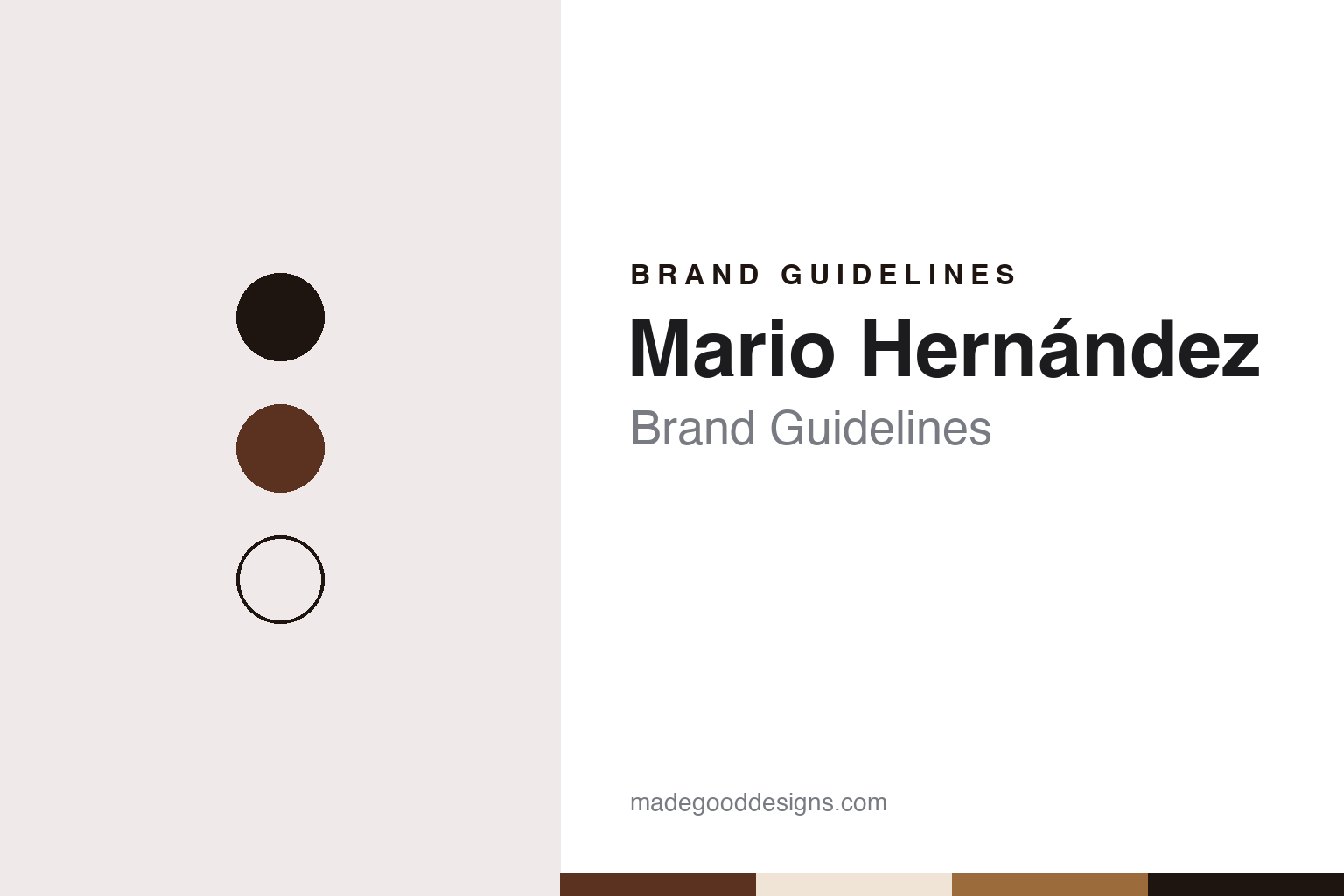
Mario Hernández Brand Guidelines
A Bogotá leather house built on Marroquinera since 1978.
Aa
Two constants: a Mario Hernández saddle brown, cognac and cream palette and a Leather-house serif register. Abstract homage — not a Mario Hernández product or mark; no bag, logo or label is reproduced.
Marroquinera
A boutique, a neighbour’s leather and a workshop bought in 1978.
The brand Mario Hernández carries its founder’s name, but the company behind it has another one. The footer of the brand’s website gives the business name as Marroquinera S.A.S., and that name goes back to the deal that started the leather business. In a long profile published in September 2013, the Bucaramanga newspaper Vanguardia traced the founder’s path into leather to 1972, when a neighbour was making leather goods that he liked enough to stock in the boutique he then ran. The step from shopkeeper to manufacturer came in 1978, when, Vanguardia reported, he bought Marroquinera Ltda, a company that was then going through bankruptcy proceedings.
Growth was quick by the standards of a small workshop. Two years after the purchase, according to the same profile, Mario Hernández already had eight stores; by 1987 the company had about 200 clients, was exporting and was still adding shops. The name of the founder became the name on the product, and the word marroquinería — the Spanish trade term for leather goods such as bags, wallets and belts — stayed in the company’s legal name.
That split between a person and a company matters for anyone writing about the brand. Mario Hernández is both a Colombian businessman who appears often in the national business press and a retail label sold in its own stores. This guide treats the founder only in his role as founder and head of the business, and looks at the brand: what it makes, where it is made and how it sells.
The family has stayed in the business. In September 2012, La Estrella de Panamá reported that the founder’s eldest son, who shares his name, was then the manager in charge of the brand. In December 2025 Forbes Colombia described the founder’s youngest son, Lorenzo Hernández, as holding the creative direction of the brand, and presented the interview as a conversation about the move to a second generation.
Colour
Leather at the core, with shoes, luggage and clothes.
The core of the range is leather. In a 2019 interview with Portafolio, the founder described the company as making leather articles and accessories, with footwear and luggage alongside, and said it carried at least 600 products and released two collections a year. In 2012 he told La Estrella de Panamá that a new collection arrived every six months but was released gradually, in limited runs of about 200 pieces per style that were not repeated once sold out; he gave the example of a line decorated with green butterflies. In the same interview he said the company also used materials other than leather, including a coated jacquard textile, and that its artisans worked the goods by hand — a description the company gives of itself.
Art has been part of the product story. The 2012 Panama collection, titled “Cuento de Hadas en una Ciudad Futurista” (a fairy tale in a futuristic city), included handbags, wallets, glasses and belts, and carried work by two painters: the Colombian artist Enrique Grau and a younger New York-based painter, Vianey, La Estrella de Panamá reported. The same report noted a new line of fashion loafers in colours. Today the brand’s website sorts its range into bags, wallets, luggage, shoes, clothing and perfume, with named collections such as Mariposas, Palenque, Tierra Arriba and Nómada.
Where the goods are made is documented in the company’s own words. In 2019 the founder told Portafolio that the company had a plant in Bogotá. In October 2021, Portafolio reported, a customer publicly questioned a “made in China” label on a bag and a suitcase she had bought; the founder replied that some inputs were not available in Colombia, that each product states where it is made and that the company does not claim otherwise. In later posts, the paper said, he wrote that the brand’s suitcases are made in China while 65 percent of what it sells is made in Colombia, where the company had about 600 direct employees. By the company’s own account, then, production is split between Colombia and imports, and the country of origin is printed on each label.
In the 2025 Forbes Colombia interview, the family described bags as the core of the business and the founder said he still walks the factory floor most days.
Typography
Design and documentation.
Colombia’s clothing, bag, leather and underwear brands are mostly home-grown companies, and several still carry the name of the person who started them. Some began as very small workshops: Vélez with belts cut by hand in Medellín in the 1980s, and Totto in a Bogotá leather factory taken over in 1987, according to Portafolio. Both grew into chains with shops across Latin America.
Much of their identity is built in the shop. Store fronts, windows and tags carry the brand as much as any advertisement does: when Totto redrew its logo in 2021, Forbes Colombia reported, the new look went to its stores, signs, shop windows and product tags. Larger-format stores and remodelled shop interiors appear in the companies’ own accounts of how they present themselves, alongside the names of their collections and of the designers, artists and athletes they work with.
Campaigns often draw on Colombian references. Totto has dressed the national Olympic delegation since 2004, Portafolio reported, and Vélez built a 2026 collection with J Balvin around the Antioquian muleteer, the arriero. Regional crafts, rural dress and the national colours recur in the way these brands show themselves at home and abroad, and the companies say so in their own campaign material.
Ownership is usually easy to trace. Several of the groups in this guide are founder-led or family-owned, and their corporate pages set out who founded them, who runs them and which export markets they serve, commonly Central and South America first, then Spain or the United States. This guide keeps to what those pages and dated press reports show, describes family-owned groups plainly, and marks the companies’ own claims as theirs.
Aa
A leather-house serif with high contrast. (Specimen set in Cormorant Garamond, a serif STAND-IN; NOT the Mario Hernández logo.)
Mario Hernández
Own stores at home, shops and exits abroad.
The brand sells through its own shops rather than through other retailers. In the 2019 Portafolio interview the founder said the company did not sell wholesale and only shipped goods to the countries where it had stores. At that time it had 60 stores, about 70 percent of them in Colombia, with 16 in Venezuela, others in Panama and Costa Rica, and a franchise in Moscow.
The international map has changed several times. In September 2012, La Estrella de Panamá reported, the brand opened a 90-square-metre store in Albrook Mall, its second in Panama after Multiplaza Pacific, and counted 48 stores across Colombia, Aruba, Venezuela, Costa Rica, Mexico and Panama; the company said the larger format let it show the whole line of shoes, clothing and luggage. In November 2020 Portafolio reported that the brand had closed its five stores in Mexico, while its shops in Venezuela, Costa Rica and Panama stayed open. In the same period it opened stores in Cartagena and Manizales and a street outlet in Bucaramanga with a small café, which the founder described as a pilot. In December 2025 the company told Forbes Colombia it had more than 50 stores and was growing in Colombia’s mid-sized cities.
For a design guide, Mario Hernández shows a leather brand whose name is a person and whose record is a company: a workshop bought in 1978, two collections a year, art used on the product and labels that say where each piece was made. Compare Vélez, another Colombian leather-goods brand, and Totto, the Colombian bag maker. For this guide we use saddle brown, cognac and cream with a serif, an unofficial interpretation; no product or logo is reproduced.
Explore & save
Keep Mario Hernández’s identity on hand — save it to a board in the Made Good inspiration library.
Mario Hernández identity set
Save the Mario Hernández saddle brown, cognac and cream palette and the Leather-house serif register to your own board.
Source & notes
Frequently Asked Questions
What font can I use to match the Mario Hernández look?
This guide describes Mario Hernández’s type as “A leather-house serif with high contrast”. Its type specimen is set in Cormorant Garamond from Google Fonts as a stand-in; Cormorant Garamond is not Mario Hernández’s own lettering.
What colours are in the Mario Hernández palette?
This guide’s Mario Hernández palette is Saddle brown #5B3220, Ink #1E1410, Cream hide #EFE4D6, Cognac #9C6B3C and Paper #FAF6F0. The tones are the guide’s own unofficial interpretation, not official Mario Hernández hex codes.
When was Mario Hernández founded?
Mario Hernández was founded in 1978 (Marroquinera bought), in Bogotá, Colombia.
Who founded Mario Hernández?
Mario Hernández was founded by Mario Hernández in 1978 (Marroquinera bought).


